Storage-Agnostic Data Management
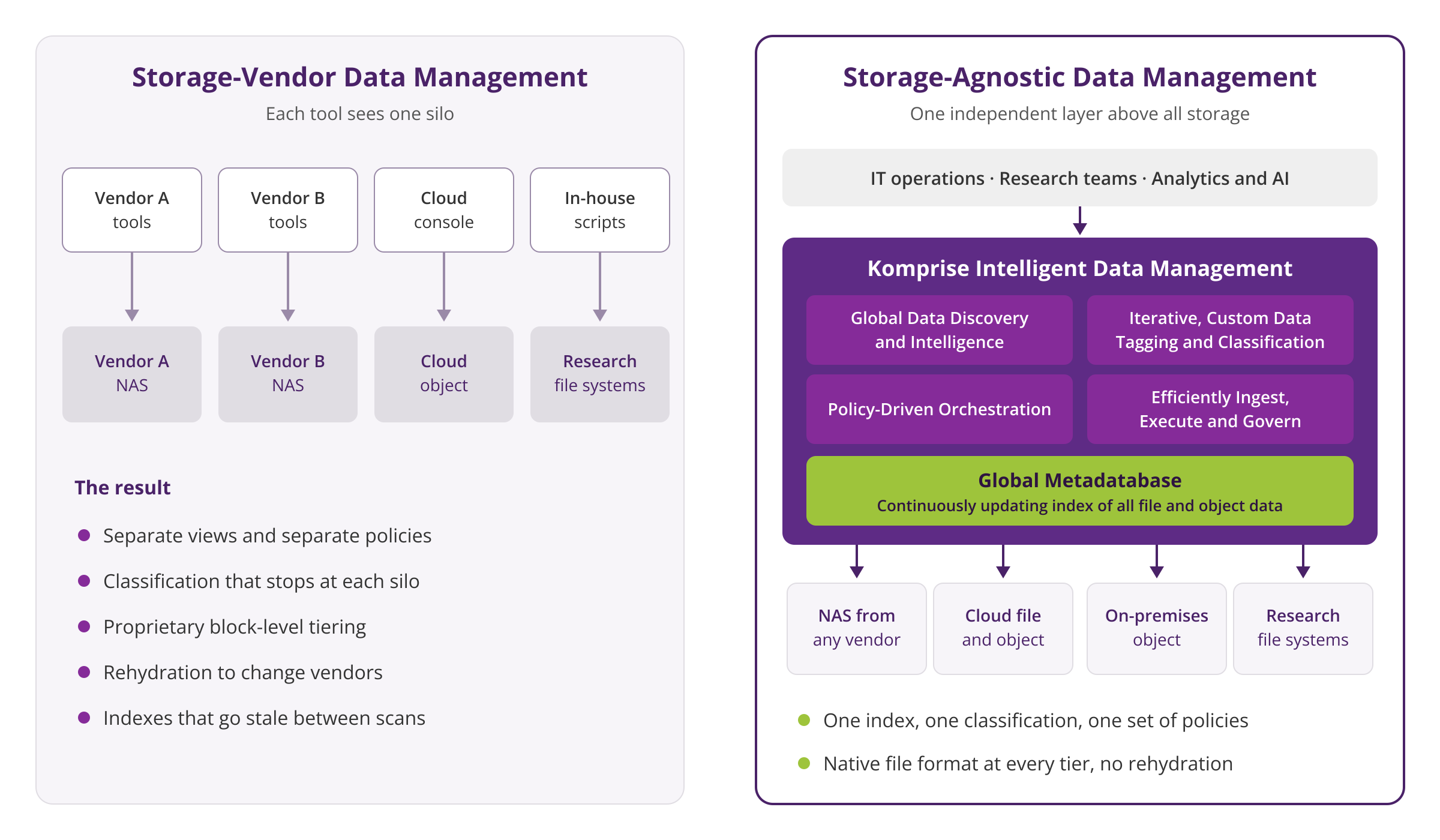
Storage-agnostic data management is the practice of finding, analyzing, moving and governing data through one independent layer that works across every storage system, vendor and cloud, rather than through the management tools built into each storage platform. It is also called vendor-neutral, vendor-agnostic or independent data management. The principle is simple: data outlives the storage it sits on, so the system that manages data should not belong to any one storage vendor.
What Is Storage-Agnostic Data Management?
Storage management optimizes how a storage system runs: performance, availability, capacity and efficiency inside one array or one cloud account. Data management decides what the data is, who owns it, what it is worth and where it should live. Storage-agnostic data management separates the two. It indexes metadata from every source into a single view, then applies the same policies everywhere: tier cold data, migrate to new platforms, confine data for governance review, and deliver curated data sets to analytics and AI.
Three properties define the approach:
- Cross-vendor visibility. One index across NAS, cloud file storage and object storage, regardless of who built the hardware.
- Execution, not only insight. The same layer that finds the data also acts on it through policy.
- No lock-in. Data stays in native, open formats at every tier, so you can change storage vendors without rehydrating or re-migrating managed data.
Independent analysts use the same test. To qualify for the DCIG Pulse for Unstructured Data Management, a product had to discover data across storage from more than one vendor, act on that data through policies such as tiering, migration, archiving or deletion, and support on-premises storage plus at least one public cloud or object target.
Source: DCIG Ranks Komprise First Across 12 Unstructured Data Management Solutions
Why Unstructured Data Needs a Layer Above Storage
Unstructured data has no schema, no central catalog and no single home. Files and objects pile up across NAS clusters, cloud buckets, research file systems and backup targets, each with its own console. The scale makes per-system management unworkable: 74% of enterprises now store more than 5PB of unstructured data, and 85% expect storage spending to rise.
Source: Komprise 2026 State of Unstructured Data Management
The estate is also multi-vendor by default. Organizations rely on an average of four separate systems for storage, backup and disaster recovery, and 22% use more than six vendors at once.
Source: Nasuni, The State of Enterprise File Data 2026
Storage hardware is typically refreshed every three to five years. The data on it is often kept for decades. Every time management features are tied to the hardware, the exit cost grows with the data. This is the core argument of the Komprise white paper Data Management Must Replace Storage Management, which answers the question many IT leaders now ask directly: why should data intelligence be separate from storage?
Storage Vendors Are Telling a Data Story. It Is Still One Silo.
Storage vendors know that capacity alone no longer differentiates them, so they now market data services, analytics and AI data preparation on top of their arrays, often by acquiring smaller data management companies. The pitch sounds like data management. The architecture is still storage management:
- Single-silo visibility. The tools see the vendor’s own systems well and everything else poorly or not at all.
- Proprietary tiering. Array-based tiering moves blocks, not files, so tiered data is readable only through the source array. Leaving means rehydration. See the block-level vs. file-level comparison below.
- Policies that end at the refresh. Tags, rules and indexes live inside the platform, so a vendor change resets them.
Gartner makes the same distinction. In its Market Guide for Data Storage Management Services, Gartner notes that storage management capabilities from traditional storage vendors are “typically confined to their own platforms,” and that organizations increasingly require vendor-agnostic solutions to manage data consistently across heterogeneous environments.
Source: Gartner, Market Guide for Data Storage Management Services, July 27, 2026 (subscription required)
The lock-in now costs more than it used to. Gartner forecasts NAND flash prices up 234% and DRAM up 125% in 2026. When every primary-capacity purchase is expensive, a tiering method that forces data back onto primary storage before you can switch vendors is a budget risk. See Storage Vendor Lock-In for the full cost breakdown.
Source: Gartner, April 8, 2026
Block-Level vs. File-Level Tiering
The tiering method decides whether data management stays independent of storage.
- Block-level tiering is how array features such as NetApp FabricPool and Dell PowerScale CloudPools work. Cold blocks move to a cheaper tier while metadata and hot blocks stay on the array. The tiered blocks cannot be read from their new location without the vendor software. Backups, antivirus scans and hardware refreshes pull blocks back to primary storage, so tiering does not shrink the backup footprint and generates egress fees. Cloud analytics and AI services cannot read tiered blocks at all. Switching vendors or clouds means rehydrating everything first.
- File-level tiering moves the whole file, including content, metadata, extended attributes and access controls, as a standards-based object. The file stays readable as a file from its original path and as an object in the cloud. Backup, antivirus, analytics and AI tools read tiered files directly, with no rehydration, and data moves between tape, on-premises object storage and cloud with no vendor in the way. Komprise puts the cost difference at 75% lower cloud egress than block tiering.
Source: Block-Level Tiering vs. File-Level Tiering
See Block-Level Tiering, File-Level Tiering and Transparent Move Technology.
Outside the Hot Data Path
A data management layer that sits between users and their active files becomes a performance bottleneck and a single point of failure. Storage-agnostic data management should work out of band: it reads metadata, moves cold files, and leaves the access path for hot data untouched. Users and applications keep reading and writing active data directly on the storage they already use, at full storage performance.
The same principle applies to moved data. Komprise Transparent Move Technology replaces each moved file with a link built on standard operating system symbolic links, not proprietary stubs, and installs no agents on servers, clients or storage. Users open moved files from the original path, and there is no change to the data path for hot data.
Source: Transparent Move Technology
Delivered as a Service, Not Built and Maintained In-House
Many organizations try to get cross-silo visibility by building it: custom scripts per array, file-indexing utilities, a database someone populates on a schedule, spreadsheets for chargeback. These toolkits often start in one department and get presented as enterprise coverage. They break as the estate grows. Every new storage system needs another integration, the index goes stale between scans, nothing acts on what the reports find, and the whole thing depends on the few people who built it.
A storage-agnostic platform replaces that work with an index delivered as a service. It needs no custom connectors to build, no plugins to maintain and no costly setup per silo. The index stays current as data changes, scales to billions of files, and feeds tiering, migration and AI workflows directly. Your team runs policies instead of maintaining tooling.
Storage-Agnostic Data Management and Gartner DSMS
Gartner calls this category Data Storage Management Services (DSMS): products that provide a unified view of enterprise data across hybrid, multicloud and SaaS environments and orchestrate its life cycle using discovery, classification and tagging. Gartner expects at least 50% of organizations to implement DSMS capabilities by 2030, up from less than 20% in mid-2026. Komprise Intelligent Data Management is named as a Representative Vendor in the Market Guide.
Source: Gartner, Market Guide for Data Storage Management Services, July 27, 2026 (subscription required)
Gartner also separates DSMS from hybrid cloud file data services. Hybrid cloud file services focus on storage infrastructure, file access and data movement. DSMS focuses on data life cycle, governance and classification across file, object and SaaS sources.
What to Require From a Storage-Agnostic Platform
- Index every silo. NAS from any vendor, cloud file and object storage, and on-premises object storage, in one place, without agents on every server.
- Act on what you find. Tiering, migration, confinement and data delivery driven by the same queries you use for analysis.
- Move files without lock-in. File-level tiering that keeps data in native format at every tier and preserves the original access path.
- Stay outside the data path. Users and applications keep working while data moves.
- Show cost by owner. Reports by department, project or principal investigator, so the people who create data see what it costs.
- Prepare data for AI. Tag, enrich and curate across silos, then deliver only the right data, with governance.
- Prove it at scale. Billions of files across petabytes, with policies that keep running after each storage refresh.
Data Classification Across Every Silo: The First Mile of AI-Ready Data
Data classification sorts data into categories by its metadata and content: owner, project, file type, age, sensitivity or business value. For unstructured data it is the first step of the AI first-mile gap. Before data can be curated, governed or sent to AI, you have to know what it is and where it lives. Gartner lists classification based on metadata, and tagging, among the mandatory features of a DSMS solution.
Source: Gartner, Market Guide for Data Storage Management Services, July 27, 2026 (subscription required)
Classification only works if it spans every silo. A storage vendor can classify data on its own arrays, and a departmental tool can tag one team’s shares, but the result is a set of partial maps with different rules. A storage-agnostic layer classifies once, across all storage, and keeps those classifications attached as data moves between tiers and vendors. See Unstructured Data Classification for the methods.
Why AI-Ready Data Depends on a Storage-Agnostic Layer
AI-ready data is data that has been found, classified, enriched and governed before it reaches an AI pipeline. The data AI needs lives in every silo. A tool that sees one vendor’s storage can prepare only that vendor’s slice of it, and block-tiered data cannot be read by cloud AI services at all. Classifying and tagging unstructured data is now the top AI challenge for IT leaders, cited by 56%, up from 41% in 2024.
Source: Komprise 2026 State of Unstructured Data Management
A storage-agnostic layer closes that gap. It searches across all storage at once, classifies, tags and enriches files in place, filters out redundant, obsolete and trivial data, and delivers only the curated set, with sensitive data handled and every step audited. The Komprise white paper Data Intelligence and Orchestration for AI sets out four requirements: global data discovery and intelligence; iterative, custom data tagging and classification; policy-driven orchestration; and efficient ingest, execution and governance.
How Komprise Delivers Storage-Agnostic Data Management
Komprise Intelligent Data Management is an independent, storage-agnostic layer for unstructured data management, delivered as a service. It sits above storage, not inside it:
- Global Metadatabase. Indexes file and object metadata across every connected storage system into one searchable view, delivered as a service, with no plugins or connectors to build and maintain. Komprise works out of band, outside the hot data path.
- Deep Analytics and Deep Analytics Actions. Query by storage system, share, owner, file type, age or tag, then use a saved query as the input to a data management plan.
- Transparent Move Technology. Tiers cold files at the file level with no stubs and no rehydration penalty. Files stay in native format, users open them from the original path, and savings reach 70%+.
- Elastic Data Migration. Moves data between any supported storage vendors and clouds, 27X faster for NFS and, with Komprise Hypertransfer, 25X faster for SMB.
- Smart Data Workflows and KAPPA data services. Classify data across silos by scanning content for sensitive data and patterns and extracting custom metadata, then store the tags in the Global Metadatabase for governance and AI. Komprise Intelligent AI Ingest delivers curated data to object storage for AI pipelines, 2X faster.
- Komprise Reports. Show cold data, orphaned data, duplicates and cost by department across all storage.
The business case is measurable. Across a modeled 4PB NAS estate growing 30% a year, Komprise saves an average of 57% on storage costs, more than $2.6 million annually.
Source: Quantifying the Value of Komprise Intelligent Data Management
DCIG ranked Komprise first among 12 unstructured data management solutions on five of eight vendor criteria, including product capabilities, innovation and customer experience, and found Komprise to be the only vendor with full support for transparent access and path preservation.
Source: DCIG Pulse for Unstructured Data Management, Vendor Strengths Edition
See how Komprise compares to storage-vendor data management on the Why Komprise page, and explore the platform on the storage-agnostic unstructured data management page.
Storage-Vendor Data Management vs. Storage-Agnostic Data Management
| Evaluation Criteria | Without Storage-Agnostic Data Management | With Komprise |
|---|---|---|
| Visibility | One vendor’s arrays, or the shares one department scripted reports for | One Global Metadatabase across NAS, cloud file and object storage from any vendor |
| Insight vs. action | Reports and recommendations; actions run per array, per cloud or through custom scripts | Deep Analytics queries feed tiering, migration, confinement and AI workflows directly through Deep Analytics Actions |
| Tiering method | Block-level, proprietary format; backups, refreshes and vendor changes rehydrate data, and cloud AI services cannot read tiered blocks | File-level Transparent Move Technology; whole files in native format, readable as files and as cloud objects, with no rehydration and 75% lower cloud egress than block tiering |
| Access after data moves | Tiered data depends on the source array to be read | Users and applications open moved files from the original path; the target tier also exposes files natively |
| Storage refresh and vendor changes | Exit means rehydrating, then migrating, all managed data | Policies and the index carry across refreshes; Elastic Data Migration runs 27X faster for NFS and Komprise Hypertransfer 25X faster for SMB |
| Data path | Agents, stubs or proprietary clients on servers and storage | Out of band: no agents, no proprietary stubs, and no change to the data path for hot data |
| Index build and upkeep | Custom scripts, connectors and in-house databases that each team builds, refreshes and maintains | Global Metadatabase delivered as a service, kept current with no connectors or plugins to maintain |
| Research and HPC estates | Separate tools for parallel file systems, lab NAS and cloud buckets | One index across file and object data reachable over NFS, SMB and S3, with project and lab views |
| Data classification and AI-ready data | Limited to data on the vendor’s own platform; tiered blocks are unreadable to AI services | Smart Data Workflows and KAPPA data services tag and curate across silos; Komprise Intelligent AI Ingest delivers curated data to object storage |
| Cost accountability | Capacity reports per array or per cloud account | Komprise Reports and showback by department, project or owner across all storage |
Frequently Asked Questions
What is storage-agnostic data management?
Storage-agnostic data management is a single, independent layer that finds, analyzes, moves and governs data across every storage system, vendor and cloud. It is also called vendor-neutral or independent data management. Instead of managing data through each array’s own tools, you index all of it in one place and apply the same policies everywhere, so data management decisions survive storage refreshes and vendor changes.
Why should data intelligence be separate from storage?
Data outlives storage. Arrays are refreshed every three to five years, but data is often kept for decades. When data intelligence lives inside a storage platform, it sees only that platform, its tiering and metadata use that vendor’s formats, and changing vendors means rehydrating and re-migrating managed data. A separate layer gives one view across all storage, keeps data in open formats, and carries policies across every refresh. The Komprise white paper Data Management Must Replace Storage Management lays out the full case.
What is the difference between storage management and data management?
Storage management runs the infrastructure: performance, availability, capacity and efficiency of a specific system. Data management governs the content: what the data is, who owns it, how often it is used, what it costs and where it belongs. Storage management answers “Is this array healthy?” Data management answers “Should this data be on this array at all?”
Is vendor-neutral data management the same as storage-agnostic data management?
Yes. Vendor-neutral, vendor-agnostic, storage-agnostic and independent data management all describe the same approach: a data management layer that is not owned by, or limited to, any one storage vendor. Gartner uses the category name Data Storage Management Services (DSMS).
How is storage-agnostic data management different from storage vendor data management tools?
Storage vendor tools manage data on that vendor’s platforms. Even when a vendor adds analytics or AI features, often through acquisitions, visibility stops at its own systems, and tiering typically uses a proprietary block format that requires rehydration to leave. A storage-agnostic layer indexes and acts on data across every vendor and keeps data in native file format, so you can tier, migrate or switch storage without lock-in. See Storage Vendor Lock-In.
How does storage-agnostic data management avoid rehydration and lock-in?
It tiers at the file level instead of the block level. Each file moves whole, in its native format, so it can be read directly at the target tier and never has to be pulled back to the original array before a migration or refresh. Komprise Transparent Move Technology also preserves the original path, so users and applications keep opening files as before. See Rehydration and File-Level Tiering.
What does Gartner call storage-agnostic data management?
Gartner calls the category Data Storage Management Services (DSMS) and describes the solutions as vendor-agnostic and data-centric. The Gartner Market Guide for Data Storage Management Services lists Komprise Intelligent Data Management as a Representative Vendor.
Is storage-agnostic data management the same as hybrid cloud file services?
No. Hybrid cloud file data services are storage infrastructure: they provide file access, caching and data movement through their own platform. Storage-agnostic data management sits above storage, including hybrid cloud file platforms, and manages data life cycle, cost and governance across all of them.
What is the difference between block-level and file-level tiering?
Block-level tiering, used by array features such as NetApp FabricPool and Dell PowerScale CloudPools, moves cold blocks to a cheaper tier, but those blocks can be read only through the source array. Backups and refreshes rehydrate them, and cloud AI and analytics services cannot use them. File-level tiering moves whole files in native format, so they stay readable from the original path and directly in the cloud, with no rehydration and no lock-in. The Komprise paper Block-Level Tiering vs. File-Level Tiering covers the full comparison.
Why should data management stay out of the hot data path?
Anything that sits between users and active files adds latency and becomes a point of failure. Storage-agnostic data management works out of band: it reads metadata and moves cold files, and active data keeps its existing path on the storage users already use. Komprise Transparent Move Technology uses no agents and no proprietary stubs, and there is no change to the data path for hot data.
Should we build our own cross-storage data management tools?
Custom scripts and in-house indexes work for one team or one array, but they rarely survive enterprise scale. Each new storage system needs another integration, the index goes stale between scans, the tools report without acting, and they depend on the people who built them. A storage-agnostic platform delivers the index as a service, keeps it current, and runs tiering, migration and AI workflows from the same view.
Does storage-agnostic data management work for research and HPC environments?
Yes. Research estates mix high performance computing file systems, lab NAS and cloud storage across sites. A storage-agnostic layer indexes them together, shows cost by project or lab, and moves finished project data to lower-cost storage while keeping it accessible.
Why does data classification need a storage-agnostic layer?
AI and governance need one consistent view of what data is, across every silo. Classification inside a storage platform covers only that platform, and in-house tagging scripts cover only the shares they were written for. A storage-agnostic layer classifies data across all storage with the same rules, keeps tags in one continuously updated index, and carries them with the data as it tiers or migrates. That makes classification the first mile of AI-ready data.
How does storage-agnostic data management support AI?
AI needs the right data from every silo, not just the data on one vendor’s platform. A storage-agnostic layer searches across all storage, tags and enriches files with metadata, excludes redundant, obsolete and trivial data, and delivers curated data sets to AI with governance. That is what makes data AI-ready. Gartner notes that DSMS solutions are increasingly used to prepare, curate and govern unstructured data before AI applications index or retrieve it.
Which layer of the AI data platform does storage-agnostic data management cover?
Storage-agnostic data management spans layers 2 through 4 of the AI Data Platform: Metadata and Discovery, Classification and Governance, and Enrichment and Curation. It sits between layer 1, Storage and Data Sources, and layer 5, AI Delivery and Consumption, which is why it must work across every storage source rather than inside one.
How does Komprise deliver storage-agnostic data management?
Komprise Intelligent Data Management indexes all connected file and object storage into the Global Metadatabase, uses Deep Analytics to find data by owner, age, type or tag, and turns those queries into policies: tier cold data with Transparent Move Technology, migrate with Elastic Data Migration, and curate data for AI with Smart Data Workflows. Customers cut 70%+ of cold data storage costs with no rehydration penalty, and Komprise ranked first on five of eight vendor criteria in the DCIG Pulse for Unstructured Data Management.
What should I look for in a storage-agnostic data management solution?
Look for indexing across every storage vendor and cloud you run, policy-based action rather than reports alone, file-level tiering with native access and no rehydration, an agentless architecture that stays out of the data path, cost reporting by owner or project, AI data curation with governance, and proven scale across billions of files.