Data Management Glossary
AI Context
What Is AI Context?
AI context is the information supplied to an AI model at the moment it generates a response, as distinct from the knowledge baked into the model’s trained weights. Context includes the prompt itself, retrieved documents, conversation history, tool outputs, and any metadata passed alongside them. A model’s context window is the finite amount of that information it can process in a single inference call, measured in tokens.
Context is what lets a general-purpose model answer a specific, current, organization-specific question. A model trained on public data has no knowledge of a company’s contracts, patient records, or engineering drawings unless that content is placed into its context at query time, through retrieval-augmented generation (RAG), an agent’s tool calls, or a direct upload. The quality of that context, not the size of the model, is usually the deciding factor in whether the response is accurate.
AI Context and Unstructured Data
Most of the content enterprises want in a model’s context is unstructured: contracts, emails, scanned forms, engineering files, images, transcripts, medical images, and research data. Unstructured data creates two problems that structured, tabular data does not.
First, there is no schema to filter by. A relational database lets a query select exactly the rows it needs. A file share does not tell a retrieval system in advance which of ten million files are current, duplicate, sensitive, or irrelevant to a given question.
Second, unstructured data grows fast and sprawls across silos, on-premises NAS, object storage, and multiple clouds, with no single system tracking what exists, where it lives, or when it was last touched. Feeding a model from that sprawl without filtering means feeding it redundant, obsolete, and trivial (ROT) data alongside anything genuinely relevant.
This matters more than it sounds like it should, because every token placed into a context window is processed, and in most deployments, billed. According to Gartner’s analysis of agentic AI workloads, agentic models can require 5 to 30 times more tokens per task than a standard generative AI chatbot, because multi-step agents resend accumulated context on every call in a reasoning loop. Retrieval-augmented generation compounds this further: RAG pipelines commonly send thousands of pages of source material into a context window on every query to ground a response, a pattern often called the context tax. Noisy, duplicate, or outdated context does not just raise cost, it lowers accuracy. Model performance degrades when a context window is filled with irrelevant or contradictory information, so reducing noise before ingestion improves both the token bill and the quality of what the model returns.
Source: Gartner analysis cited in “AI Inference Cost Crisis 2026,” Oplexa
The Case for Unstructured Data Management
Prompt engineering and bigger context windows treat the symptom. Vendors have pushed context windows past a million tokens, but larger windows do not fix a data quality problem, they just make it more expensive to run into. The underlying issue is that most enterprises cannot say, at the file level, across every storage silo, which unstructured data is current, which is sensitive, which is a duplicate, and which is actually relevant to a given AI use case. Without that visibility, RAG pipelines and AI agents pull from whatever they can reach.
Solving this requires the same capability a data fabric is built to provide: a unified, governed view of data across silos, rather than a point solution bolted onto one storage system or one vector database. It also requires a way to translate raw file and object metadata into consistent, queryable business terms, the role a semantic layer plays, so that “relevant” can be defined and enforced at scale rather than guessed at per prompt. Neither of those, on their own, curates the data. That takes continuous discovery, classification, and governed delivery across every silo the enterprise has, at a scale manual review cannot reach.
Mile 0, Not Just the Last Mile
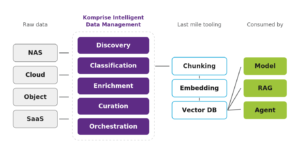
Most of the public conversation about AI context is about the last mile: bigger context windows, better chunking strategies, smarter embedding models, faster vector databases. These are real engineering problems, and data chunking, vectorization, and vector embedding each solve a piece of them, turning already-selected content into a searchable index a model can retrieve from.
None of that work addresses what happens before a file is chosen for chunking in the first place. Gartner estimates that 80% of enterprise data is unstructured, and IDC puts the figure as high as 80 to 90%, growing roughly three times faster than structured data. Komprise co-founder Krishna Subramanian has called this earlier step mile 0: the unglamorous work of discovering, classifying, and governing raw file and object data across NAS, cloud, and object storage before any of it is eligible for a context window at all. In most enterprises, 50 to 90% of unstructured data is duplicate, rarely accessed, or a non-authoritative copy, and almost none of it carries the metadata that would qualify it for an AI use case. Vectorizing that data does not fix it, it just makes the noise searchable.
This is also where AI Data Governance has to start, not end. Governance applied only at the point of delivery, after data has already been chunked and embedded, catches problems too late: PII that was already vectorized, stale content that was already indexed. Mile 0 governance confines sensitive data and filters ROT data before a single chunk is created, so the vector index a model draws context from was never built on noise in the first place.
Source: Krishna Subramanian, “Unstructured Data Lags in Enterprise Analytics and AI,” The AI Journal.
The Role of Komprise Intelligent Data Management
Komprise Intelligent Data Management does not build the model’s context window. It curates what is allowed to reach it. The Global Metadatabase continuously indexes file and object metadata across every connected NAS, cloud, and object storage system without moving the data, giving IT a single, current view of what exists before any of it is considered for AI context. Deep Analytics runs precision queries against that index to isolate the specific datasets relevant to a use case, instead of pointing a retrieval pipeline at an entire file share.
Smart Data Workflows then apply governance before content reaches a model: detecting and confining sensitive data such as PII, filtering duplicate and ROT data files, and routing only current, authorized data downstream. KAPPA data services extract domain-specific metadata from file content, such as patient identifiers in DICOM images or project codes in CAD files, and write it back into the Global Metadatabase, enriching files with the business context that makes them identifiable by an AI pipeline in the first place. Komprise Intelligent AI Ingest then delivers that curated dataset to AI platforms 2X faster than unfiltered ingestion, and Transparent File Tables can expose the same governed data as Apache Iceberg tables directly inside Snowflake, Databricks, or another data lakehouse, without a separate copy step.
Mapped to the five layers of an AI data platform, Komprise operates at Layer 2 (Metadata and Discovery), Layer 3 (Classification and Governance), and Layer 4 (Enrichment and Curation), the layers that determine what is accurate, current, and safe before anything reaches Layer 5, AI Delivery and Consumption, where context windows, RAG pipelines, and agents actually run. See AI Data Platform for how all five layers work together.
AI Context: Without Data Management vs. With Komprise
| Evaluation Criteria | Without Data Management | With Komprise |
|---|---|---|
| What enters the context window | Whatever a file share or bucket returns, including duplicates, stale files, and ROT data | Curated datasets filtered by freshness, relevance, and governance policy before delivery |
| Sensitive data handling | Discovered after ingestion, if at all | Detected and confined by Smart Data Workflows before data reaches an AI pipeline |
| Metadata available to the model | Basic file system attributes only (name, size, date) | Enriched, domain-specific metadata via KAPPA data services, indexed in the Global Metadatabase |
| Storage coverage | Siloed per NAS, cloud, or object store, no single view | Unified across every connected storage vendor via the Global Metadatabase |
| Cost per query | Rises with every irrelevant or duplicate file sent into context | Lower token volume per query from filtering noise before ingestion |
| Path to a lakehouse or vector pipeline | Requires a separate copy or export step | Transparent File Tables expose governed data as Iceberg tables in place |
Komprise Universal File MCP loads file metadata first and full content only when needed, which keeps irrelevant files out of the context window and reduces MCP bloat.
Frequently Asked Questions
What is AI context?
AI context is the information, prompt text, retrieved documents, conversation history, and metadata, that a model uses to generate a response at inference time, as opposed to what the model learned during training.
What is the difference between a context window and AI context?
AI context is the content itself. A context window is the capacity limit, measured in tokens, on how much of that content a given model can process in one inference call.
Why does unstructured data make AI context harder to manage?
Unstructured data has no schema, so there is no built-in way to filter it before it reaches a model. It also sprawls across silos and grows quickly, making it difficult to know which files are current, duplicate, or sensitive without a metadata layer to track them.
Does more context always mean better AI results?
No. Model performance degrades when a context window is filled with irrelevant, outdated, or contradictory information. Curating what enters the context, not maximizing the volume, is what improves accuracy.
How does Komprise deliver curated AI context from unstructured data?
Komprise indexes unstructured data across every storage silo in the Global Metadatabase, uses Deep Analytics to isolate relevant datasets, applies Smart Data Workflows to filter sensitive and ROT data, and delivers the result to AI pipelines through Komprise Intelligent AI Ingest or Transparent File Tables.
What is “mile 0” in enterprise AI data preparation?
Mile 0 is the discovery, classification, and governance work done on raw unstructured data before it is chunked, embedded, or delivered to a model, as opposed to the last mile work of context windows, vector databases, and retrieval. Most enterprise AI investment has gone toward the last mile. Komprise operates at mile 0, so the data reaching Data Chunking, Vectorization, and Vector Embedding tools is already current, relevant, and cleared of sensitive content.
Which layer of the AI data platform does AI context belong to?
AI context is consumed at Layer 5, AI Delivery and Consumption, the layer where models, RAG pipelines, and agents run. Komprise operates at Layers 2 through 4, Metadata and Discovery, Classification and Governance, and Enrichment and Curation, to determine what reaches Layer 5. See AI Data Platform for the full five-layer breakdown.