Data Management Glossary
Data Discovery
What Is Data Discovery
Data discovery is the process of scanning storage environments to build a complete, continuously updated inventory of what data exists, where it lives, and basic metadata about it, such as file type, size, owner, and last access time. It is the foundational step that every other data management activity depends on: an organization cannot classify, govern, enrich, or deliver to AI a file it does not know exists. Data discovery is a core input to the broader discipline of data intelligence, which analyzes what discovered data contains, how it is used, and what value it holds. Without discovery, data intelligence has nothing to analyze.
How Data Discovery Works
Data discovery works by scanning an organization’s data sources, structured databases, data warehouses, SaaS applications, and unstructured file and object storage, to build an index of what data exists and basic information about it, so data can be found, understood, and acted on before any deeper analysis, classification, or governance can happen. For unstructured data specifically, this means scanning file and object storage systems across the environment, typically without installing agents on production systems, and building an index of standard metadata for every file and object found, such as file type, size, owner, and last access time. This differs sharply from a one-time storage audit or capacity report, which captures a snapshot that goes stale the moment new files are created. Effective data discovery runs continuously, updating the index as files are added, modified, or deleted, so that the inventory always reflects the current state of the environment rather than a picture from whenever the last scan happened to run, which matters even more for unstructured data given how much faster it is created and how much less consistently it is named or organized compared to structured records.
Komprise implements this continuous index as the Global Metadatabase, which scans every connected storage system without agents and keeps the inventory current as data changes. Once that index exists, Komprise Deep Analytics queries it by file type, tags, size, owner, and other attributes to isolate a specific subset of data, whether that is every file belonging to a research project, every file untouched for three years, or every file containing a certain kind of sensitive content.
A saved Deep Analytics query does not stop at search results, it becomes the input to whatever needs to happen next. For tiering, archiving, or retention, the query becomes the input to a Deep Analytics Actions policy, so files matching the criteria are continuously moved, retained, or deleted as new data arrives without anyone rerunning the search. For more targeted processing, the same query can drive a Smart Data Workflow, which covers several use cases: scanning the identified files for PII and other sensitive content using 68 built-in scanners plus keyword and regular expression matching, converting and copying the identified files to object storage for AI ingestion, or routing the files through KAPPA data services for custom metadata enrichment and metadata extraction using Python functions written for that specific data type. Discovery is what makes all of these downstream actions precise: the query only reaches the files that actually match, rather than processing the entire data estate indiscriminately.
Komprise extends data discovery to AI agents through Komprise Universal File MCP, which exposes the Komprise Global Metadatabase index to any MCP-compatible AI client.
Data Discovery vs. Data Classification vs. Metadata Enrichment
These three activities are sequential and often confused with one another. Discovery answers “what data exists and where.” Classification takes that inventory and categorizes it by type, sensitivity, and relevance, deciding which files matter for a given purpose. Metadata enrichment goes a step further, adding business or domain-specific context, such as a project code, a DICOM imaging attribute, or a genomics sample ID, that a generic index cannot capture on its own. A file has to be discovered before it can be classified, and classified before enrichment can be applied efficiently, since enrichment at petabyte scale should target the files that matter rather than the entire estate indiscriminately. In practice, a Deep Analytics query is what connects these stages: Smart Data Workflows execute classification tasks such as PII scanning against the files a query identifies, and KAPPA data services execute enrichment against that same scoped set. For a deeper look at each stage, see AI Data Classification, Metadata Extraction, and Metadata Enrichment.
Why Data Discovery Matters for AI
AI and analytics initiatives fail most often at the data foundation, not the model. Only 7% of organizations say their data is completely ready for AI adoption, according to a Cloudera and Harvard Business Review survey of enterprise IT leaders published in March 2026, and Gartner warns that organizations will abandon 60% of AI projects through 2026 that lack an AI-ready data foundation.
Source: Cloudera and Harvard Business Review Analytic Services, Enterprise AI Readiness Survey, March 2026,
Discovery is the reason so many of those foundations are missing. Unstructured data makes up 80% to 90% of the enterprise data estate and is growing at 55% to 65% annually, and most of it has never been indexed at all, which means an AI initiative built on top of it is working from an incomplete picture before classification or governance even enters the conversation.
Source: Gartner, as cited by Komprise
Data Discovery Across Multiple Storage Systems
The hardest part of data discovery at enterprise scale is rarely the scanning itself, it is doing it across every storage system at once. Many discovery tools are built to pair tightly with a specific storage platform or a single cloud data platform, which means they see everything on that platform in detail but nothing on the NAS system, object store, or cloud tier next to it. An enterprise with storage from multiple vendors accumulated over years of purchasing decisions ends up with as many separate discovery views as it has storage platforms, none of which can answer a single question spanning the whole environment. Solving this requires a discovery layer that sits above the storage infrastructure itself and connects to every vendor using standard protocols, rather than one built as an extension of a single storage or analytics platform.
Choosing a Data Discovery Solution
The table below outlines what to evaluate when choosing a data discovery solution for an unstructured data estate, and how Komprise addresses each requirement.
| Evaluation Criteria | Without Cross-Silo Discovery | With Komprise |
|---|---|---|
| Storage vendor coverage | Discovery is tied to a specific storage platform or cloud data platform, leaving other silos unindexed | The Global Metadatabase indexes file and object metadata across every NAS, cloud, and object storage vendor from a single interface |
| Deployment model | Many discovery tools require agents installed on source systems | Komprise discovers and indexes without agents, avoiding changes to production systems |
| Index freshness | Point-in-time scans and audits go stale as soon as new data is created | The Global Metadatabase updates continuously, reflecting the current state of the environment |
| Path to classification and enrichment | Discovery output sits in a separate tool, requiring manual handoff to whatever classifies or enriches it next | A Deep Analytics query becomes the direct input to Smart Data Workflows for classification and PII scanning, and to KAPPA data services for custom metadata enrichment, all within the same platform |
| Policy-driven tiering and retention | Identifying what to tier, archive, or delete requires a separate manual review disconnected from the discovery index | A Deep Analytics query becomes the input to a Deep Analytics Actions policy, so matching files are continuously tiered, retained, or deleted as new data arrives |
| Scale | Many discovery tools slow down or require sampling at petabyte scale | Komprise indexes billions of files across petabytes of data without sampling |
| Path to AI delivery | Discovery is a standalone reporting exercise disconnected from how data actually reaches an AI pipeline | A Deep Analytics query can drive a PII scanning workflow to sanitize the data first, followed by an AI ingestion workflow that converts and copies exactly the cleared files an AI use case needs |
Data Discovery Frequently Asked Questions
How does data discovery work?
Data discovery works by scanning an organization’s data sources, structured databases, data warehouses, SaaS applications, and unstructured file and object storage, to build an index of what data exists and basic information about it, so data can be found, understood, and acted on before any deeper analysis happens. For unstructured data specifically, this means scanning file and object storage systems, typically without agents, to capture standard metadata such as file type, size, owner, and last access time for every file and object found. Effective discovery runs continuously rather than as a one-time scan, so the index reflects the current state of the environment as files are created, modified, and deleted, which matters even more for unstructured data given how much faster it is created and how much less consistently it is named or organized compared to structured records.
What is the difference between data discovery and data classification?
Data discovery answers what data exists and where it lives, producing an inventory. Data classification takes that inventory and categorizes files by type, sensitivity, and relevance. Discovery has to happen first: a file cannot be classified until it has been found and indexed.
How does data discovery relate to data intelligence?
Data discovery is the foundational input to data intelligence. Data intelligence analyzes what discovered data contains, how it is used, and what business value it holds, but it has nothing to analyze until discovery has built the underlying inventory. An organization pursuing data intelligence without first solving discovery is trying to generate insights from data it cannot fully see.
How does Komprise deliver data discovery for AI use cases?
The Global Metadatabase continuously indexes file and object metadata across every NAS, cloud, and object storage vendor without agents or bulk data movement, giving AI and data teams a single, current inventory to work from. Komprise Deep Analytics queries that inventory by file type, tags, and custom attributes to identify exactly the data a given AI use case needs, and that query becomes the input to a Smart Data Workflow. For AI specifically, this often means two workflows working together: a PII scanning workflow that checks the identified files for sensitive content using 68 built-in scanners plus keyword and regex matching and sanitizes what it finds, followed by an AI ingestion workflow that converts and copies the cleared files to object storage for the AI pipeline. Discovery is not a one-time audit in this model, it is the always-current foundation that every downstream AI data preparation step builds on.
Can data discovery results be used to automate actions beyond AI, such as tiering or retention?
Yes. A saved Deep Analytics query does not have to feed an AI pipeline to be useful. Komprise calls this capability Deep Analytics Actions: once a query identifies a specific data set, that query becomes the input to a policy, so that as new files matching its criteria are created, they are automatically and continuously tiered, migrated, retained, or deleted according to that policy without anyone rerunning the query by hand. The same query mechanism also drives other Smart Data Workflow types beyond tiering, including PII and sensitive data scanning and KAPPA data services for custom metadata enrichment, so a single discovery query can be the starting point for cost management, compliance, governance, or AI preparation depending on which downstream action it is connected to.
Learn more: Komprise Deep Analytics Actions
What are the benefits of automated data discovery?
Automated discovery replaces manual, one-time audits with a process that runs continuously and consistently, catching new and changed data as it appears instead of waiting for the next scheduled review. It reduces the manual effort of tracking data across systems, gives downstream activities such as classification, governance, and reporting a current and complete starting point instead of a partial one, and surfaces data that manual review tends to miss entirely. For unstructured data, these benefits matter even more because of scale: unstructured data is growing at 55% to 65% annually according to Gartner, a pace at which manual or periodic discovery falls permanently behind.
How do I discover data across multiple storage systems?
Discovery across multiple storage systems requires a tool that connects to every storage vendor using standard protocols rather than one built as an extension of a single platform. Komprise connects to NAS, cloud, and object storage across vendors and indexes all of it into a single Global Metadatabase, so a single query can span the entire environment instead of one storage system at a time.
What should I look for in a data discovery tool?
Evaluate whether the tool covers every storage vendor in the environment or only the one it was built to pair with, whether it requires agents on production systems, whether its index updates continuously or only on a scheduled scan, whether discovery output connects directly to classification and enrichment workflows or requires a manual handoff, and whether it can scale to billions of files without sampling.
Where does data discovery fit in the AI data platform?
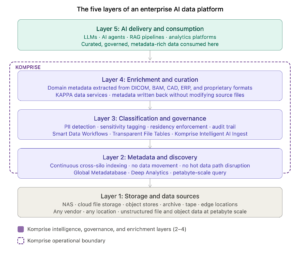
Data discovery sits at Layer 2 of the AI data platform: Metadata and Discovery. It sits directly above Layer 1, Storage and Data Sources, where data physically lives, and feeds Layer 3, Classification and Governance, which cannot categorize or apply policy to data that has not yet been found and indexed. Komprise operates at this layer through the Global Metadatabase, which continuously indexes file and object metadata across every storage vendor. See AI Data Platform for how all five layers work together.