Data Management Glossary
Data Catalog
What is a Data Catalog?
A data catalog is a centralized inventory of data assets that helps organizations discover, understand, classify, govern, and use data more effectively. Much like a library catalog, a data catalog makes it easier for users to find the right data, understand where it came from, assess quality, and determine whether it is appropriate for analytics, reporting, compliance, or AI.
Modern data catalogs typically include:
- Metadata indexing and search
- Business glossaries and definitions
- Data lineage tracking
- Ownership and stewardship information
- Tags and classifications
- Access and governance controls
- Usage insights and popularity metrics
Data catalogs have become a foundational component of modern data strategies because organizations cannot use what they cannot find or trust. See the AWS definition: What is a Data Catalog?
A Brief History of Data Catalogs
Most early data catalog platforms were built to support structured and semi-structured data, including:
- Relational databases
- Data warehouses
- BI platforms
- ETL pipelines
- Data lakes
- Lakehouse environments
- APIs and application data sources
Their primary users have historically been:
- Data analysts
- BI teams
- Data engineers
- Governance teams
- Compliance leaders
- Data scientists
These structured data platforms helped organizations organize tables, schemas, dashboards, and pipelines, but often provided limited visibility into the much larger universe of enterprise unstructured data.
Popular Data Catalog Vendors
Well-known data catalog and metadata management platforms include:
- Collibra
- Alation
- Informatica
- Microsoft (Purview)
- AWS (Glue Data Catalog)
- Databricks (Unity Catalog)
- Snowflake Horizon Catalog
These solutions are strong for structured analytics ecosystems, governance workflows, and BI operations.
The Rise of the Unstructured Data Catalog
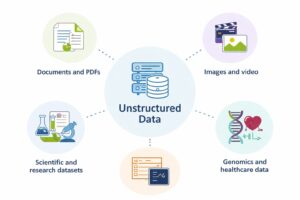 Today, most enterprise data growth comes from unstructured data, including:
- Files and folders
- PDFs and Office documents
- Images and video
- Genomics and research data
- Engineering files
- Audio content
- Logs and archives
- SaaS-generated content
This data often lives across:
- NAS systems
- Object storage
- Public cloud
- Edge environments
- Departmental data silos
- Legacy platforms
Traditional data catalogs were not designed to index billions of files across heterogeneous storage systems or optimize the storage lifecycle of that data.
That has created a new need: the unstructured data catalog.
What is an Unstructured Data Catalog?
An unstructured data catalog provides searchable metadata, classification, policy intelligence, and lifecycle visibility across distributed file and object data. It helps organizations answer questions such as:
- What data do we have?
- Where is it located?
- Who owns it?
- How old is it?
- Is it sensitive?
- Is it duplicated or stale?
- Does it need to be enriched?
- Is it valuable for AI?
- Should it be tiered, archived, moved, or deleted?
This is becoming mission-critical for cost control, security, compliance, and AI success.
Why Unstructured Data Catalogs Matter for AI
Generative AI and enterprise AI depend heavily on unstructured content.
Without an unstructured data catalog, organizations struggle to:
- Find relevant documents for RAG pipelines
- Eliminate duplicate or low-value content
- Exclude sensitive data from AI tools
- Curate domain-specific datasets
- Understand data provenance
- Control AI storage and compute costs
AI is increasing the value of metadata intelligence.
How Komprise Delivers an Unstructured Data Catalog
Komprise provides a differentiated, storage-agnostic approach to unstructured data cataloging through its Global Metadatabase.
What is the Komprise Global Metadatabase?
The Global Metadatabase is a unified metadata intelligence layer spanning NAS, cloud, and object storage environments. It gives enterprises visibility into billions of files without disrupting users or applications.
Key Capabilities
1. Data Classification
Classify data by file type, age, owner, path, usage, location, custom metadata, and sensitive data indicators.
2. Data Curation
Build high-value datasets for AI, analytics, investigations, and governance initiatives.
3. Search at Scale
Find relevant data across silos without manually traversing storage systems.
4. Lifecycle Intelligence
Identify cold data for tiering, migration, archiving, or deletion.
5. Storage-Agnostic Flexibility
Works across mixed environments rather than locking customers into one storage vendor.
Why Storage-Agnostic Matters
Most enterprises do not operate in a single storage ecosystem.
They use combinations of:
- NetApp
- Dell Technologies
- Everpure (Pure Storage)
- Hewlett Packard Enterprise
- IBM
- Amazon Web Services
- Microsoft Azure
- Other platforms and SaaS systems
A storage-agnostic data catalog avoids lock-in and creates one control plane for unstructured data management.
Why is the Komprise Unstructured Data Catalog Different?
Many catalog vendors focus on metadata for databases and BI tools. Komprise focuses on operationalizing metadata for unstructured data, combining:
- Catalog + Search
- Data Classification + Governance
- Curation + AI readiness
- Tiering + Storage Cost optimization
- Migration + Mobility (take action based on data intelligence)
- Sensitive data workflows (see sensitive data management)
The Komprise Global Metadatabase turns a passive catalog into an active data management platform.

Data Catalog FAQs
What is a data catalog?
A data catalog is a centralized, searchable inventory of data assets that helps organizations discover, understand, classify, govern, and use data more effectively. It captures metadata including data ownership, lineage, classification, access history, and governance status so that users can find the right data, understand where it came from, assess its quality, and determine whether it is appropriate for analytics, compliance, AI, or other business uses. Data catalogs have become a foundational component of modern data strategies because organizations cannot use what they cannot find or trust.
What is an unstructured data catalog?
An unstructured data catalog is a catalog designed specifically for file and object data distributed across network-attached storage environments, cloud object storage, and hybrid storage estates. Unlike traditional data catalogs built for databases and data warehouses, an unstructured data catalog must index billions of files across heterogeneous storage systems, capture file-level metadata including age, owner, type, access history, and custom tags, and provide the lifecycle intelligence needed to govern, tier, migrate, and curate that data. The Komprise Global Metadatabase is an unstructured data catalog that goes beyond passive documentation to become an active data management platform, connecting metadata intelligence directly to policy-based data mobility and AI data workflows.Why are traditional data catalogs limited for unstructured data?
Why are traditional data catalogs limited for unstructured data?
Traditional data catalog platforms from vendors including Collibra, Alation, Informatica, and Microsoft Purview were built primarily for structured and semi-structured data in databases, data warehouses, and BI pipelines. They excel at documenting schemas, lineage, and ownership for SQL tables and analytics datasets but have limited or no support for unstructured file and object data, which represents 80-90% of all enterprise data. They cannot index billions of NAS files across multi-vendor storage environments, cannot apply tiering or lifecycle policies based on catalog metadata, and do not connect catalog intelligence to data mobility actions. For organizations managing petabyte-scale unstructured data estates, a dedicated unstructured data catalog is needed alongside or instead of a structured data catalog.
How does Komprise help with unstructured data cataloging?
Komprise provides an unstructured data catalog through the Global Metadatabase, which indexes all file and object data across multi-vendor NAS and cloud storage environments without agents or changes to existing infrastructure. Every file is indexed with standard system metadata including file type, size, age, owner, and access history. Custom metadata enriched by KAPPA data services adds domain-specific business context extracted directly from file content, such as project codes, clinical parameters, or sensitivity classifications. All metadata is searchable via Komprise Deep Analytics using any combination of standard and custom tag criteria. Unlike passive catalog platforms, the Global Metadatabase connects directly to Komprise Smart Data Workflows and data mobility policies, so catalog queries become the trigger for automated actions including tiering, migration, AI ingestion, and governance. This makes it an active metadata layer rather than a documentation system.
Why is a data catalog important for enterprise AI?
AI models, RAG pipelines, and agentic AI systems can only work with data that is discoverable, well-classified, and governed. Without a data catalog, AI teams cannot reliably find the right datasets across distributed storage environments, cannot filter out irrelevant or sensitive content before ingestion, and cannot verify that the data entering a model is current, authorized, and accurate. Gartner estimates that up to 60% of enterprise AI projects fail due to inadequate data readiness, and the absence of a data catalog for unstructured data is one of the primary contributing factors. The Komprise Global Metadatabase solves this for unstructured data by maintaining a continuously updated, queryable index of all file and object data across the enterprise, enriched with custom metadata and connected to governed AI data workflows that automatically curate and deliver the right data to AI platforms.
How does the Komprise Global Metadatabase differ from a traditional data catalog?
Traditional data catalogs document what structured data exists. The Komprise Global Metadatabase governs what unstructured data does. The distinction is that traditional catalogs are primarily reference systems: they help users find and understand data that someone manually or semi-automatically registered. The Global Metadatabase is continuously updated through scheduled Komprise scans across all storage environments, so it always reflects the current state of the unstructured data estate without requiring manual registration or curation. It supports tag-based search that performs at the same speed as standard metadata queries across billions of files, and it connects directly to data mobility policies and Komprise Smart Data Workflows so that any catalog query can trigger an automated action. Organizations do not just know what their unstructured data is, they can act on it immediately based on what the catalog reveals.
Can Komprise work alongside existing data catalog platforms like Purview, Collibra, or Alation?
Yes. Komprise addresses the unstructured file and object data layer that most enterprise data catalog platforms do not cover. For organizations already using Purview, Collibra, Alation, or similar platforms for their structured data governance programs, Komprise complements those investments by extending metadata intelligence and governance to the unstructured data estate. KAPPA data services can synchronize custom metadata tags with Microsoft Purview, ensuring that sensitivity classifications and governance labels are consistent across both structured and unstructured data environments. The Global Metadatabase can serve as the authoritative index for unstructured file and object data while existing catalog platforms continue to govern structured databases, warehouses, and BI datasets.