Data Management Glossary
AI Data Platform
What Is an AI Data Platform?
An AI data platform is the software and infrastructure stack that makes enterprise data discoverable, governed, and AI-ready at scale. It spans every layer of the data estate: from raw storage across NAS systems, cloud, and object stores at the base, through the data management and governance layer that classifies and enriches data in the middle, to the AI applications, models, and analytics tools that consume curated, trusted datasets at the top.
The term is used broadly. Storage vendors use it to describe GPU-accelerated infrastructure. Cloud providers use it to describe managed data lake and lakehouse services. Analytics platforms use it to describe unified query and modeling environments. What all of those definitions share is the recognition that AI cannot produce reliable outputs without a governed, organized, and accessible data foundation underneath it.
For enterprises with large unstructured data estates, the most important layer in that stack is not the AI model and not the storage infrastructure. It is the intelligence and governance layer in between: the layer that decides which data is relevant, which is sensitive, which is current, and which is worth sending to an AI pipeline at all.
Why AI Data Platforms Are Now a Strategic Priority
Enterprise AI adoption has crossed from pilot to production. According to McKinsey, 72% of enterprises have at least one AI workload in production as of 2026, up from 55% in 2024. Global spending on AI systems is forecast to surpass $300 billion in 2026.
Source: McKinsey Global AI Survey 2026; IDC Worldwide AI Spending Guide 2026
The problem is that deploying AI at scale requires data infrastructure that most enterprises do not have. Only 7% of organizations say their data is completely ready for AI adoption, according to a Cloudera and Harvard Business Review survey of enterprise IT leaders published in March 2026. And Gartner warns that through 2026, organizations will abandon 60% of AI projects that lack AI-ready data foundations.
Source: Cloudera and Harvard Business Review Analytic Services, Enterprise AI Readiness Survey, March 2026; Gartner, Predicts 2026: Data and Analytics Leaders Must Address AI-Ready Data Gaps
The gap between AI investment and AI outcome traces directly to data. According to Gartner, up to 40% of AI project costs stem from fixing data issues identified only after deployment. McKinsey notes that companies with high-quality training datasets experience 20-30% higher accuracy across enterprise AI models.
Source: Gartner and McKinsey, cited in Techment Data Quality for AI 2026 Enterprise Guide
The urgency compounds as AI agents become a standard enterprise capability. Gartner predicts 40% of enterprise applications will integrate task-specific AI agents by the end of 2026, up from less than 5% in 2025. AI agents require continuous, governed access to current, accurate unstructured data to function reliably. Without an AI data platform that manages and governs that data supply, agent-based AI produces unreliable outputs.
Source: Gartner, press release, August 2026
Is Komprise an AI data platform?
Yes. Komprise operates at many different layers of a modern enterprise AI data platform, from raw storage up to the point unstructured data reaches an AI model.
- Storage-level visibility. The Global Metadatabase indexes file and object data across every NAS, cloud, and object storage system without moving the underlying data.
- Governance and classification. Smart Data Workflows detect PII, protected health information, and other regulated content, and classify what is safe to use before anything reaches an AI pipeline.
- Enrichment. KAPPA data services extract metadata from proprietary formats, including DICOM, BAM, and CAD files, that generic tools cannot read.
- Policy-based orchestration. Ongoing policies confine and tier data automatically, so the right files land in the right place without a manual cleanup project.
- AI delivery. Komprise Intelligent AI Ingest delivers the curated, governed dataset directly to the AI pipeline, up to 2X faster than unmanaged approaches.
That range is what drives AI success and ROI. Fewer hallucinations and inconsistent outputs, because the AI reasons from trustworthy files instead of duplicate or stale ones. Lower AI compute and token cost, because irrelevant content never gets processed in the first place. Faster time to production, because data teams are not manually hunting for the right files across a dozen storage silos. Komprise does not replace enterprise storage or the AI models themselves. It is the connective layer that makes both of them productive for AI.
The Layers of an AI Data Platform
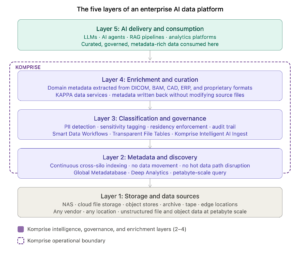
A complete AI data platform covers five functional layers. Each one is required. Missing any one of them creates a failure point that propagates through every AI initiative built on top of it.
Layer 1: Storage and Data Sources. The foundation layer covers every system where enterprise data actually lives: NAS environments, cloud file storage, object stores, archive systems, tape, and edge locations. Most large enterprises manage dozens of storage systems across multiple vendors and locations simultaneously. No AI initiative can succeed without knowing what data exists across all of them.
Layer 2: Metadata and Discovery. The intelligence layer indexes what data exists, where it lives, what it contains, and who owns it, across every storage system simultaneously without moving the underlying data. This is the layer that makes discovery possible: before data can be governed, curated, or delivered to AI, it has to be findable. Metadata covers file name, size, type, age, access frequency, owner, sensitivity classification, and custom domain-specific attributes extracted from file content.
Layer 3: Classification and Governance. The governance layer classifies data by type, sensitivity, jurisdiction, and AI relevance; enforces policies automatically; detects PII and regulated content before it enters AI pipelines; and maintains an auditable record of what data was acted on, when, and why. Without this layer, AI pipelines ingest whatever they are pointed at, including duplicate, stale, sensitive, and irrelevant content.
Layer 4: Enrichment and Curation. The enrichment layer extracts domain-specific metadata from proprietary and specialized file formats that standard indexing tools cannot parse, including DICOM medical images, genomics BAM files, engineering CAD drawings, and ERP exports. It adds the business context that makes generic file data meaningful for specific AI use cases. Without metadata enrichment, domain-specific data is invisible to AI pipelines.
Layer 5: AI Delivery and Consumption. The top layer covers the AI applications, models, RAG pipelines, vector databases, analytics platforms, and data engineering tools that consume curated, governed datasets. This includes LLMs, AI agents, data lakehouses, and any downstream system that requires high-quality unstructured data to function.
Why Unstructured Data Is the Hardest Layer to Manage
Structured data platforms have a 30-year head start. Databases, data warehouses, and data lakes were built to manage rows, columns, and defined schemas. Unstructured data: the files, documents, images, genomics outputs, sensor logs, and multimedia content that make up 80-90% of the enterprise data estate, was never designed to be managed as a data asset. It was designed to be stored.
The consequences show up in every AI initiative. Unstructured data lacks consistent schemas, making it difficult to classify automatically. It lives across dozens of storage silos with no native cross-silo index. It grows at 40-60% per year, compounding the management backlog. Standard governance tools were built for structured databases and cannot read proprietary file formats. And most organizations have no unified view of what unstructured data they have, where it lives, or whether it is safe to use in AI.
By 2027, IT spending focused on managing multistructured data will represent 40% of total IT spending on data management technologies and services, according to Gartner. The share of AI spending dedicated to AI data readiness is expected to grow sevenfold between 2025 and 2029.
Source: Gartner Data and Analytics Summit 2026, cited in InfotechLead
Meanwhile, IDC predicts a 15% productivity loss by 2027 for companies that fail to establish AI-ready data foundations. The cost of inaction is measurable, not hypothetical.
Source: IDC, cited in Enterprise AI Agents Adoption Statistics 2026
There are two approaches to solving this problem in an AI data platform, and they lead to very different architectures.
The first approach is to consolidate: copy unstructured data into a centralized platform where it can be managed, classified, and served. This creates version drift, doubles storage costs, triggers cloud egress fees, and introduces exactly the cross-border data movement that sovereignty regulations prohibit.
The second approach is to manage data in place: index, classify, enrich, and govern the data where it already lives, without copying it, and deliver only the curated, governed subset each AI use case actually needs. This is the architecturally correct approach for organizations with petabyte-scale unstructured data estates. It avoids the data movement cost, the governance exposure, and the vendor lock-in that consolidation-based approaches create.
Where Komprise Fits in the AI Data Platform Stack
Most AI data platform vendors address layers 1 and 5: the storage infrastructure at the base and the AI applications at the top. Komprise addresses layers 2, 3, and 4: the intelligence, governance, and enrichment layers in the middle that determine whether the data reaching those AI applications is worth using.
Komprise sits above heterogeneous storage without sitting in the hot data path. It connects to NAS systems, cloud environments, and object stores using standard protocols and indexes metadata continuously without moving data or disrupting production workloads. This vendor-agnostic position is what makes it the correct layer for organizations with multi-vendor storage estates: a single intelligence and governance layer that spans every storage system simultaneously, rather than one management tool per vendor.
- The Global Metadatabase is the discovery and intelligence foundation. It continuously indexes standard and custom metadata across every storage silo, making every file discoverable, classifiable, and queryable from a single interface. A Deep Analytics query can span billions of files across all storage vendors simultaneously, returning results in seconds. That query then becomes the data source for a Smart Data Workflow or a tiering plan, connecting discovery directly to action.
- KAPPA data services extend that index to proprietary file formats that standard tools cannot reach: DICOM headers, genomics BAM files, engineering drawings, legal contracts. The extracted metadata writes back to the Global Metadatabase without modifying the source file, making previously opaque domain-specific data as queryable as any standard file type.
- Smart Data Workflows enforce governance policies automatically. They scan file content using 68 built-in PII scanners plus custom regex, detect sensitive data before it reaches an AI pipeline, and trigger classification, confinement, or routing actions based on the results. Files that should not enter an AI pipeline are excluded before they get there.
- Transparent File Tables expose the Global Metadatabase as SQL-queryable virtual tables in Snowflake, Databricks, and other data platforms, giving data engineering teams direct access to file metadata alongside structured data without copying the underlying files. This connects the unstructured data estate to the modern analytics and AI stack without data movement.
- Komprise Intelligent AI Ingest delivers the curated, governed, metadata-enriched dataset to the AI pipeline. Data engineering and AI teams receive exactly the files each use case requires, classified, enriched, and cleared of sensitive content, delivered 2x faster than manual curation at petabyte scale.
The result is an AI data platform layer that storage vendors cannot replicate because they are tied to their own infrastructure, and that AI application vendors cannot replicate because they do not manage the data estate at the source.
| Challenge | Without Komprise | With Komprise |
|---|---|---|
| Cross-silo visibility | ✗ Unstructured data is siloed across NAS, cloud, and object storage with no unified index. No single view of what exists, where it lives, or what it contains across storage vendors and locations. | ✓The Global Metadatabase continuously indexes standard and custom metadata across every storage silo simultaneously, without moving data or disrupting production workloads. Every file is discoverable from a single query interface. |
| Proprietary and domain-specific file formats | ✗ Standard indexing tools cannot parse DICOM medical images, genomics BAM files, engineering CAD drawings, or ERP exports. High-value domain data remains invisible to AI pipelines and governance workflows. | ✓KAPPA data services extract domain-specific metadata from any proprietary format and write it back to the Global Metadatabase without modifying the source file. Previously opaque domain data becomes as queryable as any standard file type. |
| Data quality before AI ingestion | ✗ AI pipelines ingest raw, unfiltered file stores containing duplicate, outdated, and irrelevant content. According to Gartner, up to 40% of AI project costs come from fixing data issues identified only after deployment. | ✓Deep Analytics curates the exact dataset each AI use case requires, excluding duplicates, stale files, and unauthorized content before ingestion. McKinsey finds that clean training datasets improve model accuracy by 20-30%. |
| Sensitive data governance before AI | ✗ PII, PHI, and regulated content enter AI pipelines ungoverned. Retrieval systems surface sensitive data in AI outputs, creating compliance exposure that is discovered after the fact rather than prevented at the source. | ✓Smart Data Workflows detect sensitive content using 68 built-in PII scanners plus custom regex before any file enters an AI pipeline. Sensitive files are excluded, tagged, or quarantined automatically. The vector index is governed by policy, not by chance. |
| Storage vendor independence | ✗ Storage-vendor-native management tools only govern their own infrastructure. Organizations with multi-vendor estates need one management tool per vendor, each with its own policies, reporting, and governance gaps between silos. | ✓Komprise operates above heterogeneous storage without sitting in the hot data path. One unified intelligence and governance layer spans every storage vendor simultaneously. No rehydration penalty when switching vendors or tiers. |
| AI pipeline maintenance and index freshness | ✗ Every data estate change requires reprocessing the full corpus for re-indexing, re-embedding, or re-vectorization. At petabyte scale this is expensive and slow, leaving AI pipelines operating on stale data between runs. | ✓The Global Metadatabase tracks every file change continuously. Komprise Intelligent AI Ingest delivers only new, updated, or newly relevant files to the AI pipeline, eliminating full corpus reprocessing and keeping the AI index current without manual intervention. |
| SQL access to unstructured data for analytics | ✗ File metadata cannot be joined with structured data in analytics platforms without custom ETL pipelines. Data engineers build and maintain separate integrations for every storage source, adding complexity and cost. | ✓Transparent File Tables expose Global Metadatabase content as SQL-queryable virtual tables in Snowflake and Databricks. Data engineers query file metadata alongside structured data using the tools they already use, with no file copying required. |
| Audit trail and AI governance | ✗ No record of what data entered an AI pipeline, what governance was applied, or when the index was last updated. Compliance audits and AI output explanations require manual reconstruction across disconnected systems. | ✓The Global Metadatabase maintains a complete, queryable audit trail covering every file curated, enriched, governed, and delivered to any AI pipeline. Compliance reports are generated on demand rather than reconstructed manually. |
Frequently Asked Questions
What is an AI data platform?
An AI data platform is the software and infrastructure stack that makes enterprise data discoverable, governed, and ready for AI at scale. It spans from raw storage at the base through metadata management, classification, governance, and enrichment in the middle to the AI models, agents, and analytics tools that consume curated data at the top. The middle layers, which manage data quality, sensitivity, and relevance before data reaches AI, are where most enterprises struggle and where the difference between a successful AI program and a failed one is made.
What are the layers of an AI data platform?
A complete AI data platform requires five layers: storage and data sources at the base, which is where data physically lives; metadata and discovery, which indexes what data exists and where; classification and governance, which enforces policies and controls sensitive data; enrichment and curation, which adds business context and domain-specific attributes; and AI delivery, which covers the models, agents, RAG pipelines, and analytics platforms that consume curated data. Organizations that attempt to operate layer 5 without layers 2 through 4 in place feed AI systems ungoverned, low-quality data and produce unreliable outputs.
Read the AI Data Preparation Guide.
Why is unstructured data the hardest part of an AI data platform to manage?
Structured data has defined schemas, consistent formats, and decades of tooling designed to manage it. Unstructured data: the files, documents, images, and proprietary formats that make up 80-90% of the enterprise data estate, has none of those properties. It lives across dozens of storage silos with no cross-silo index, grows at 40-60% per year, and contains domain-specific content in formats that standard governance and indexing tools cannot parse. Standard AI data platform solutions address structured data and generic file formats well but leave proprietary and domain-specific unstructured data effectively invisible to AI pipelines.
What is the difference between an AI data platform and a data lakehouse?
A data lakehouse combines data lake storage with data warehouse query performance, optimized for structured and semi-structured data. An AI data platform is broader: it encompasses the full stack from raw storage through governance and enrichment to AI consumption, and it must handle unstructured data at scale. Most lakehouse platforms address structured and semi-structured data well. They do not natively index file metadata across heterogeneous storage vendors, detect sensitive content in proprietary file formats, or govern AI pipelines for unstructured data. An AI data platform for unstructured data requires a management and data intelligence layer that sits above the storage infrastructure, not embedded within a single lakehouse vendor.
How does Komprise fit into an enterprise AI data platform?
Komprise sits at the intelligence, governance, and enrichment layers of the AI data platform stack, above heterogeneous storage and without sitting in the hot data path. The Global Metadatabase indexes all file and object data continuously across every storage vendor. Deep Analytics makes that index queryable at petabyte scale. KAPPA data services enrich proprietary file formats with domain-specific metadata. Smart Data Workflows classify and govern data automatically before it reaches any AI pipeline. Transparent File Tables expose the index to Snowflake, Databricks, and other data platforms. Komprise Intelligent AI Ingest delivers the curated, governed dataset directly to AI and analytics platforms. This is the unstructured data management layer that storage vendors and AI application vendors cannot provide, because neither operates across the full heterogeneous storage estate independently.
What happens when an AI data platform is missing the governance layer?
Without a governance layer, AI pipelines ingest whatever they are pointed at: duplicate files, outdated versions, PII, regulated health information, and proprietary IP that should never have entered a model or RAG index. The AI system faithfully represents that ungoverned content in its outputs, producing responses that are inaccurate, stale, or legally exposed. According to Gartner, up to 40% of AI project costs come from fixing data issues identified only after deployment. The governance layer is not optional infrastructure; it is the mechanism that determines whether AI outputs are trustworthy.
How does an AI data platform support AI agents?
AI agents require continuous, governed access to current and accurate data to function reliably. An agent that retrieves stale, duplicate, or unauthorized content produces incorrect decisions and recommendations that compound in autonomous workflows. An AI data platform that continuously indexes and governs unstructured data, enforces freshness by identifying changed files for re-indexing, and prevents sensitive content from entering retrieval indexes is what makes AI agent deployments trustworthy at scale. Gartner predicts 40% of enterprise applications will integrate AI agents by the end of 2026. Organizations that have not addressed the unstructured data governance layer before deploying agents at scale are building on an ungoverned foundation.