Data Management Glossary
Data Provenance
What Is Data Provenance?
Data provenance is the documented history of a piece of data across its lifecycle: where it originated, who created or owns it, what transformations and movements it has undergone, and how it has been accessed and used over time. The purpose of provenance is trust and accountability, an organization, auditor, or AI system should be able to answer “where did this come from and can I rely on it” for any given piece of data, rather than treating data as if it appeared with no history. Provenance is a broader concept than data lineage, which typically refers to the technical trail of transformations data undergoes as it moves through a pipeline. Provenance includes lineage but also covers ownership, licensing, access history, and chain of custody, information a lineage diagram alone does not capture.
Why Data Provenance Matters for Unstructured Data
Structured data has a natural head start on provenance: a database record usually carries a creation timestamp, an owner field, and an audit log by default. Unstructured data, files, images, documents, video, has none of that built in. A file can be copied, renamed, moved between storage systems, and edited by multiple people with no automatic record of any of it, and standard file system metadata like “last modified” tells you nothing about where the file originally came from or what it has been through before that. At enterprise scale, with billions of files spread across NAS, cloud, and object storage, this turns provenance from an occasional question into a structural gap: most organizations simply cannot answer where a given file came from once it has moved a few times.
The Case for Unstructured Data Management in Data Provenance
Solving provenance for unstructured data cannot be a manual or one-time exercise, the volume makes that impossible, and the stakes are rising because so much unstructured data is now training or feeding AI systems. A 2026 industry risk assessment found that 78% of organizations cannot validate their training data before use, and 77% cannot trace data provenance at all, a gap that becomes a direct compliance problem once an auditor or regulator asks where a model’s training data actually came from.
Source: 2026 Data Risk Forecast: 10 Predictions That Will Define AI Governance
Regulation is making this urgent rather than optional. The EU AI Act’s Article 10 requires documented provenance, scope, and collection methodology for training datasets used in high-risk AI systems, with enforcement beginning in August 2026, meaning organizations need provenance infrastructure operating now, not a policy document promising to build it later. Solving this requires continuous, automated metadata capture across every storage system a file might pass through, not a manual audit trail that depends on someone remembering to document a file’s history at the moment it was created.
How Komprise Supports Data Provenance
The Global Metadatabase continuously indexes file and object metadata, including origin attributes, ownership, access history, and movement across storage systems, as data moves through an environment, so a provenance record builds automatically rather than depending on manual documentation at the time of creation. Komprise Deep Analytics can then query that history by file, by project, or by data set, to answer exactly where a given piece of data came from and what has happened to it since. For unstructured data with domain-specific provenance needs, such as a chain-of-custody requirement in life sciences or a licensing attribute in media, KAPPA data services can extract and tag that custom information at the file level using Python functions written for that specific format, adding it to the same searchable record. None of this requires modifying the source files themselves, provenance metadata is captured and enriched in the Global Metadatabase, while the original files remain untouched.
Choosing a Data Provenance Approach for Unstructured Data
| Evaluation Criteria | Without Automated Provenance Tracking | With Komprise |
|---|---|---|
| Capturing origin and history | Provenance depends on someone manually documenting a file’s origin at creation, which is inconsistent and easy to skip | The Global Metadatabase continuously captures origin, ownership, and access metadata as files are indexed, without relying on manual documentation |
| Tracking across storage migrations | Provenance history is often lost or disconnected when a file moves between storage systems or vendors | Komprise indexes metadata across every connected storage vendor, so provenance history persists as data moves through the environment |
| Scale | Manual provenance documentation cannot realistically cover billions of files | Komprise indexes and tracks provenance metadata across petabytes of data without sampling |
| Domain-specific provenance needs | Generic tools cannot capture industry-specific chain-of-custody or licensing attributes | KAPPA data services extract and tag custom provenance attributes for specific file formats and industries |
| Evidence for compliance audits | Reconstructing a file’s history for an auditor or regulator requires manual investigation across disconnected systems | A Deep Analytics query can produce a file’s full provenance record on demand from a single, continuously updated index |
Data Provenance Frequently Asked Questions
What is the difference between data provenance and data lineage?
Data lineage is the technical trail of transformations data undergoes as it moves through a pipeline, most commonly tracked for structured data in ETL and analytics systems. Data provenance is broader: it includes lineage but also covers ownership, licensing, access history, and chain of custody. A file can have full lineage information (every transformation it went through) while still lacking provenance information (who owns it, where it originally came from, whether it is licensed for the intended use).
Why is data provenance important for AI?
AI systems are only as trustworthy as the data they are trained or run on, and provenance is what makes that trust verifiable rather than assumed. Without documented provenance, an organization cannot demonstrate that training data is properly licensed, free of unauthorized personal information, or free of bias introduced by an unreliable source, all of which are now explicit regulatory requirements under frameworks like the EU AI Act for high-risk AI systems.
How do you track data provenance for unstructured data at scale?
Tracking provenance for unstructured data at scale requires a continuously updated index of file and object metadata that captures origin, ownership, and movement automatically as data is created and used, rather than relying on manual documentation. Komprise does this through the Global Metadatabase, which indexes metadata across every connected storage system without agents, so a provenance record builds as a byproduct of normal indexing rather than a separate manual process.
What are the data provenance requirements under the EU AI Act?
The EU AI Act’s Article 10 requires providers of high-risk AI systems to document the provenance, scope, and main characteristics of training datasets, with enforcement beginning in August 2026. This includes documenting where training data came from, how it was collected, and what quality checks were applied, requirements that depend on having provenance metadata available before a model is trained, not reconstructed after the fact.
How does Komprise deliver data provenance tracking for AI training data?
The Global Metadatabase captures origin, ownership, and access history metadata continuously as it indexes file and object data across every storage system, and that record persists even as files move between vendors or tiers. Before data reaches an AI pipeline, Komprise Deep Analytics can query this history to confirm where a data set came from, and Smart Data Workflows can scan the same data for sensitive content as an additional compliance step, so the provenance record and the AI readiness check happen against the same governed metadata rather than two disconnected processes.
Where does data provenance fit in the AI data platform?
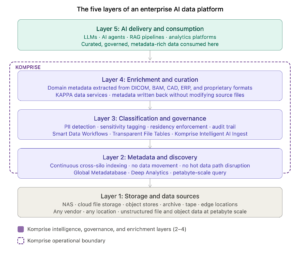
Data provenance is captured primarily at Layer 2 of the AI data platform, Metadata and Discovery, where the Global Metadatabase records origin, ownership, and access history as it indexes every file and object. It extends into Layer 4, Enrichment and Curation, where KAPPA data services add domain-specific provenance attributes, such as a chain-of-custody field or a licensing tag, that the base index cannot capture on its own. See AI Data Platform for how all five layers work together.