Actionable Data Intelligence
What Is Actionable Data Intelligence?
Actionable data intelligence is insight about data that is directly connected to the ability to act on it. It answers what data exists, where it lives, who owns it, how it is used, how sensitive it is and what it costs, and it turns those answers into policies, workflows and data movement without exporting results to another tool. Data intelligence tells you what you have. Actionable data intelligence pairs that intelligence with orchestration and closes the loop from finding to doing. The difference shows up in the output. Report-only data intelligence produces dashboards, spreadsheets and tickets. Actionable data intelligence produces a saved query that a policy engine executes, re-evaluates on a schedule and audits.
Why Insight Alone Falls Short
Most data intelligence ends at a report. Someone exports a list of cold files, duplicate files or sensitive files, opens a ticket, and waits for another team to act in another tool. By the time anything moves, the list is stale, the scope has drifted, and nobody can prove which files were handled. The gap is visible in survey data. 47% of IT leaders worry that departments lack visibility into storage spend and data use, and 64% name cost optimization as their top storage priority. Source: Komprise State of Unstructured Data Management Report For AI, the gap is wider. Only 6% of organizations say their enterprise data is fully ready to support AI at scale, and readiness depends on acting on data, not just describing it. Source: Dun and Bradstreet, July 28, 2026
Why Unstructured Data Needs Actionable Intelligence
For structured data, intelligence and action already live close together: a database query can update the rows it finds. Unstructured data has no equivalent. It spans billions of files across NAS, object storage and cloud, from multiple vendors, with no schema and inconsistent naming. A finding about those files is only useful if the same system that found them can act on all of them, across every silo, at once.
Three Approaches to Data Intelligence, and Where Each Stops
Most enterprises already have some form of data intelligence. The question is how far it reaches and whether it can act. Storage-vendor tools. Storage vendors increasingly bundle data intelligence and AI data services with their arrays. These tools see the vendor’s own systems well, but most enterprises run file and object data on several vendors and clouds, so the view is partial. Actions stay inside the vendor’s platform, and array-based tiering keeps data in a proprietary format that has to be rehydrated at the next refresh. The intelligence is real; it is also a reason to stay on that platform. See Storage Vendor Lock-In. Departmental and custom-built toolkits. Some teams build their own visibility with scanners, scripts and catalogs that they host on their own servers. These toolkits often work well inside one department, such as a research or HPC group, and are described as enterprise in scope. In practice, each site needs its own index servers, every action needs custom code, and the knowledge sits with a few people. There is no central console, no enterprise-wide policy and no consistent audit trail, and the approach strains as file counts reach the billions. Enterprise actionable data intelligence. A storage-independent service indexes every silo in one place, stays out of the hot data path, and acts on the data where it lives through policy. That is the model Komprise follows: unstructured data intelligence and orchestration delivered as a service.
What Actionable Data Intelligence Requires
- Visibility across every silo. Metadata for all file and object data across vendors, sites and clouds, in one index, kept current without moving data.
- Enterprise scale without infrastructure. No agents on storage or servers, no plugins, and no customer-run index servers to size and maintain.
- Classification and enrichment. Sensitive-data detection, tags and content metadata added at scale, so queries reach beyond file system attributes.
- A query layer. The ability to define precise datasets by storage system, share, path, file type, age, owner and tags.
- A policy engine. Saved queries that drive actions directly: tier, copy, migrate, confine, tag, enrich and deliver to AI.
- Interfaces for people and AI. Self-service access for data owners, and governed access for AI agents and analytics tools, from the same index.
- Proof. Audit trails, showback and before-and-after cost reporting for every action.
How Komprise Delivers Actionable Data Intelligence
Komprise Intelligent Data Management delivers unstructured data intelligence and orchestration for AI. It feeds AI the right data while cutting storage costs and risks, across every storage vendor and cloud, and it works in five steps: discover, auto-classify, enrich, query and act.
- Discover. The Global Metadatabase, delivered as a managed, auto-scaling service, indexes file and object data across NAS, object and cloud storage from any vendor. Komprise is agentless, with no plugins, connectors or customer-run index servers. Deployments index hundreds of billions of files, and first analytics on petabyte-scale data arrive in about 15 to 30 minutes while full indexing continues in the background.
- Auto-classify. 68 built-in sensitive-data detectors and rule-based tagging classify files at scale. Tags persist when files move. See Sensitive Data Detection.
- Enrich. Smart Data Workflows and KAPPA data services run extraction code on each file to add content metadata, such as DICOM headers for medical images. Recurring runs rescan only changed files.
- Query. Deep Analytics queries every connected system by name, path, size, age, owner and tags. Universal File MCP lets AI assistants query the same index in plain language under the user’s existing permissions, and Transparent File Tables expose the index to Snowflake and Databricks as Apache Iceberg tables.
- Act. A saved Deep Analytics query becomes the input to a data management plan or Smart Data Workflow. This is Deep Analytics Actions. Plans tier files with Transparent Move Technology, copy, migrate or confine them, or assemble curated datasets for AI with Komprise Intelligent AI Ingest, and they can run on a schedule as new files match.
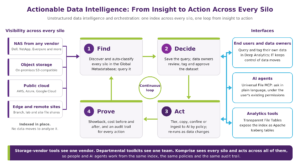
Every action is measurable. Showback reports show total cost, cost after tiering and savings by site, share or department. Komprise stores metadata only, never customer file data, and stays out of the hot data path, so users and applications keep accessing data directly on their storage. Confine is a decision, not a deletion. Komprise prepares and isolates data such as ROT data so data owners make the final call. Actionable data intelligence spans layers 2 through 4 of the AI Data Platform model: Metadata and Discovery, Classification and Governance, and Enrichment and Curation.
Independent Analyst View
In the DCIG Pulse for Unstructured Data Management, which scored 12 vendors on 68 product capabilities, Komprise had 23 full-support capabilities, the most of any vendor, and led five of eight vendor criteria, including Product Capabilities. Komprise was the only vendor with full support for curated dataset assembly, a central console, cost savings reporting, transparent recall, path preservation and multi-cloud data movement. Source: DCIG Pulse for Unstructured Data Management, Komprise Vendor Strengths Edition
Actionable Data Intelligence in Practice
- Storage cost. Query files untouched for a year across every NAS, save the query, and attach it to a tiering plan. Cold data moves at the file level with no rehydration penalty, and Transparent Move Technology cuts storage costs 70% or more.
- AI readiness. Query a research share for a project tag and file type, scan for PII, and send the curated result to a RAG knowledge base with Komprise Intelligent AI Ingest.
- Governance. Query for files belonging to departed employees, review the Orphaned Data report with the data owner, and confine the result.
- Smart Migration. Tier cold data first, then migrate hot data 27X faster for NFS data with Elastic Data Migration.
Comparing Approaches to Data Intelligence
| Evaluation Criteria | Storage-Vendor Tools | Departmental or Custom-Built Toolkits | With Komprise |
|---|---|---|---|
| Visibility | That vendor’s arrays only | The shares one team chose to scan | All file and object data across vendors, sites and clouds in one index |
| Scale | One platform at a time | Limited by the servers and scripts the team maintains | Hundreds of billions of files; first analytics in 15 to 30 minutes on petabytes |
| Deployment | Built into the array | Customer-run index servers, scanners and code | Agentless; Global Metadatabase delivered as a managed service |
| Path to action | Acts only inside the vendor’s platform | Export results, then script or ticket the work | A saved query drives tiering, copying, confining or AI ingest by policy |
| Data format after action | Proprietary block format; rehydration at refresh | Varies by script | Native file format; no rehydration penalty |
| Data access path | Through the array | Through whatever the team built | Out of the hot data path; metadata only, no file data stored |
| Governance | Per array | Per department; no enterprise audit | One console for all sites, with an audit trail on every plan and workflow |
| Interfaces | Vendor console | Team-specific scripts and dashboards | Deep Analytics for people, Universal File MCP for AI agents, Transparent File Tables for analytics |
| Proof of results | Capacity reports | Built by hand | Showback, cost before and after, and savings by site, share or department |
Actionable Data Intelligence FAQ
What is actionable data intelligence?
Actionable data intelligence is insight about data that is directly connected to the ability to act on it. It identifies what data exists, where it lives, who owns it, how it is used, how sensitive it is and what it costs, and it drives policies, workflows and data movement from those findings without exporting results to another tool.
What is the difference between data intelligence and actionable data intelligence?
Data intelligence produces understanding: reports, dashboards and catalogs. Actionable data intelligence pairs that understanding with orchestration, so a saved query becomes a tiering, copy, confine or AI ingest plan that runs, re-evaluates and is audited in the same system.
How is actionable data intelligence different from storage-vendor data intelligence?
Storage-vendor tools see and act on the vendor’s own arrays, and array-based tiering keeps data in a proprietary format. Actionable data intelligence from Komprise is storage-independent: it indexes every vendor, site and cloud in one place, acts on data in native format, and keeps you free to change storage vendors.
Why don’t departmental or custom-built data intelligence tools scale to the enterprise?
They depend on index servers, scanners and scripts that one team builds and runs. That works for a department, but each new site adds infrastructure, every action needs custom code, and there is no central console, enterprise policy or consistent audit trail. Komprise is agentless and delivered as a service, with one console for all sites.
How is actionable data intelligence different from data observability?
Data observability monitors the health of data pipelines and systems, such as freshness, volume and failures. Actionable data intelligence is about the data itself, what it is and what it costs, and about acting on it through policy.
How does Komprise deliver actionable data intelligence?
Komprise delivers unstructured data intelligence and orchestration as a service in five steps: discover, auto-classify, enrich, query and act. The Global Metadatabase indexes all file and object data, Deep Analytics queries it, and saved queries drive tiering, copying, confining, enrichment and AI ingestion across any storage vendor.
What is Deep Analytics Actions?
Deep Analytics Actions is the Komprise capability that uses a saved Deep Analytics query as the input to a data management plan. Instead of an age-based rule applied to a whole share, the plan acts on a precise dataset, such as one project, file type or owner, and keeps acting as new files match the query.
Can business users act on data without IT risk?
Yes. A Deep Analytics role lets data owners search, analyze and tag their own data without the ability to move or delete it. IT attaches their saved queries to plans, so domain knowledge drives decisions while IT keeps control of execution.
How does actionable data intelligence support AI?
AI needs the right subset of data, not all of it. Actionable data intelligence finds that subset across silos, classifies and enriches it, keeps sensitive data out, and delivers it to AI through Komprise Intelligent AI Ingest. AI agents can also query the index in plain language through Universal File MCP, under the user’s existing permissions.
Which AI Data Platform layers does actionable data intelligence cover?
Layers 2 through 4: Metadata and Discovery, Classification and Governance, and Enrichment and Curation. It prepares and hands off data to layer 5, AI Delivery and Consumption. See the AI Data Platform glossary page for the full model.
Does actionable data intelligence require moving data first?
No. Komprise indexes metadata in place and stores no customer file data, so analysis, querying and tagging happen without moving data or sitting in the hot data path. Data moves only when a plan or workflow acts on a query result.