Data Management Glossary
Vector Embeddings
What is Vector Embedding?
A vector embedding is a numerical representation of a piece of content, typically a chunk of text, an image, or a document segment, expressed as a high-dimensional array of numbers called a vector. Embedding models convert text or other content into these numerical representations so that semantic meaning is captured as geometric relationships: content with similar meaning produces vectors that are close together in the vector space, and content with dissimilar meaning produces vectors that are far apart.
Vector embeddings are the mechanism that makes semantic search possible. Where traditional keyword search matches on exact terms, embedding-based retrieval matches on meaning. A query about “patient records from cardiac procedures” can retrieve a document that uses the phrase “coronary catheterization outcomes” without either document mentioning the other’s exact terminology, because the embeddings of both are geometrically close in the vector space.
In a RAG pipeline, the embedding process works in two phases. During indexing, document chunks are converted into embeddings and stored in a vector database alongside their metadata. During retrieval, the user’s query is converted into an embedding using the same model, and the vector database returns the chunks whose embeddings are closest to the query embedding. Those chunks are then passed to the AI model as context for generating a response.
Why Vector Embedding Quality Matters for Enterprise AI
Embedding model selection is important, but it is rarely the first variable worth changing in a RAG system. Most retrieval failures trace back to poor chunking or missing metadata, not to the embedding model itself.
Source: StackAI, RAG Best Practices for Enterprise AI, 2026
That priority order has direct implications for enterprise AI investment. Organizations that spend significant budget on premium embedding models while feeding those models poorly classified, duplicate-heavy, metadata-stripped file data are optimizing the wrong variable. The embedding model can only represent what the chunk contains. If the chunk contains stale, irrelevant, or ungoverned content, the embedding faithfully represents that content, and the retrieval system faithfully returns it in response to queries.
For enterprise unstructured data, the embedding problem compounds across three dimensions.
- Volume: embedding tens of millions of document chunks at petabyte scale requires significant compute, and re-embedding is required whenever the chunking strategy or model changes.
- Governance: embedding sensitive content into a shared vector database creates compliance exposure, because retrieval can surface regulated content in contexts where access was never authorized.
- Domain specificity: general-purpose embedding models trained on public text perform poorly on highly specialized enterprise content such as genomics data, medical imaging reports, engineering specifications, and legal contracts, where the vocabulary and conceptual relationships differ substantially from training data.
The Embedding Problem With Traditional RAG on Unstructured Data
Three failure modes recur across enterprise embedding deployments built on unclassified unstructured data.
- Embeddings of poor-quality source data. A corpus of duplicate documents produces redundant embeddings that increase vector index size, raise retrieval noise, and consume compute budget on content that should have been deduplicated before indexing. A corpus of outdated files produces embeddings that represent superseded information as current knowledge. An embedding model cannot distinguish a current policy document from an obsolete one: that distinction requires metadata and governance upstream of the embedding step.
- Sensitive content embedded without governance. When unclassified file stores are ingested directly into embedding pipelines, PII, protected health information, confidential IP, and jurisdiction-restricted data enter the vector index without review. Retrieval can then surface that content in AI responses to queries that the original data owners never intended it to answer. This is not a hypothetical risk: it is the primary data governance failure mode in enterprise RAG deployments, and it is not addressable at the embedding layer.
- Re-embedding costs at scale. Enterprise data estates change continuously. New files are created, existing files are updated, and outdated files are retired. Every change to chunking strategy, metadata schema, or embedding model requires re-embedding affected content. Without a metadata layer that precisely identifies which files changed and which meet current curation criteria, re-embedding defaults to reprocessing everything, which is expensive and slow.
How Komprise Improves Embedding Quality at the Source
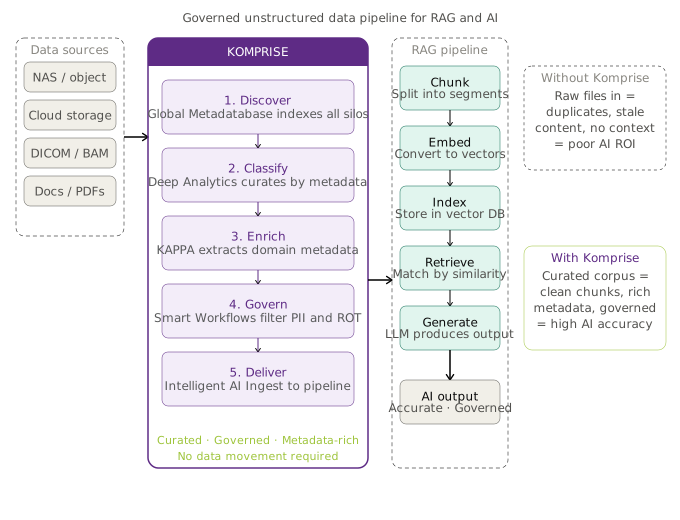 Komprise operates upstream of the embedding step. The quality of embeddings produced by any model is directly determined by the quality, classification, and metadata richness of the content fed into the chunking and embedding pipeline. Komprise governs that upstream process.
Curating the corpus before embedding. The Global Metadatabase indexes all file and object data across the enterprise storage estate continuously. Deep Analytics queries that index to define precisely which files belong in a specific embedding corpus, using metadata criteria including file type, last-modified date, access frequency, sensitivity classification, owner, and custom business context tags. Only files that meet the curation criteria enter the pipeline. Duplicate, stale, and unauthorized files do not produce embeddings in the first place.
Enriching content before embedding. KAPPA data services extract domain-specific metadata from proprietary file formats and write those attributes back to the Global Metadatabase. When files are passed to the chunking and embedding pipeline, they carry metadata that can be attached to each chunk before embedding. Retrieval systems that support metadata filtering can then use those attributes to narrow the vector search before evaluating semantic similarity, which reduces noise and improves retrieval precision without requiring a better embedding model.
Governing sensitive content before it enters the vector index. Smart Data Workflows detect PII, PHI, and regulated content before files reach the embedding pipeline. Sensitive files are excluded, quarantined, or routed to restricted-access indexes automatically. The vector database receives a corpus that has passed a governance checkpoint, which means retrieval cannot surface unauthorized content regardless of query similarity.
Reducing re-embedding costs through targeted updates. Because the Global Metadatabase maintains a continuously updated index of every file across all storage environments, identifying which files changed since the last embedding run is a metadata query rather than a full storage scan. Komprise delivers only the changed, new, or newly relevant files to the embedding pipeline, reducing re-embedding compute and keeping the vector index current without full reprocessing.
| Challenge | Without Komprise | With Komprise |
|---|---|---|
| Corpus quality before embedding | ✗ Duplicate, stale, and unauthorized files produce redundant and misleading embeddings that inflate the vector index and degrade retrieval accuracy | ✓Deep Analytics curates the corpus by metadata criteria before any file is chunked or embedded, producing a clean, governed input to the embedding pipeline |
| Sensitive content in the vector index | ✗ Unclassified PII, PHI, and regulated content enters the vector database and can be surfaced by retrieval in contexts where access was never authorized | ✓Smart Data Workflows detect and exclude sensitive content before embedding; the vector index is governed by policy, not by chance |
| Domain-specific content | ✗ Proprietary formats including DICOM, BAM, and CAD files cannot be parsed by standard embedding pipelines; high-value domain knowledge is missing from the index | ✓KAPPA data services extract domain-specific metadata and prepare proprietary files for chunking, extending embedding coverage to specialized enterprise content |
| Metadata on embeddings | ✗ Retrieval relies on semantic similarity alone; governance and business context cannot be applied at query time, surfacing topically similar but unauthorized content | ✓KAPPA-enriched metadata travels with each chunk, enabling metadata-filtered retrieval that combines semantic similarity with business context and governance controls |
| Re-embedding costs | ✗ Every data estate change or model update requires reprocessing the full corpus, which is expensive and slow at petabyte scale | ✓The Global Metadatabase identifies exactly which files changed, enabling targeted re-embedding of only affected content without full corpus reprocessing |
| Audit trail | ✗ No record of which content was embedded, what governance was applied, or when the vector index was last updated with current data | ✓The Global Metadatabase maintains a complete audit trail of curation, enrichment, and delivery for every file that enters an AI pipeline |
Vector Embeddings Frequently Asked Questions
What is a vector embedding?
A vector embedding is a numerical representation of a piece of content, expressed as a high-dimensional array of numbers. Embedding models convert text, images, or document chunks into these vectors so that semantic meaning is encoded as geometric relationships: similar content produces vectors that are mathematically close, and dissimilar content produces vectors that are far apart. Vector embeddings are the foundation of semantic search and retrieval-augmented generation, enabling AI systems to find relevant content by meaning rather than by keyword matching.
Why does the quality of source data matter more than the embedding model?
The embedding model can only represent what the input chunk contains. If the chunk contains stale, duplicate, or ungoverned content, the embedding accurately represents that content, and the retrieval system accurately returns it in response to queries. Most enterprise RAG retrieval failures trace back to poor source data quality or missing metadata rather than to the embedding model itself. Upgrading the embedding model while feeding it an uncurated corpus of enterprise file data produces marginal gains at best and significant compute cost at worst.
What governance risks come from embedding unclassified unstructured data?
When unclassified file stores are ingested directly into embedding pipelines, PII, protected health information, confidential IP, and jurisdiction-restricted data enter the vector index without review. Retrieval can then surface that content in AI responses to queries that the original data owners never intended it to answer. This risk is not addressable at the embedding layer: by the time a sensitive file is embedded, the governance window has passed. Sensitive content must be identified and excluded upstream, before any file enters the chunking and embedding pipeline.
How does Komprise reduce re-embedding costs at petabyte scale?
The Global Metadatabase maintains a continuously updated index of every file across all storage environments. When data changes, the files that changed are identifiable by metadata query. Komprise delivers only new, updated, or newly relevant files to the embedding pipeline rather than reprocessing the full corpus. This reduces the compute cost of maintaining a current vector index and eliminates the need for full re-embedding runs whenever the underlying data estate changes.
How does metadata enrichment improve embedding-based retrieval without changing the model?
Metadata enrichment attaches business context attributes to each chunk before embedding: file origin, sensitivity classification, jurisdiction, project code, and domain-specific tags. Retrieval systems that support metadata filtering can combine semantic similarity with business context filtering at query time, surfacing chunks that are not just topically similar but also current, authorized, and domain-appropriate. Microsoft Azure Architecture Center research from 2025 found that metadata enrichment on chunks boosts question-answering accuracy from roughly 50-60% to 72-75% without any change to the embedding model or retrieval architecture.