Data Management Glossary
AI Token
What is an AI Token?
An AI token is the basic unit of text a large language model reads, processes, and generates. A token is not necessarily a full word. Depending on the model’s tokenizer, a token might be a whole word, part of a word, a single character, or a punctuation mark. As a rough rule of thumb for English text, one token is about four characters, or roughly three-quarters of a word.
Tokens matter for two practical reasons. First, every model has a fixed context window, a maximum number of tokens it can process in a single request, covering both the input prompt and the generated response. Second, AI providers price their models per token, typically per million tokens, with output tokens usually costing several times more than input tokens. Token count is therefore both the technical constraint and the financial unit of enterprise AI. For the process that converts text into tokens, see Tokenization.
Why AI Token Volume Matters for Enterprise Unstructured Data
For most enterprises, tokens are not an abstract technical detail. They are a line item. Every file, email, and document pulled into a prompt, a retrieval-augmented generation query, or an embedding job gets converted into tokens and billed accordingly. Published 2026 pricing shows how wide the range is: some efficient models price under $1 per million tokens, while frontier models charge $15 to $75 per million output tokens, with output tokens commonly running three to eight times the cost of input tokens.
Source: published API pricing pages, accessed July 2026: OpenAI, Anthropic, and Google Gemini.
That range means the composition of what gets tokenized, not just the model chosen, is a major cost driver. Enterprise unstructured data is uniquely bad at token efficiency. Gartner estimates unstructured data is growing 55% to 65% annually, three times faster than structured data, and most of that growth lands in a form that tokenizes poorly: duplicate document versions, stale drafts, boilerplate legal footers, and proprietary formats such as DICOM images, CAD drawings, and genomics files that a generic tokenizer cannot read without prior extraction.
In the Komprise 2026 State of Unstructured Data Management Report, 62% of IT and data storage leaders cite reducing data risk from AI as their top business challenge, and 46% cite corporate data leakage as their top generative AI security concern. Both point to the same exposure: once a file is tokenized and sent to an LLM, whatever it contains, including sensitive data, has already left the organization’s control.
The Token Problem With Raw Enterprise File Data
Sending uncurated file shares straight into an AI pipeline creates token waste and token risk at the same time.
Noisy data burns billable tokens with no accuracy benefit. Forty conflicting versions of a company policy is not just a storage problem. Each version consumes tokens when it is embedded, and consumes tokens again every time it is pulled into a retrieval context at query time. Enterprises pay per token to process content that actively degrades the quality of the answer.
Context windows fill up with the wrong content. Even generous context windows are finite. When a retrieval system pulls in duplicate or stale chunks alongside relevant ones, it spends a share of the token budget on content that adds no value and can crowd out the passage that actually answers the question.
Sensitive data becomes a token before anyone reviews it. Automated ingestion scripts that tokenize and forward everything in a network share do not distinguish a project specification from a payroll file or a patient record. Once that content is tokenized and sent to a third-party model, it cannot be recalled. Regulatory exposure under GDPR, HIPAA, or similar frameworks starts at the moment of tokenization, not at the moment of a data breach.
How Komprise Reduces Enterprise Token Cost and Risk
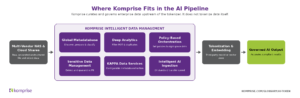
Komprise does not generate or process AI tokens. That happens inside the LLM or embedding model. What Komprise does is control what enterprise content ever reaches that point, so organizations tokenize and pay for a curated, governed dataset instead of a full, unfiltered file share.
Cut token volume at the source. The Global Metadatabase indexes file and object data across every NAS, cloud, and object storage silo without moving the underlying data, and Deep Analytics queries that index to identify duplicate, stale, and orphaned files. Filtering that content out before ingestion means it is never tokenized, never billed, and never available to dilute a retrieval result.
Automate that filtering with policy, not a one-time cleanup project. Komprise Intelligent Data Management lets organizations set ongoing data management policies on top of that index, for example confining certain data to specific storage or locations, or tiering data automatically by age and access pattern. The same policy engine that keeps cold data off expensive primary storage also keeps out-of-scope data off the path to a tokenizer on an ongoing basis, not just at the moment someone runs a one-time cleanup.
Make proprietary formats usable instead of wasted. KAPPA data services extract content and metadata from DICOM headers, genomics BAM files, engineering drawings, and other specialized formats that a standard tokenizer cannot read, so that high-value domain data reaches the AI pipeline in a form that can actually be tokenized and used, rather than being skipped or garbled.
Quarantine sensitive data before it can be tokenized. Smart Data Workflows scan file content for PII, protected health information, and other regulated data using built-in scanners and custom regex, and exclude flagged files from the AI delivery path. Sensitive content is stopped before it becomes a token, not after.
Deliver a curated dataset, not a raw share. Komprise Intelligent AI Ingest delivers the curated, governed subset of enterprise data directly to the AI pipeline, whether that is an LLM provider, a vector database, or an internal RAG system, 2X faster than unmanaged approaches, because it is moving a filtered dataset instead of an entire storage estate.
Komprise sits upstream of wherever tokens get created, whether the framing is the tokenization process or the token as a billing unit.
Every file an agent reads costs tokens; Komprise Universal File MCP filters irrelevant, outdated, conflicting, and duplicate files through Deep Analytics before they reach the model, and replaces multiple storage connectors to reduce MCP bloat.
AI Token Cost and Risk: Without Komprise vs. With Komprise
| Evaluation Criteria | Without Komprise | With Komprise |
|---|---|---|
| Token cost from duplicate content | Duplicate and outdated file versions are tokenized and billed repeatedly, with no accuracy benefit | Deep Analytics filters duplicates and stale files out before ingestion, so token spend maps to unique, relevant content |
| Sensitive data exposure | PII, PHI, and regulated content are tokenized and sent to third-party AI services with no review | Smart Data Workflows quarantine sensitive content before any file reaches a tokenizer or external AI API |
| Proprietary file formats | DICOM, BAM, CAD, and ERP files cannot be tokenized by standard tools and are skipped or garbled | KAPPA data services extract usable content from proprietary formats so it can be tokenized and deliver value |
| Context window efficiency | Retrieval pulls in duplicate and irrelevant chunks, consuming token budget without improving the answer | A curated, deduplicated corpus means more of every token budget represents unique, query-relevant content |
| Cost visibility and audit | No record of which files were tokenized, sent to which AI service, or reviewed for sensitivity beforehand | The Global Metadatabase maintains a queryable audit trail of every file curated and delivered to the AI pipeline |
AI Token Frequently Asked Questions
What is an AI token?
An AI token is the basic unit of text a large language model processes, roughly a word, part of a word, or a character, depending on the model’s tokenizer. Models read input and generate output in tokens, and AI providers typically price their APIs per million tokens. Token count also determines whether content fits inside a model’s fixed context window.
How many words is one AI token?
As a general rule of thumb for English text, one token is about four characters, or roughly three-quarters of a word. Exact ratios vary by tokenizer and by language; languages with different scripts or more complex word structures can tokenize less efficiently than English.
What is the difference between an AI token and tokenization?
A token is the unit itself, the piece of text a model reads or generates. Tokenization is the process that produces tokens, converting raw text into the numeric units a model can process. Enterprises typically care about token count for cost and context-window reasons, and about tokenization as the mechanism that determines how their content gets converted into that billable, limited resource.
Why do enterprise AI token costs run higher than expected?
Token costs scale with volume, and enterprise unstructured data estates generate far more token volume than their useful content would suggest. Duplicate file versions, stale drafts, and boilerplate content all get tokenized and billed as if they were unique, valuable information. Because output tokens typically cost three to eight times more than input tokens, inefficient retrieval that generates longer or repeated responses compounds the problem further.
How does Komprise reduce AI token costs and exposure for enterprises?
Komprise operates upstream of tokenization. The Global Metadatabase and Deep Analytics identify and filter duplicate, stale, and irrelevant files before they are ever sent to an AI pipeline, which reduces the volume of content that gets tokenized and billed. Smart Data Workflows detect and quarantine PII and other regulated content before ingestion, so sensitive data is never tokenized or exposed to a third-party AI service. KAPPA data services extract usable content from proprietary formats so that high-value domain data can be tokenized and used rather than skipped. The result is a smaller, cleaner, better-governed token footprint.
Which layer of the AI data platform governs AI token cost and risk?
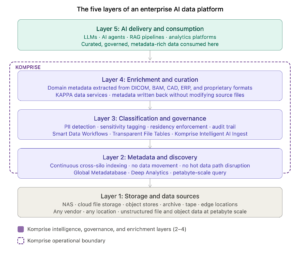
Tokens are created and consumed in Layer 5, AI Delivery and Consumption, where LLMs, RAG pipelines, and vector databases operate. But token cost and token risk are determined upstream, in Layers 2 through 4 of the AI Data Platform: Metadata and Discovery, Classification and Governance, and Enrichment and Curation. Komprise operates in those layers, which is why reducing enterprise token spend starts with data curation, not with switching AI models.