Data Management Glossary
AI First-Mile Gap
AI First-Mile Gap
The AI first-mile gap is the gap between an organization’s investment in downstream AI tooling and the readiness of the data that feeds it. The last mile of AI (chunking, embedding, vector databases, retrieval-augmented generation, and model serving) receives most of the attention and budget. The first mile (discovering, indexing, classifying, and curating the data those tools consume) is often skipped. When the first mile is skipped, AI tools run on incomplete, stale, duplicated, or sensitive data, and results suffer regardless of how good the model is.
Komprise CEO Kumar Goswami framed the problem in 2026 in Your Data is Not Ready: Solving the First Mile Gap for Enterprise AI.
“The AI industry has thus far focused on the reasoning layer, while the data preparation layer has received comparatively less attention in mainstream AI discussions.”
First Mile vs Last Mile
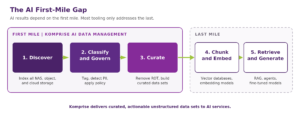
- First mile. Discover and index data across all storage. Classify it and detect sensitive content. Curate by removing redundant, obsolete, and trivial (ROT) files and enriching metadata. Govern who can use what.
- Last mile. Chunk and embed data. Load vector databases. Retrieve and generate with RAG, agents, or fine-tuned models.
The last mile depends on the first. A vector database cannot fix data that was never found, and a RAG pipeline cannot filter what it was never told is outdated.
Why the First-Mile Gap Is an Unstructured Data Problem
Structured data arrives in tables with schemas, owners, and quality checks already applied. Unstructured data does not.
- Volume. Unstructured data makes up 80% to 90% of enterprise data.
- No schema. Files carry only basic system metadata such as size, dates, owner, and path, so relevance and sensitivity are not visible without analysis.
- Sprawl. File and object data spans NAS from several vendors, object storage, cloud, and SaaS, with no single inventory.
- Noise. Duplicates, old versions, and trivial files are common and degrade AI results when ingested.
- Sensitivity. PII and regulated data sit in ordinary file shares with no labels.
The consequence is measurable. Gartner predicts that through 2026, organizations will abandon 60% of AI projects unsupported by AI-ready data, and 63% of organizations either do not have or are unsure whether they have the right data management practices for AI.
A May 2026 Dun & Bradstreet survey of 10,000 businesses in 32 countries found 97% have active AI initiatives, but only 5% say their data is fully ready. Half cite limited data access as a barrier.
Why Storage Vendors and Point Tools Do Not Close the Gap
Last-mile tools assume someone has already delivered the right data. Manual curation by data scientists does not scale to billions of files and goes stale as data changes. And the newest entrants to the first mile, storage vendors selling AI data engines, solve it for one slice of the estate.
- One vendor’s data. A storage-vendor AI data engine is designed to index that vendor’s storage first. The data an AI project needs sits across several NAS vendors, object storage, cloud, and SaaS.
- New hardware first. Several vendor AI data engines run on new all-flash platforms or GPU appliances. With enterprise SSD prices at record highs in 2026, a first mile that starts with a flash purchase is the most expensive way to begin. See the Memflation glossary page.
- Lock-in. Metadata, classifications, and curated data sets built inside one vendor platform stay there. Every AI-ready terabyte prepared that way makes the vendor harder to leave.
- Metadata silos. Run two or three storage vendors and you get two or three vendor catalogs, each with its own schema, APIs, and version of the truth. AI agents querying them through MCP have to learn each API, pull from each, and reconcile the answers before responding. That is MCP bloat, and it costs tokens, time, and accuracy.
You do not buy your database from your storage vendor. There is no reason to buy the metadatabase behind your AI from one either. Storage changes every three to five years. Data, and the AI built on it, lasts for decades.
Closing the first mile requires a storage-independent index of all unstructured data, policy-based classification and curation, and a governed path to whatever AI stack and agents the organization uses.
The First Mile Also Pays for Itself
The work that makes data AI-ready also exposes what it costs to store. The same index that finds relevant data for AI finds cold, duplicate, and orphaned data on expensive primary storage. About 70% of unstructured data on primary storage is typically cold. Tiering it and removing ROT data frees budget at the moment flash prices are rising fastest, which funds the AI program instead of competing with it.
The Foundation: One Consistent Global Metadatabase
AI needs one source of truth about enterprise data, no matter where that data resides. If it sees only part of the data, or reconciles conflicting catalogs, it returns incomplete answers and hallucinates. The Komprise Global Metadatabase provides one consistent, actionable data intelligence layer across NAS, object, cloud, SaaS, and tape.
- Future-proofs AI projects. Change storage vendors and the AI project is unaffected, because the metadatabase does not live on the storage.
- Raises AI ROI. AI has access to all the data, regardless of where it resides.
- Reduces MCP bloat. Agents use one set of APIs against one metadatabase, with no reconciliation across catalogs.
- Ends vendor lock-in. Change storage vendors at will. The Global Metadatabase stays intact.
- Delivered as a service. No hardware, no kit to build, no GPUs, and no staff to run it. The Global Metadatabase is a scale-out system that works with hundreds of billions of files.
How Komprise Closes the AI First-Mile Gap
Komprise operates at layers 2 through 4 of the AI data platform: Metadata and Discovery, Classification and Governance, and Enrichment and Curation.
- Discover. Komprise indexes file and object metadata across NAS, object, cloud, SaaS, and tape from any vendor into the Komprise Global Metadatabase.
- Classify and govern. Smart Data Workflows detect PII and other sensitive content with policy-based tagging and regex matching, and Deep Analytics finds data by owner, age, type, and tags.
- Enrich. KAPPA data services is a serverless compute environment that extracts custom metadata across billions of files. Teams create a custom function in minutes, and KAPPA data services runs hundreds of these simultaneously. Organizations extend the core Global Metadatabase with metadata specific to their business, such as project codes, instrument types, or patient IDs. Visit the KAPPA Library for examples.
- Curate. Saved Deep Analytics queries exclude redundant, obsolete, and trivial files and build curated data sets, including on custom metadata, that feed data management plans and Smart Data Workflows.
- Deliver to AI pipelines. Komprise Intelligent AI Ingest delivers curated, governed data sets to any AI stack with 2X faster data flows, and removes 70%+ of unstructured data noise before transfer.
- Deliver to AI agents. Komprise Universal File MCP gives AI agents and users one Model Context Protocol interface to the Global Metadatabase. Ask questions in natural language about data on NAS, cloud, SaaS, or tape, generate reports, and schedule them. Every query runs under the requesting user’s existing permissions, agents load metadata before full files to cut token waste, and tiered and archived data is reachable with no rehydration. One enterprise connector replaces a tangle of storage-specific connectors and plugins.
- Deliver to analytics. Transparent File Tables turn a curated slice of the Global Metadatabase into an Apache Iceberg table with pointers to the underlying files, ready for Databricks and Snowflake, so teams join ERP and business tables with file metadata.
- Cut storage costs along the way. Transparent Move Technology tiers the cold data the index uncovers, with no rehydration penalty, and cuts 70%+ of storage costs. The Komprise Flash Stretch Assessment quantifies how much primary flash capacity can be reclaimed, up to 70%.
KAPPA data services enriches. Universal File MCP queries, learns, and orchestrates.
Komprise does this at enterprise scale today. It has run in production with large enterprises for more than 10 years and manages more than one exabyte of enterprise data across unstructured data storage and cloud platforms.
| Evaluation Criteria | Without a Storage-Independent First Mile | With Komprise |
|---|---|---|
| Metadata foundation | Per-vendor catalogs, each with its own schema and APIs | One consistent Global Metadatabase across NAS, object, cloud, SaaS, and tape |
| Delivery model | Kits to build, hardware to buy, or GPU appliances to run | Delivered as a service; no hardware, kit, GPUs, or staff to run it |
| Scale | Varies by vendor platform | Hundreds of billions of files; scale-out clusters each designed for 10 billion files per day |
| Data discovery | Data scientists search known shares, or a vendor indexes its own estate | Every silo indexed across 15+ storage and cloud platforms |
| Metadata enrichment | Manual tagging or vendor classification | KAPPA data services runs hundreds of custom Kaplets across billions of files; custom metadatabase extensions |
| Curation and ROT | Whole shares copied; duplicates and stale versions ingested | Curated data sets; 70%+ of noise removed before ingest |
| Sensitive data | Discovered after it appears in AI output | PII detected with Smart Data Workflows before data moves |
| Delivery to pipelines | Custom scripts per pipeline | Komprise Intelligent AI Ingest, 2X faster data flows to any AI stack |
| Delivery to agents | Storage-specific connectors, plugins, and MCP bloat | Komprise Universal File MCP: one enterprise connector, natural-language queries, permission-aware |
| Delivery to analytics | File metadata locked in storage silos | Transparent File Tables create Iceberg tables for Databricks and Snowflake |
| Storage cost | Cold data stays on primary flash at record 2026 prices | Cold data tiered with Transparent Move Technology; 70%+ storage cost savings |
| When storage changes | Metadata, curated data, and AI pipelines rebuilt | Global Metadatabase stays intact; AI projects unaffected |
AI First-Mile GAP FAQs
What is the AI first-mile gap?
The AI first-mile gap is the difference between enterprise investment in downstream AI tooling (models, vector databases, and RAG pipelines) and the readiness of the unstructured data that feeds it. The first mile covers finding, indexing, classifying, and curating data before it reaches AI. When organizations skip it, AI runs on incomplete, stale, or sensitive data.
What is the difference between the first mile and the last mile of AI?
The first mile prepares data: discovery, indexing, classification, curation, and governance. The last mile consumes it: chunking, embedding, vector search, retrieval, and generation. Most enterprise AI tooling addresses the last mile. Results depend on the first.
Why do enterprise AI projects fail because of data?
AI projects fail when the data behind them is incomplete, outdated, duplicated, or unsafe to use. Gartner predicts that through 2026, organizations will abandon 60% of AI projects unsupported by AI-ready data.
Source: Gartner
How do you close the AI first-mile gap?
Index all unstructured data across every storage system, classify it and detect sensitive content, remove redundant, obsolete, and trivial files, enrich metadata so relevant data is findable, and deliver curated data sets to AI through a governed, auditable process. Automate the steps so the data stays current as it changes.
Who owns the first mile of AI data preparation?
The first mile usually falls between teams. Data science teams own models and pipelines, while infrastructure and storage teams own the files. Closing the gap requires infrastructure teams to provide a searchable, governed index of unstructured data that data teams can curate from without copying everything.
Can storage vendors close the AI first-mile gap?
Only for their own storage. Storage-vendor AI data engines are designed to index the vendor’s storage first, often require new all-flash or GPU hardware, and keep metadata and curated data inside that ecosystem. The first mile spans every storage system an enterprise runs, so closing it requires storage-independent software.
How does closing the first-mile gap reduce storage costs?
The index that finds AI-relevant data also finds cold, duplicate, and orphaned data. Tiering cold data and removing ROT data frees primary capacity. Komprise customers cut storage costs by 70%+ with Transparent Move Technology, and the Komprise Flash Stretch Assessment identifies how to reclaim up to 70% of primary flash.
How do AI agents get first-mile prepared data?
Through a governed interface rather than raw file shares. Komprise Universal File MCP exposes the Komprise Global Metadatabase to AI agents through the Model Context Protocol, with permission-aware queries, metadata-first loading to cut tokens, and access to tiered data with no rehydration.
Why does AI need one consistent metadatabase?
AI needs one source of truth about enterprise data. With a separate catalog for each storage vendor, AI sees partial data or must reconcile conflicting answers, which lowers accuracy and drives hallucinations. One consistent metadatabase across NAS, cloud, SaaS, and tape gives AI access to all the data through one set of APIs, and it stays intact when storage changes.
Should the metadata behind your AI come from your storage vendor?
No. Storage changes every three to five years, while data and the AI built on it last for decades. A metadatabase tied to one storage vendor creates a metadata silo per vendor and ties AI projects to that vendor relationship. The Komprise Global Metadatabase is storage-independent and delivered as a service.
How does Komprise address the AI first-mile gap?
Komprise indexes unstructured data across all storage into the Global Metadatabase, classifies and curates it with Deep Analytics and Smart Data Workflows, and delivers curated data sets to any AI stack with Komprise Intelligent AI Ingest at 2X faster data flows. AI agents reach the same governed data through Komprise Universal File MCP. Because Komprise is storage-independent, the work stays portable, and the same index cuts storage costs by 70%+ by tiering cold data. The Global Metadatabase is delivered as a service with no hardware or GPUs, KAPPA data services enriches it with custom metadata, and Transparent File Tables feed curated metadata to Databricks and Snowflake. Komprise manages more than one exabyte of enterprise data today.
Which layers of the AI data platform make up the first mile?
The first mile maps to layers 2 through 4 of the five-layer AI data platform: Metadata and Discovery, Classification and Governance, and Enrichment and Curation. Layer 5, AI Delivery and Consumption, is the last mile. See the AI Data Platform glossary page.