Data Management Glossary
Data Chunking
What is Data Chunking?
Data chunking is the process of breaking large documents and files into smaller, discrete segments before they are converted into vector embeddings and stored in a vector database for AI retrieval. Chunking is a prerequisite for retrieval-augmented generation (RAG) pipelines: because AI models have fixed context windows, they cannot process an entire document at once. Chunking determines which segment of a document the model sees in response to a query, which makes it one of the most direct determinants of RAG output quality.
A chunk can be defined by a fixed number of tokens (fixed-size chunking), by natural language boundaries such as sentences or paragraphs (semantic chunking), or by document structure such as headers and sections (structural chunking). The right approach depends on the document type, the query patterns the AI system is expected to handle, and the cost constraints of the deployment.
Chunking sits between data ingestion and embedding in the AI data pipeline: data must be discovered, classified, and curated before chunking can produce meaningful results, and chunk quality directly determines how accurately embeddings capture the content’s meaning.
Why Data Chunking Is Important for Enterprise AI
Chunking configuration influences retrieval quality as much as or more than embedding model selection, according to a peer-reviewed NAACL 2025 study across 25 chunking configurations and 48 embedding models.
That finding matters for enterprise AI teams because most RAG optimization effort goes into model selection and infrastructure, while chunking decisions are made once and rarely revisited. A poorly chunked corpus cannot be rescued by a better embedding model. The semantic integrity of each chunk is what allows the embedding to represent the content’s meaning accurately. Chunks that cut across sentence boundaries, split related concepts, or include irrelevant surrounding content produce embeddings that retrieve the wrong context, which degrades AI accuracy regardless of model quality.
For unstructured enterprise file data, the chunking challenge is compounded by format diversity. A consistent chunking strategy that works for plain text PDFs fails on DICOM medical images, engineering drawings, genomics BAM files, or scanned contracts. Enterprise RAG pipelines that ingest raw, unclassified file stores without format-aware preparation produce chunks of wildly uneven quality, which is one of the primary reasons AI output accuracy varies so dramatically across query types in production systems.
Metadata enrichment on chunks boosts question-answering accuracy from roughly 50-60% to 72-75% without changing the retrieval architecture.
Source: Microsoft Azure Architecture Center, 2025, cited in RAG Chunking Strategies and Embeddings Optimization, 2026
That figure reflects a critical insight: chunk quality is not determined solely by how you split the text. It is determined by what metadata travels with the chunk. A chunk that carries jurisdiction, file origin, sensitivity classification, project code, and last-modified date allows the retrieval system to filter by business context before it evaluates semantic similarity. Without that metadata, retrieval is purely semantic, which means it surfaces topically similar content regardless of whether that content is current, authorized, or relevant to the specific query context.
The Chunking Problem With Traditional RAG on Unstructured Data
Traditional RAG pipelines assume clean, structured text input. Enterprise unstructured data is neither. The result is three compounding failure modes.
- Poor source data quality. If the files fed into a chunking pipeline contain duplicate documents, outdated versions, redundant content, and files with no access in years, the chunks inherit those problems. Duplicate chunks increase retrieval noise. Outdated chunks surface stale content as authoritative answers. Redundant chunks waste vector storage and index capacity. No chunking strategy compensates for this upstream data quality failure.
- Auto-annotation at scale produces diminishing returns. Attempting to enrich every file with AI-generated metadata before chunking is expensive, difficult to maintain, and produces many unused annotations. Reprocessing large corpora when underlying data changes is slow and costly. Organizations that try to auto-annotate everything spend compute budget on files that never get queried while missing the domain-specific context that makes enterprise chunking meaningful.
- No context travels with the chunk. Most chunking implementations strip files down to raw text before splitting. The provenance, ownership, sensitivity classification, and business context that would make chunks precisely queryable are lost. The retrieval system is left with semantic similarity as its only signal, which is insufficient for governed enterprise AI.
How Komprise Solves the Chunking Problem at the Source
Komprise does not perform chunking. Chunking happens inside the RAG pipeline tooling. What Komprise does is solve the data quality and metadata problems that determine whether chunking produces high-signal or low-signal chunks.
Discovery and curation before chunking. The Global Metadatabase continuously indexes all file and object data across NAS, cloud, and object storage without moving the underlying data. Deep Analytics queries that index to identify precisely the files that belong in a specific AI dataset, filtering by file type, age, access pattern, owner, sensitivity status, and custom tags. Only curated, relevant, governed files enter the chunking pipeline. Duplicate, outdated, and unauthorized files never reach the chunker.
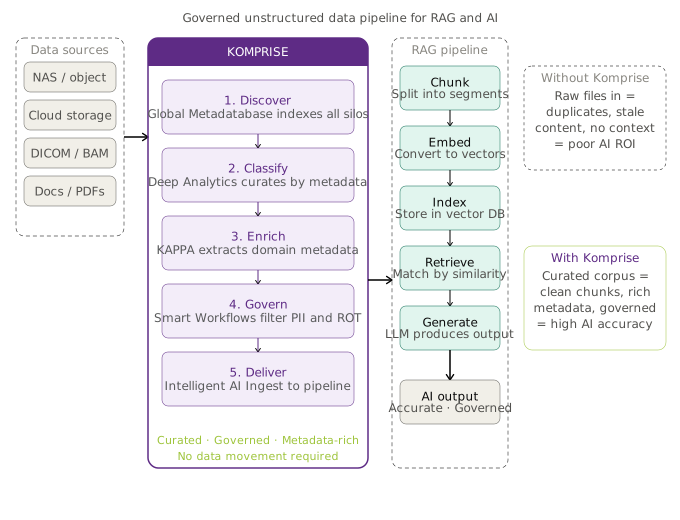
Metadata enrichment that travels with the chunk. KAPPA data services extract domain-specific metadata from proprietary file formats including DICOM headers, genomics BAM files, engineering drawings, and PDF contracts, and write those attributes back to the Global Metadatabase as searchable tags. When files are delivered to a RAG pipeline, they carry rich metadata context that chunking tools can attach to each chunk. This is what drives the accuracy improvement from 50-60% to 72-75%: not a better chunking algorithm, but chunks that carry business context the retrieval system can use.
Governance before ingestion. Smart Data Workflows run sensitive data detection across the curated dataset before any file enters the chunking pipeline. Files containing PII, regulated health information, or IP subject to access restrictions are excluded automatically. Chunks never inherit unauthorized content because that content is filtered at the source.
Targeted delivery. Komprise Intelligent AI Ingest delivers the curated, metadata-enriched dataset directly to the AI pipeline in native file format, without format conversion, rehydration, or unnecessary copying. The chunking tool receives a clean, governed, context-rich corpus instead of a raw file share.
| Challenge | Without Komprise | With Komprise |
|---|---|---|
| Source data quality | ✗ Duplicate, stale, and redundant files enter the chunking pipeline, producing noisy chunks and degrading retrieval accuracy across the entire RAG system | ✓Deep Analytics identifies and excludes duplicates, outdated files, and unauthorized content before chunking begins, delivering a clean corpus |
| Metadata on chunks | ✗ Chunks carry raw text only; retrieval relies on semantic similarity with no business context filtering, surfacing topically similar but unauthorized or outdated content | ✓KAPPA data services enrich files with domain-specific metadata that travels with each chunk, boosting question-answering accuracy from ~50-60% to 72-75% |
| Proprietary file formats | ✗ Standard chunking tools cannot parse DICOM, BAM, CAD, or ERP files; high-value domain data is excluded from the vector index entirely | ✓KAPPA data services extract format-specific metadata and prepare proprietary files for chunking without requiring custom ETL development |
| Sensitive data in chunks | ✗ Regulated content enters the pipeline ungoverned and may surface in AI outputs, creating PII, PHI, and IP compliance exposure | ✓Smart Data Workflows detect and exclude PII, PHI, and restricted IP before any file reaches the chunker, using 68 built-in scanners plus custom regex |
| Auto-annotation cost | ✗ Attempting to annotate everything is expensive, produces many unused annotations, and requires frequent reprocessing as the data estate changes | ✓Metadata enrichment via KAPPA is targeted by Deep Analytics query: only files meeting curation criteria are enriched and processed, eliminating wasted compute |
| Audit and governance | ✗ No record of which files were chunked, what metadata they carried, or whether governance policies were applied before ingestion | ✓The Global Metadatabase maintains a complete, queryable audit trail of every file curated, enriched, and delivered to the AI pipeline |
Data Chunking Frequently Asked Questions
What is data chunking in AI?
Data chunking is the process of splitting large documents and files into smaller segments before they are converted into vector embeddings for AI retrieval. AI models have fixed context windows and cannot process entire documents at once, so chunking determines which portion of a document the model sees in response to a query. Chunk quality is one of the primary determinants of RAG accuracy: chunks that are too large, too small, or stripped of metadata produce poor retrieval results regardless of the embedding model used.
Why does chunk quality matter more than embedding model selection?
According to a peer-reviewed NAACL 2025 study across 25 chunking configurations and 48 embedding models, chunking configuration influences retrieval quality as much as or more than the choice of embedding model. Most RAG teams invest in model selection while making chunking decisions once and leaving them unchanged. A poorly chunked corpus with strong metadata outperforms a well-chunked corpus with no metadata context, because retrieval systems can use metadata to filter by business relevance before evaluating semantic similarity.
What is the biggest chunking challenge for enterprise unstructured data?
Two problems compound each other. First, most enterprise file stores contain duplicate, outdated, and irrelevant files that produce low-quality chunks when ingested without prior curation. No chunking strategy compensates for poor source data quality. Second, standard chunking tools strip files to raw text, discarding the provenance, ownership, sensitivity classification, and business context that would make chunks useful in governed enterprise AI. The result is a retrieval index that surfaces topically similar content without regard to whether that content is current, authorized, or relevant to the specific query.
How does Komprise improve chunking quality without replacing the chunking tool?
Komprise operates upstream of the chunking step. The Global Metadatabase indexes all file and object data across the enterprise storage estate, and Deep Analytics queries that index to identify precisely which files belong in a specific AI corpus. Only curated, governed, relevant files enter the chunking pipeline. KAPPA data services extract domain-specific metadata from proprietary formats and write it back to the Global Metadatabase, so files delivered to the chunker carry rich metadata context that can be attached to each chunk. Smart Data Workflows filter sensitive content before any file reaches the chunker. The chunking tool receives a clean, metadata-rich corpus instead of a raw file share.
What is metadata enrichment on chunks and why does it improve AI accuracy?
Metadata enrichment on chunks means attaching business context attributes to each chunk alongside its text content: file origin, sensitivity classification, jurisdiction, project code, last-modified date, and domain-specific tags extracted from the source file. Retrieval systems that support metadata filtering can then combine semantic similarity with business context when responding to a query, surfacing chunks that are not just topically similar but also current, authorized, and relevant. Microsoft Azure Architecture Center research from 2025 found that metadata enrichment on chunks boosts question-answering accuracy from roughly 50-60% to 72-75% without changing the retrieval architecture.