Unstructured Data Catalog
What Is an Unstructured Data Catalog?
An unstructured data catalog is a searchable index of file and object data that records what each file is, where it lives, who owns it, how old it is, how often it is used and whether it holds sensitive content. Teams use it to find, govern and act on unstructured data without opening files one by one or knowing which storage system holds them.
The idea of a catalog is not new. Data warehouses and data lakes have used data catalogs for years to document tables, columns, lineage and business definitions, and the market is crowded with tools that do it well. What is new is the need to catalog files and objects: documents, images, video, instrument output, design files and logs spread across NAS, cloud and object storage. Those tools were not built for that job. For how catalog entries are stored and organized, see metadata catalog.
Why Traditional Data Catalogs Miss Unstructured Data
Unstructured data is most of what enterprises store. Gartner puts it at 70% to 90% of organizational data.
Source: Gartner, Data & Analytics Summit London, May 12, 2026
Catalogs designed for structured data break down on files for five reasons:
- Scale. A warehouse holds thousands of tables. A file estate holds billions of files, and the count grows daily.
- No schema. A table describes itself. A file has system metadata, such as name, size, owner and dates, but its contents and context must be extracted.
- Silos. Files sit on NAS, cloud file services and object storage from several vendors, often bought by different teams at different times. See data sprawl.
- Connectors. Traditional catalogs reach sources through connectors built for databases and SaaS applications, not for petabytes of file shares.
- Change. Files are created, copied, moved and tiered constantly. A one-time crawl is out of date within days.
Analysts see the same shift. Gartner describes metadata management moving from augmented data catalogs toward platforms that orchestrate metadata anywhere, and warns that data management vendors that cannot manage unstructured data will be left behind as generative and agentic AI take hold.
Source: Gartner, Magic Quadrant for Metadata Management Solutions, November 2025
Source: Gartner, Unstructured Data Support Will Decide the AI Data Readiness Race, June 19, 2026
What an Unstructured Data Catalog Must Do
Most enterprises cannot yet see all of their file data. In a Cloud Security Alliance survey, 35% of organizations reported full visibility into their unstructured data.
Source: Cloud Security Alliance, The Rise in Unstructured Data and AI Security Risks, March 31, 2026
Closing that gap takes a catalog built for files from the start. Evaluate any unstructured data catalog against seven requirements:
- Every storage silo. NAS, cloud and object storage from any vendor, in one index.
- Full scale. Every file indexed, not a sample.
- Rich metadata. System, header and sensitive-data metadata, plus custom tags for project, department, content and use case.
- Continuous freshness. The index updates as data changes.
- Search and query. Self-service search for storage teams and data owners, an API for automation and a natural-language path for AI agents.
- Action. A query result becomes a policy: tier, move, confine, exclude or deliver to AI.
- No lock-in. The catalog stays independent of the storage it indexes, so changing storage vendors does not mean rebuilding visibility.
Why Unstructured Data Catalogs Matter for AI
AI projects fail on finding the right data before they fail on models. An AI agent or retrieval pipeline cannot use what no one can locate, and every stale or duplicate file it reads adds token and compute cost. A catalog lets teams find the right subset by query, check it for sensitive content and deliver only what the use case needs. This is the work described in the AI first-mile gap and AI data preparation.
Few enterprises have that foundation for file data. In a Komprise survey of 500 technical decision makers, 4% had built a schema for more than 70% of their file data and made it available to lakehouse and analytics teams, and 13% could not say how much of their unstructured data is ready for AI.
Source: Komprise Unstructured Data for AI & Lakehouses Survey
Storage-Vendor Catalogs vs. a Storage-Independent Catalog
Storage vendors including NetApp, Dell and Everpure now offer data intelligence features. Those features are designed around each vendor’s own platform, and the index lives inside that vendor’s stack. Enterprises that run storage from several vendors end up with several partial catalogs, and moving to a different vendor means rebuilding visibility from scratch. That is storage vendor lock-in applied to metadata.
The other common approach is a departmental toolkit: scripts, open-source indexers and custom databases that one team builds and maintains. These cover a few shares well but rarely reach enterprise scale, and they depend on the people who built them.
An unstructured data catalog should sit above storage, not inside it. Visibility across silos is the point, and it holds its value only if it survives the next storage refresh. For the broader discipline, see unstructured data management.
How Komprise Delivers an Unstructured Data Catalog: The Global Metadatabase
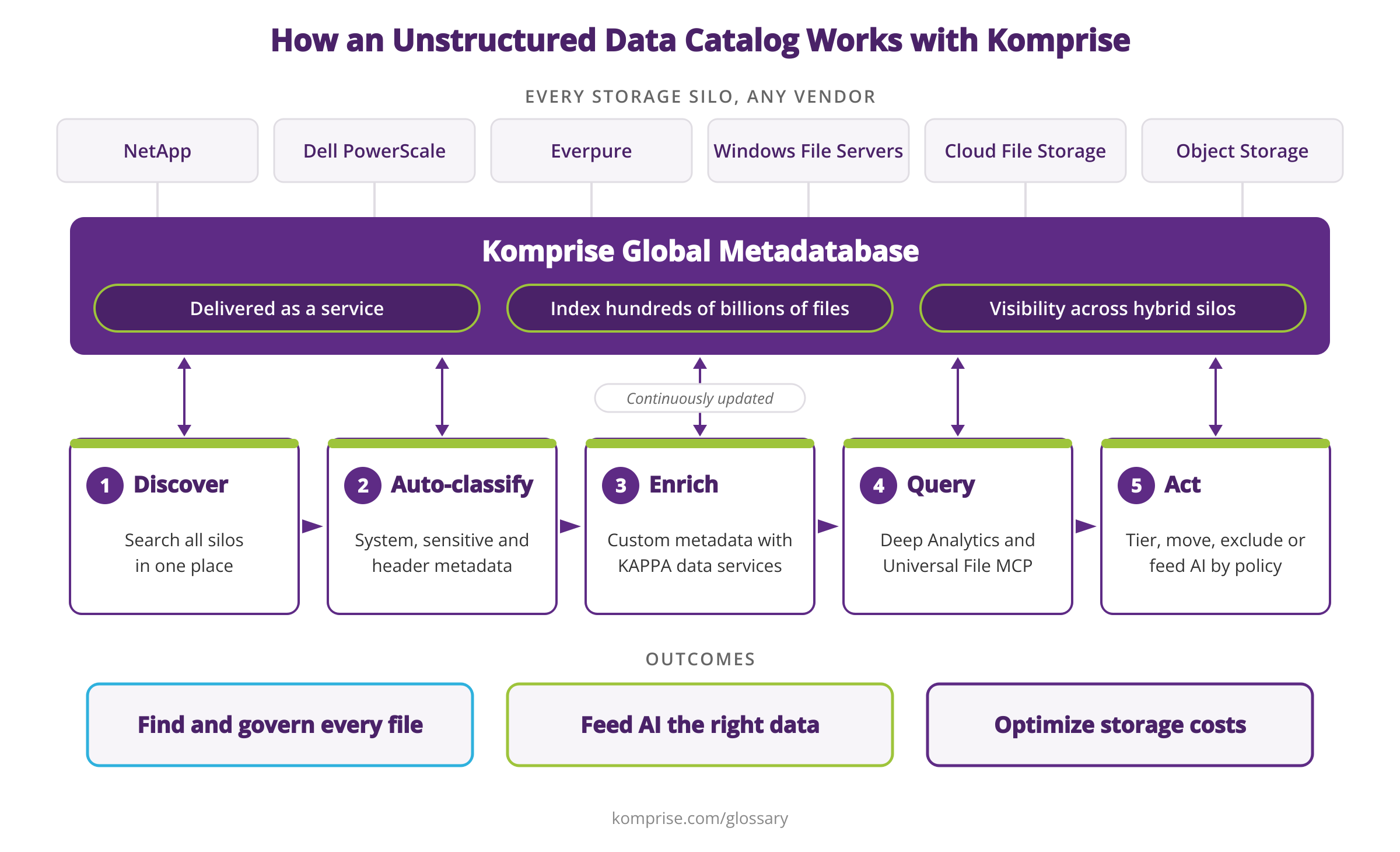
Komprise Intelligent Data Management is powered by the Global Metadatabase Service, a searchable, enriched, actionable index of every file on every storage and cloud. Three differences set it apart:
- Every storage silo, no lock-in. The Global Metadatabase indexes NAS, cloud and object storage from any vendor in one place, and the index is independent of the storage it covers. Data tiered with Transparent Move Technology stays in native format and stays indexed, with no rehydration, so teams switch storage vendors without losing visibility.
- Hundreds of billions of files indexed. Komprise indexes every file at enterprise scale rather than sampling, and the service scales to exabytes.
- No costly setup, clunky plugins or connectors. The Global Metadatabase is delivered as a fully managed service. There is no database to install, no infrastructure to manage and no agents on storage systems.
The catalog then works in five steps:
- Discover. Search across all data silos in one place.
- Auto-classify. Extract system, sensitive and header metadata.
- Enrich. Add any custom metadata with KAPPA data services, such as DICOM attributes in medical images or project codes in lab data.
- Query. Find just the right data with Deep Analytics in the UI and API, or in natural language through Komprise Universal File MCP. Transparent File Tables make file metadata queryable in lakehouses with access controls intact.
- Act. Tier, move, exclude or feed data to AI by policy, at scale, with Deep Analytics Actions, Smart Data Workflows and Komprise Intelligent AI Ingest.
Independent analysis backs the approach. In the DCIG Pulse for Unstructured Data Management, Komprise had full support on 23 capabilities, the most among 12 unstructured data management platforms, and was the only platform with full support for multi-cloud data movement, curated dataset assembly and cost savings reporting.
Traditional and Storage-Vendor Catalogs vs. an Unstructured Data Catalog
| Evaluation Criteria | Traditional Catalogs and Storage-Vendor Tools | Unstructured Data Catalog with Komprise |
|---|---|---|
| Built for | Tables, columns and BI assets, or one vendor’s arrays | Files and objects at enterprise scale, across every vendor |
| Storage coverage | Database and SaaS sources, or a single storage platform | NAS, cloud and object storage from any vendor in one Global Metadatabase |
| Scale | Thousands to millions of assets, or sampled scans | Hundreds of billions of files indexed |
| Setup | Connectors, plugins, agents or servers to deploy and maintain | Delivered as a fully managed service; no database to install and no agents on storage |
| Metadata captured | Schema, lineage and business glossary terms | System, header, sensitive and custom metadata, enriched with KAPPA data services |
| Freshness | Scheduled crawls or one-time scans | Continuous indexing as data changes |
| Tiered and archived data | Out of scope, or recalled before use | Stays indexed and searchable after tiering, with no rehydration |
| Lock-in | Index tied to a storage platform; rebuilt when vendors change | Index independent of storage; switch vendors without rebuilding visibility |
| Path to action | Documentation and stewardship tasks | Deep Analytics Actions and Smart Data Workflows tier, move, confine, exclude or feed data to AI by policy |
| AI access | Limited for file content | Universal File MCP for agents, Transparent File Tables for lakehouses, Komprise Intelligent AI Ingest for object storage |
Unstructured Data Catalog FAQs
What is an unstructured data catalog?
An unstructured data catalog is a searchable index of file and object data across an organization’s storage. It records each file’s location, owner, size, age, access history, type, sensitivity and custom tags, so teams can find, govern and act on unstructured data without opening files or knowing which system holds them.
How is an unstructured data catalog different from a data catalog?
A traditional data catalog documents structured assets such as tables, columns, dashboards and pipelines, using connectors to databases and SaaS applications. An unstructured data catalog indexes billions of files and objects across NAS, cloud and object storage, extracts metadata that files do not carry in a schema and stays current as files change. Many enterprises run both.
How is an unstructured data catalog different from a metadata catalog?
A metadata catalog is the repository that stores and organizes metadata. An unstructured data catalog is the full capability built on one for file and object data: discovery across silos, classification, enrichment, search, and the ability to act on results by policy.
Why can’t traditional data catalogs handle unstructured data?
They were built for a different scale and shape of data. Files number in the billions, carry no schema, change constantly and sit on storage from many vendors. Catalogs designed around database connectors and scheduled crawls cannot index that volume at full scale or keep it current.
What should I look for in an unstructured data catalog?
Look for coverage of every storage silo and vendor, full-scale indexing rather than sampling, system, header, sensitive and custom metadata, continuous updates, search for people and AI agents, a path from query to action, and independence from your storage vendor. Also ask what it takes to deploy: agents, plugins, connectors and self-managed databases add cost and upkeep.
Does an unstructured data catalog require agents or connectors on storage?
It depends on the product. Many catalogs and departmental tools rely on agents, plugins or per-source connectors that must be installed and maintained. The Komprise Global Metadatabase is delivered as a fully managed service with no database to install and no agents on storage systems.
Can one unstructured data catalog cover NetApp, Dell PowerScale and Everpure storage?
Yes, when the catalog is independent of storage. Komprise indexes file and object data across NetApp, Dell PowerScale, Everpure, Windows file servers and cloud and object storage in one Global Metadatabase. Storage-vendor data intelligence features are designed around their own platforms, so a mixed estate otherwise ends up with several partial views.
How does an unstructured data catalog support AI?
It finds the right data before anything moves. Teams query the catalog for the files a use case needs, exclude sensitive and redundant, obsolete and trivial (ROT) data and deliver only the curated set. With Komprise, AI agents query the catalog through Universal File MCP, which returns metadata first and scopes each response to the requesting user’s permissions. Komprise Intelligent AI Ingest delivers curated data to object storage with 2X faster data flows to AI.
How does Komprise deliver an unstructured data catalog?
Komprise delivers it through the Global Metadatabase Service in Komprise Intelligent Data Management. It indexes every file across every storage silo with no lock-in, scales to hundreds of billions of files and requires no costly setup, plugins or connectors. Teams discover, classify, enrich, query and act on data from that one index, from tiering cold data with Transparent Move Technology, which cuts storage costs 70% or more, to feeding the right data to AI.
Which layer of an AI data platform does an unstructured data catalog cover?
An unstructured data catalog is layer 2, metadata and discovery, in an AI data platform. It also feeds layer 3, classification and governance, and layer 4, enrichment and curation. Komprise operates at layers 2 through 4.
Does an unstructured data catalog replace tools like Microsoft Purview, Collibra or Alation?
No. Those platforms govern structured data, business glossaries and lineage. An unstructured data catalog covers the file and object data they were not built to index at scale. With Komprise, file metadata can be published as Apache Iceberg tables through Transparent File Tables, so lakehouse and governance teams work with file data alongside structured data.