Data Management Glossary
Tokenization
What Is Tokenization?
Tokenization is the process of breaking text, or other content, into tokens: the words, subwords, or characters that an AI model actually reads and generates. Before a large language model or embedding model can process a document, every piece of text has to be converted into tokens, numeric IDs drawn from the model’s vocabulary. Most current models, including GPT, Claude, and Llama, use subword tokenization algorithms such as Byte Pair Encoding (BPE), which build a vocabulary by iteratively merging the most frequent adjacent character pairs. That approach balances the small vocabulary of character-level tokenization against the unmanageable vocabulary size of pure word-level tokenization.
Tokenization sits between chunking and embedding in the AI data pipeline. A document is first split into chunks, then each chunk is tokenized, then the model converts those tokens into a vector embedding or uses them directly to generate a response. Token count, not word count and not file size, is what determines whether a chunk fits inside a model’s context window. Token count is also the unit AI providers use to price compute, which means tokenization is not just a technical step. It is a direct line item on the AI budget. (See AI Token.)
Why Tokenization Matters for Enterprise Unstructured Data
Tokenization behaves predictably on clean, plain-text input. Enterprise unstructured data is rarely clean or plain text. Most enterprise AI corpora are built from files, not from tidy training sets: PDFs with embedded images and scanned pages, DICOM medical images, engineering CAD drawings, genomics BAM files, emails with quoted reply chains, and decades of duplicate or superseded document versions. Every one of those formats tokenizes differently, and most of them tokenize badly when fed to a generic tokenizer without preparation. (See Garbage In, Garbage Out)
Gartner estimates that unstructured data is growing three times faster than structured data, at an annual rate of 55% to 65%. That growth compounds the tokenization problem directly: more files means more tokens, and if the files entering the pipeline are duplicate, outdated, or irrelevant, the organization is paying to tokenize, embed, and query noise rather than signal.
IDC forecasts that of the roughly 175 zettabytes of data expected to exist worldwide by 2025, only about 1.4 zettabytes, under 1%, will actually be touched by AI and cognitive systems. That is the industry-wide version of the enterprise tokenization problem: the vast majority of an organization’s data never reaches a tokenizer at all, and much of what does reach one arrives unfiltered, duplicated, and ungoverned.
Source: IDC, Data Age 2025 (sponsored by Seagate). Note this figure covers all data, not unstructured data alone.
In the Komprise 2026 State of Unstructured Data Management Report, 58% of IT and data storage leaders name classifying data for AI as their top technical challenge in unstructured data management, and 56% name classification and tagging as their top challenge in preparing data for AI specifically. Both numbers point at the same root cause tokenization exposes downstream: organizations do not know which files are worth tokenizing until after they have already paid to tokenize all of them.
The Tokenization Problem With Raw Enterprise File Data
Feeding raw, uncurated file shares directly into a tokenizer creates three compounding failures.
- Noise inflates token counts and degrades output quality. Forty conflicting versions of the same policy document do not just waste storage. Each version gets tokenized, embedded, and indexed separately, and at query time a retrieval system has no way to tell which version is authoritative. The AI system pays to process the noise and then reproduces it in the form of inconsistent or hallucinated answers.
- Proprietary formats break generic tokenizers. Standard text tokenizers assume readable text. They cannot meaningfully tokenize a DICOM header, a genomics BAM file, or an AutoCAD drawing without format-specific extraction first. Organizations that skip that step either lose high-value domain data entirely or feed a tokenizer garbled extraction artifacts that waste tokens and produce low-quality embeddings.
- Sensitive data gets tokenized before anyone checks for it. Once a file is tokenized and passed to an embedding model or an LLM API, its content, including any PII, protected health information, or regulated financial data it contains, has already left the organization’s control. Automated ingestion scripts that tokenize everything in a network share do not distinguish a project spec from a payroll file. Governance has to happen before tokenization, not after.
How Komprise Prepares Unstructured Data Before It Reaches a Tokenizer
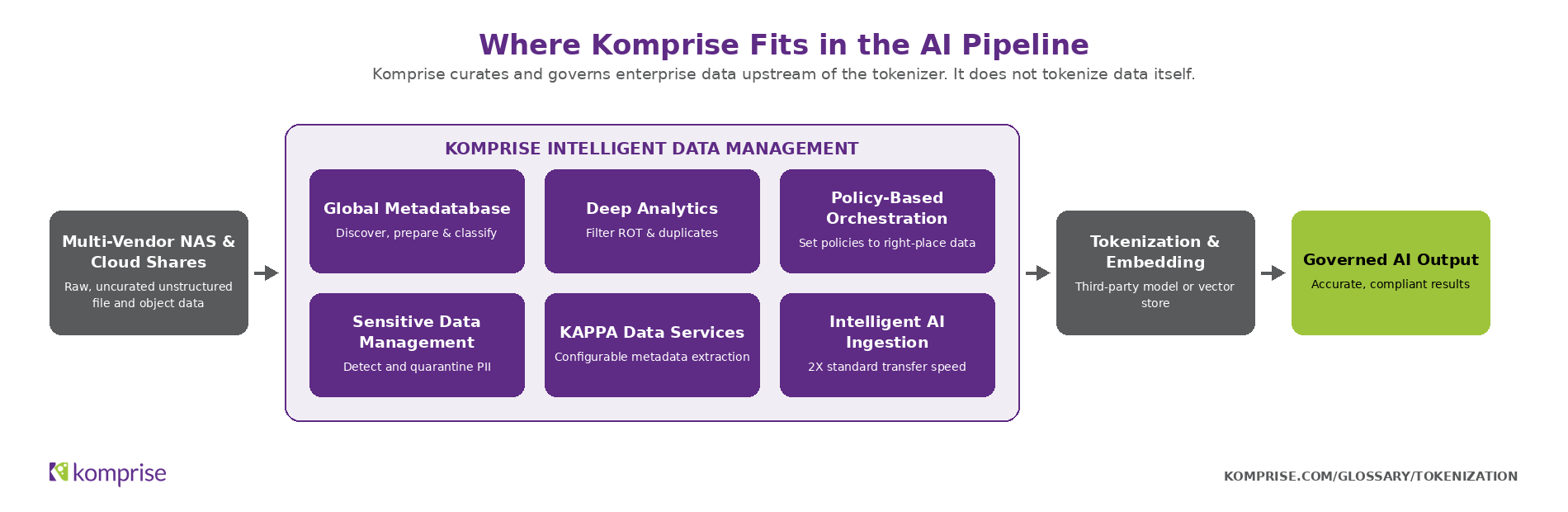
Komprise does not tokenize data. Tokenization happens inside the embedding model or the LLM itself. What Komprise does is control what reaches the tokenizer in the first place, so organizations pay to tokenize a curated, governed dataset instead of a raw file share.
Discover and filter before tokenization
The Global Metadatabase continuously indexes file and object data across NAS, cloud, and object storage without moving the underlying data. Deep Analytics queries that index to identify duplicate, stale, and orphaned files, so they can be filtered out before a single token is spent processing them.
Automate the filtering with policy, not a one-time cleanup
Komprise Intelligent Data Management lets organizations set ongoing data management policies on top of that index, for example confining certain data to specific storage or locations, or tiering data automatically by age and access pattern. That means the files eligible for tokenization are not a one-time export decision. As new files land and old ones age, the same policy engine that keeps cold data off expensive primary storage also keeps ungoverned or out-of-scope data off the path to a tokenizer.
Extract proprietary formats into usable content.
KAPPA data services extract domain-specific metadata and content from DICOM headers, genomics BAM files, engineering drawings, and other proprietary formats that generic tokenizers cannot read, and write those attributes back to the Global Metadatabase as searchable tags. Files delivered downstream arrive in a form a tokenizer and embedding model can actually use.
Quarantine sensitive content before it is ever tokenized
Smart Data Workflows scan file content for PII, protected health information, and other regulated data using built-in scanners plus custom regex, and exclude that content from the AI delivery path before tokenization can happen. Sensitive files never reach a third-party AI API in the first place.
Deliver only the curated subset
Komprise Intelligent AI Ingest passes the curated, governed dataset directly to the AI pipeline, whether that is a vector store, an LLM provider, or an internal RAG system, in native file format. Komprise Intelligent AI Ingest delivers data flows to AI pipelines 2X faster than unmanaged approaches, because the pipeline is moving a filtered dataset instead of a full file share.
Tokenization: Without Komprise vs. With Komprise
| Evaluation Criteria | Without Komprise | With Komprise |
|---|---|---|
| Token volume and cost | Duplicate, stale, and irrelevant files are tokenized along with everything else, inflating token counts and compute cost with no corresponding accuracy gain | Deep Analytics filters duplicate, outdated, and irrelevant files out of the corpus before tokenization, so organizations pay to tokenize only curated, high-value content |
| Proprietary file formats | Generic tokenizers cannot read DICOM, BAM, CAD, or ERP files; this data is either skipped entirely or tokenized as unusable extraction noise | KAPPA data services extract format-specific content and metadata so proprietary files arrive in a form a tokenizer can use |
| Sensitive data exposure | Automated ingestion scripts tokenize and forward whatever they are pointed at, including PII, PHI, and regulated financial data, with no review | Smart Data Workflows detect and quarantine sensitive content before any file reaches a tokenizer or third-party AI API |
| Context window efficiency | A meaningful share of every token budget is spent on duplicate or irrelevant content instead of the information a query actually needs | Curated, deduplicated files mean a higher proportion of every token budget represents unique, relevant content |
| Audit trail | No record of which files were tokenized, when, or whether governance review happened before ingestion | The Global Metadatabase maintains a queryable audit trail of every file curated, filtered, and delivered to the AI pipeline |
Tokenization Frequently Asked Questions
What is tokenization in AI?
Tokenization is the process of converting text into tokens, the numeric units a language model or embedding model actually processes. Most modern models use subword tokenization methods such as Byte Pair Encoding, which split text into pieces larger than a single character but smaller than a full word. Tokenization happens after a document has been chunked and before it is embedded or sent to a model for inference, and the resulting token count determines both context window usage and compute cost.
How is tokenization different from chunking?
Chunking splits a large document into smaller segments that fit within a model’s context window. Tokenization converts each of those segments, or any other piece of text, into the numeric tokens a model actually reads. Chunking operates at the document level; tokenization operates at the text level inside each chunk. A chunking strategy determines what content lands together, while tokenization determines how that content is represented to the model and how much it costs to process.
Why does tokenization affect AI accuracy?
Retrieval and generation quality depend on the tokens a model actually sees. If the corpus feeding the tokenizer contains duplicate, outdated, or conflicting versions of the same content, the model tokenizes and processes all of them as if they were equally valid, which increases the chance it retrieves or reproduces stale or contradictory information. Token-level noise from poor source data is one of the most direct, and most overlooked, causes of AI hallucination in enterprise deployments.
Why is tokenization expensive for enterprise unstructured data?
Enterprise file data is rarely clean text. Proprietary formats such as DICOM images, CAD drawings, and genomics files require format-specific extraction before they can be meaningfully tokenized. Duplicate and stale files get tokenized and billed as if they were unique, valuable content. Because AI providers price compute by token volume, an uncurated enterprise file share tokenizes into a far larger, far more expensive corpus than the actual unique, relevant content it contains.
How does Komprise reduce the token cost and risk of preparing unstructured data for AI?
Komprise operates upstream of tokenization rather than performing it. The Global Metadatabase and Deep Analytics identify and filter out duplicate, stale, and irrelevant files before they ever reach a tokenizer. KAPPA data services extract usable content from proprietary formats that generic tokenizers cannot read. Smart Data Workflows detect and quarantine PII and other regulated content before ingestion. Komprise Intelligent AI Ingest then delivers only the curated, governed dataset to the AI pipeline, so organizations tokenize and pay for a filtered, relevant corpus instead of a raw file share.
Which layer of the AI data platform does tokenization belong to?
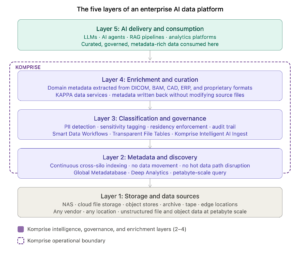
Tokenization itself happens in Layer 5, AI Delivery and Consumption, inside the embedding model or LLM. But whether tokenization produces a clean, cost-efficient corpus or an expensive, noisy one (see Noisy Data) is decided upstream, in Layers 2 through 4 of the AI Data Platform: Metadata and Discovery, Classification and Governance, and Enrichment and Curation. Komprise operates in those three layers, which is why the quality of what reaches the tokenizer, not the tokenizer itself, is where Komprise adds value.