Data Management Glossary
Data Intelligence
What Is Data Intelligence?
Data intelligence is the process of analyzing data to understand what it contains, how it is used, and how it can deliver business value. It combines data discovery, metadata analysis, classification, and usage insights to help organizations make better decisions about managing, protecting, and using their data.
Data intelligence solutions typically fall into two main categories based on the types of data they analyze:
Structured and Semi-Structured Data Intelligence
Platforms such as Databricks, Snowflake, and Informatica focus primarily on structured and semi-structured data intelligence. These platforms analyze data stored in:
- databases
- data warehouses
- data lakes
- analytics platforms
They provide insights into schemas, tables, pipelines, and analytics workloads to help organizations manage data used for business intelligence, analytics, and AI model training.
Storage-Based Data Intelligence
Primary storage vendors now market data intelligence, data discovery, and AI data preparation as part of their platforms. The capabilities sound similar to storage-independent data intelligence. The scope is not.
Storage-vendor data intelligence is designed to see the vendor’s own data estate. It indexes data on that vendor’s arrays first, often runs on that vendor’s hardware or appliances, and acts on data only inside that vendor’s ecosystem. Where cross-vendor discovery exists, it typically stops at visibility. Tiering, migration, and data placement decisions still route back to the vendor’s own storage.
Enterprises do not run on one vendor. Unstructured data spans NAS from several vendors, object storage, multiple clouds, and SaaS, and it makes up 80% to 90% of enterprise data. Data intelligence that sees one slice of that estate produces a partial answer, and partial answers lead to the wrong decisions about cost, risk, and AI.
The Lock-In Problem
Storage-vendor data intelligence deepens lock-in in four ways.
- The insight lives on the array. Analysis, tags, classifications, and policies are stored in the vendor platform. Replace or add a vendor, and that work stays behind.
- The actions keep data in place. Vendor tiering moves data within the vendor ecosystem, often in proprietary formats that are not readable as files outside the original system. That creates a rehydration penalty: data must return to primary storage before it can move to another platform.
- Insight requires more hardware. When data intelligence runs on vendor appliances or the latest platform generation, getting visibility becomes a reason to buy more of the same storage.
- The refresh decision is made for you. When the only data intelligence available comes from the incumbent vendor, the analysis that should inform a storage refresh is shaped by the company selling the refresh.
Storage-independent data intelligence reverses each of these. It indexes all storage equally, keeps the index and policies independent of any array, moves data at the file level in open formats with no rehydration penalty, and carries over intact when a storage vendor changes. The data belongs to the organization, not to the platform it happens to sit on today.
Data Intelligence for AI Agents
AI agents are becoming consumers of data intelligence. An agent asked to find every contract with a specific clause, or every imaging study from a given scanner, needs the same cross-storage index a storage architect uses. It also needs to respect file permissions. Storage-vendor data intelligence exposes only the vendor’s own estate to agents, so the agent’s view of enterprise data is as narrow as the platform it connects to.
Komprise Universal File MCP gives AI agents one Model Context Protocol interface to the Komprise Global Metadatabase, covering file and object data across every storage silo. Agents query metadata first and load full files only when needed. Every query runs under the requesting user’s existing access permissions, and agents reach tiered and archived data with no rehydration.
Why Data Intelligence Matters
Modern enterprises generate enormous volumes of data across data centers, cloud environments, and edge systems. Without data intelligence, organizations often struggle with:
- Data sprawl across multiple storage platforms
- Rising storage and infrastructure costs
- Limited visibility into sensitive or regulated data
- Difficulty finding high-quality datasets for analytics and AI
Data intelligence provides the visibility and insights needed to manage data strategically, ensuring that the right data is accessible, secure, and optimized for cost and performance.
Storage-Vendor Data Intelligence vs Storage-Independent Data Intelligence
| Evaluation Criteria | Storage-Vendor Data Intelligence | With Komprise |
|---|---|---|
| Scope of visibility | The vendor’s own data estate first | NAS, object, and cloud storage from any vendor, indexed equally |
| Where the insight lives | On the vendor platform; stays behind if you change vendors | In the Global Metadatabase, independent of any array |
| Hardware dependency | Often requires the vendor’s latest platform or appliances | Software; no storage purchase required to get visibility |
| Actions on data | Tiering and placement stay inside the vendor ecosystem | Tier, migrate, copy, delete, or deliver across any storage |
| Tiered data format | Often proprietary and not readable as files outside the array | Whole files in open formats, readable natively at the destination |
| Rehydration penalty | Data must return to primary storage before it can move | None |
| Storage refresh decisions | Analysis shaped by the vendor selling the refresh | Independent analysis of what is hot, cold, and worth buying for |
| AI data preparation | Limited to data on the vendor’s storage | Curated data sets from every silo, delivered to any AI stack |
| AI agent access | Agents see only the vendor’s own estate | Komprise Universal File MCP gives agents permission-aware access to files across all storage |
| After a vendor change | Rebuild the analysis and rehydrate tiered data | Index, tags, and policies carry over intact |
What Is Unstructured Data Intelligence?
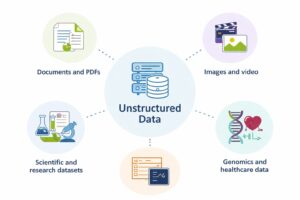 Unstructured data intelligence focuses on analyzing and understanding unstructured data, which represents the majority of enterprise data and includes:
- Documents and PDFs
- Images and video
- Scientific and research datasets
- Machine logs and application files
- Genomics and healthcare data
Much of this data resides on network-attached storage (NAS) systems and object storage platforms.
Unlike structured data stored in databases, unstructured data typically lacks defined schemas or consistent metadata. As a result, it is far more difficult to analyze, govern, and optimize without specialized technology.
Unstructured data intelligence platforms like Komprise Intelligent Data Management, analyze file metadata, file system activity, and content attributes to provide insights such as:
- Which files are actively used vs. inactive or “cold” data
- Where sensitive or regulated information is stored
- Which datasets are valuable for AI, analytics, or research
- Which data can be moved to lower-cost storage tiers
Because unstructured data accounts for 80–90% of enterprise data, gaining intelligence into this data is essential for modern data strategies.
Why Unstructured Data Intelligence Is Different
Managing unstructured data presents unique challenges that traditional data intelligence tools were not designed to address.
- Massive Scale: Unstructured datasets often contain billions of files and petabytes of storage spread across multiple systems.
- Distributed Storage Environments: Data may be stored across:
- NAS platforms
- object storage
- cloud file services
- research storage environments
- Vendor Silos: Storage systems only provide analytics within their own platform. If organizations rely on vendor-specific tools, they can only see data within that particular storage silo.
To truly understand and optimize unstructured data, organizations need a storage-agnostic approach to data intelligence that provides a unified view across all storage platforms.
A storage-agnostic model allows organizations to analyze data wherever it resides and take action across heterogeneous environments without vendor lock-in.
Unstructured Data Intelligence from Komprise
Komprise Intelligent Data Management provides powerful storage-agnostic unstructured data intelligence that enables organizations to analyze and manage file data across heterogeneous storage environments.
Komprise analyzes file data across NAS, object, and cloud storage platforms, providing insights into billions of files and petabytes of data without disrupting users or applications.

With Komprise, organizations can:
- Analyze file data at petabyte scale across NAS and object storage platforms
- Identify inactive data to optimize storage cost and capacity planning
- Discover and classify sensitive data for governance and compliance
- Create AI-ready datasets from valuable unstructured data
- Enable intelligent data tiering by moving cold data to lower-cost storage
Because Komprise operates independently of any specific storage vendor, organizations gain a unified view of unstructured data across their entire storage estate.
This storage-agnostic approach enables enterprises to unlock the value of unstructured data while optimizing cost, improving governance, and accelerating AI and analytics initiatives.

Data Intelligence FAQs
What is data intelligence?
Data intelligence is the practice of analyzing data and its metadata to understand what data exists, where it lives, who uses it, how it is changing, and what it is worth. It combines data discovery, metadata analysis, classification, and usage analytics so organizations make informed decisions about cost, risk, governance, and AI use.
What is unstructured data intelligence?
Unstructured data intelligence applies data intelligence to files and objects rather than database tables. Because unstructured data has no schema, it relies on file system metadata (size, age, owner, access time, file type), content-derived tags, and classification to reveal what the data is and how it should be managed. With KAPPA data services, the Global Metadatabase, and a high-performance scale out architecture, Komprise is uniquely positioned to deliver storage-agnostic unstructured data intelligence and orchestration for AI.
What is the difference between data intelligence and a data catalog?
A data catalog is an inventory that documents data assets and their meaning, typically for structured analytics. Data intelligence is broader: it adds usage patterns, growth trends, cost, sensitivity, and ownership, and it drives action such as tiering, migration, deletion, or delivery to AI.
How is storage-vendor data intelligence different from storage-independent data intelligence?
Storage-vendor data intelligence is built to see and act on the vendor’s own data estate, and its analysis, policies, and data movement stay inside that ecosystem. Storage-independent data intelligence indexes NAS, object, and cloud storage from any vendor in one place, acts on data across all of them, and keeps working when a storage vendor is added or replaced.
Does storage-vendor data intelligence create lock-in?
Yes. When analysis, classifications, and data management policies live on the array, and tiering keeps data in vendor-specific formats, every insight and every tiered file ties the organization more closely to that vendor. Changing vendors means rebuilding the analysis and rehydrating tiered data back to primary storage before it can move.
Why does data intelligence matter for AI?
AI projects fail on data that cannot be found, trusted, or governed. Gartner predicts that through 2026, organizations will abandon 60% of AI projects unsupported by AI-ready data. Data intelligence identifies which unstructured data is relevant, current, and safe to use before it enters a model or RAG pipeline, across every storage system, not one.
How does data intelligence reduce storage costs?
The right approach to data intelligence can reveal how much data is cold, duplicated, or orphaned. About 70% of unstructured data on primary storage is typically cold. With that visibility, IT tiers inactive data to lower-cost storage and sizes new purchases on active data only, which matters more with enterprise flash prices at record highs in 2026.
How does Komprise deliver data intelligence across multi-vendor storage?
Komprise indexes file and object metadata across NAS, object, and cloud storage from any vendor into the Komprise Global Metadatabase. Deep Analytics queries that index to find data by age, owner, type, tags, or content-derived attributes, and Deep Analytics Actions turn results into policies: tier with Transparent Move Technology, migrate with Elastic Data Migration, or curate and deliver to AI with Smart Data Workflows. The index and policies are independent of any storage vendor, and customers use them to reclaim 70%+ of primary capacity.
Which layer of the AI data platform does data intelligence belong to?
Data intelligence spans layer 2, Metadata and Discovery, and layer 3, Classification and Governance, of the five-layer AI data platform model. Komprise operates at layers 2 through 4. See the AI Data Platform glossary page for the full model.