Komprise Frequently Asked Questions
Getting Started with Komprise
Can I get a Komprise demo or assessment? How does that work?
Yes!
You can see for yourself how simple Komprise is to deploy and operate, and assess how much cold data is in your environment, and the cost savings of using Komprise to transparently tier and archive cold data to less expensive secondary cloud storage or object storage. You can also learn about Smart Data Workflows and how to deliver the right unstructured data to AI and analytics.
Schedule Now!
Where can I learn more about Komprise customer benefits?
We’re always looking to showcase quantifiable customer results. Be sure to check out our case studies on the website. Also subscribe to our LinkedIn newsletter and our YouTube channel.
Komprise Intelligent Data Management helps data-heavy enterprise IT organizations dramatically reduce storage costs while making unstructured data far more usable for the business. By continuously analyzing data across file, object, and SaaS environments, Komprise identifies cold, redundant, and low-value data (see ROT Data).
It automatically tiers this low-access data to the most cost-effective storage, often delivering 50–70% storage cost savings without forcing migrations or disrupting users. Using Transparent Move Technology™, applications and users continue to access files normally, even as data is optimized across tiers and locations.
At the same time, Komprise builds a Global Metadatabase across all unstructured data silos, giving IT operations a single, real-time view of what data exists, who owns it, how it’s used, and what it costs.
This enables IT teams to operate data as a shared service, with storage as a service (STaaS) and showback models that make departments accountable for their data footprint. With self-service tagging and search, business teams can easily find, classify, and request data for analytics, compliance, or AI. The result is lower infrastructure spend, stronger governance, and faster, more scalable delivery of data services across the enterprise.
What are the main Komprise use cases?
There are many possible unstructured data management use cases for Komprise Intelligent Data Management, including:
 Visibility:
Security:
Mobility:
- Data Tiering (patented TMT)
- Data Migration
- AI Ingestion
Can I point Komprise at my production storage? What impact will it have on users?
Yes, there will be no noticeable impact to users and applications when you point Komprise at your production storage and start analyzing it.
This is because Komprise uses an adaptive architecture. Komprise automatically throttles back as your primary storage and network resources are actively used, so that it runs non-intrusively in the background. Think of Komprise as a housekeeper of data. Just as a good housekeeper should never get in the way, Komprise too runs non-intrusively in the background. Learn more about Komprise Transparent Move Technology.
Where can I find Komprise documentation, support and training information?
Check out the guides, documentation, release notes, etc. on our customer portal.
To register for training or watch best practices videos, visit Komprise.com/KTP.
Where can I learn more about how Komprise customers manage unstructured data?
Komprise publishes detailed customer case studies across industries including healthcare, life sciences, financial services, engineering, and pharmaceuticals. For example, a global financial services leader that saved $550,000 and accelerated cloud migrations with storage-agnostic unstructured data management; an integrated healthcare system that saved $5M while avoiding vendor lock-in with Komprise cloud tiering; a pharmaceuticals manufacturer that reclaimed 2PB+ of primary NAS capacity with Komprise Intelligent Tiering; and a global engineering firm saving 50%+ annually with Komprise cloud tiering.
All case studies are available at komprise.com/type/case-study.

How is Komprise Different?
How is Komprise different from other data management solutions?
Gartner estimates that unstructured data now makes up 80% to 90% of all enterprise data and is growing at 55% to 65% annually, roughly three times the growth rate of structured data. Komprise was built from the ground up to solve today’s unstructured data management and data intelligence challenges, from analyzing and managing large scale environments to AI data preparation, metadata enrichment and AI ingestion.

Unlike legacy data management solutions that are not storage agnostic, disrupt performance and/or are costly and complex to deploy, Komprise is a modern scale-out solution. It deploys in minutes, requires no agents on the storage, scales to handle massive data without any central database or bottlenecks, and works with any NFS, SMB/CIFS and REST/S3 storage. (Komprise Architecture Overview)
How is Komprise different from storage tiering solutions?
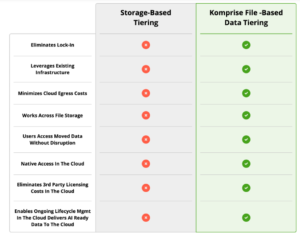
Storage array data tiering solutions move blocks to and from the cloud within their file system without allowing native access in the cloud to the moved data. Komprise is an open file-based solution that enables access to the data either from the cloud itself or from the source. It retains a 1-1 mapping between files and objects, and requires no additional array software licensing to work.
Komprise cloud tiering is not limited to any particular storage vendor and it works across any NFS, SMB/CIFS and REST/S3 storage. Why Komprise is the Easy, Fast, No Lock-In Path to the Cloud.
What is data rehydration and how does Komprise help me avoid it?
Data rehydration happens when you need to access data stored in cold or archive storage tiers, like AWS Glacier or Azure Archive, which triggers additional fees and latency as the data is moved (“rehydrated”) back to active storage.
This process often comes with what feels like a penalty: you pay to retrieve data you already own, wait hours (or longer), and may even have to rehydrate entire datasets just to access a small portion.
Komprise helps you avoid these costs with transparent data tiering (TMT). Files tiered by Komprise remain fully accessible in their native format and location, without the need for rehydration. You can search, filter, and move only the data you need, when you need it, without incurring unexpected cloud retrieval charges. This lets you save on storage while maintaining fast, direct access to data for users, AI, analytics, or compliance.
How is Komprise different from cloud gateways?
While Komprise moves data to the cloud and provides a file gateway to the moved data for transparent access from the source, Komprise does not incur the high retrieval costs and performance degradation of cloud gateways.
Cloud storage gateways incur high data retrieval costs and require dedicated hardware for hot data because they are using the cloud as primary storage. Komprise is intelligent, analytics-driven and uses the customer’s existing storage for the hot data and the cloud for inactive / cold data storage.
Komprise minimizes data retrieval costs, has no impact on the hot data path, requires no dedicated hardware, and works with existing storage without any rip and replace.
Komprise helps you leverage the cloud while minimizing data retrieval and transfer costs. You get the best of both worlds: lower cost of operations and greater flexibility but without high retrieval fees and unexpected transfer costs. Read the white paper: Storage-Based vs. Gateways vs. File-Based Cloud Tiering and the blog post Cloud Storage Gateways – A Good Choice for Cloud Migration?
What is the Komprise Data Experience (KDX)
The Komprise Data Experience (KDX) offers a storage-agnostic platform that delivers global visibility, scalable performance, and intelligent data workflows across hybrid environments. KDX benefits from a Global Metadatabase to index metadata across on-prem and cloud silos, providing fast, non-disruptive insights and automation via Smart Data Workflows.
Customers benefit by gaining visibility across data silos, lowering the cost of migrations, no rehydration penalties, and without sharing sensitive information with AI systems. This translates to optimized storage and backup costs, migration efficiency, risk mitigation, and AI-readiness, all while maintaining uninterrupted access for users and avoiding vendor lock-in.
Unstructured Data Management for AI
Why is Unstructured Data Preparation a Challenge for AI?
Unstructured data preparation is a major challenge for AI because most enterprise data (files, images, and logs) is scattered across silos, poorly tagged, and full of noise. Without visibility and context, AI models waste time and resources on irrelevant or incomplete data.
Komprise helps data-heavy enterprises overcome this by delivering global visibility, smart filtering, and automated workflows. IT and business users can identify, classify, and move only the right unstructured data to AI platforms, making AI initiatives faster, more cost-effective, and compliant.
How does Komprise prepare data for AI versus ETL?
Unstructured data, because of its size, varied formats and lack of context and structure, is not a good fit for ETL which works with structured and semi-structured data from databases and data warehouses. ETL also does not fit well with the non-linear processes for AI and requirements for AI data governance.
Komprise Smart Data Workflows delivers an automated process for unstructured data preparation and mobility.
- Global metadata indexing and curation: Identify relevant data before moving it, integrating with AI processors as needed for rapid content analysis and tagging.
- User tagging: Allow end users to tag their own data.
- Iterative enrichment: Store results as reusable metadata to avoid redundant processing.
- Built-in AI data governance: Automatically detect sensitive information and maintain comprehensive audit trails.
How does Komprise help ensure that the data fed into AI workflows is not only accessible but also high-quality, relevant, and governed?
Komprise doesn’t just move data, but curates it intelligently for AI using its Global Metadatabase Service. This service continuously indexes and analyzes unstructured data across file, object, and SaaS environments. It is a unified metadata layer that gives enterprises a real-time view of what data exists, where it lives, how it’s used, and how it’s classified.
Komprise uses this intelligence to filter out noise such as duplicates, stale files, and ROT data, enrich valuable content with searchable tags, and deliver only the right, high-value datasets to AI platforms. The result is higher-quality training and inference data, lower cloud and compute costs, and built-in governance and compliance.

How does Komprise help reduce rising storage and flash costs?
Komprise analyzes file usage across all storage and automatically moves inactive data off expensive flash and primary storage to lower-cost tiers such as object storage or cloud.
Business outcomes:
- Reduce storage costs by up to 70%+
- Extend the life of existing storage investments
- Avoid costly hardware upgrades driven by capacity growth
Learn more about how to stretch flash and primary storage capacity without penalty.
How does Komprise prepare unstructured data for AI initiatives?
Komprise identifies, indexes, and organizes unstructured data across the enterprise, enabling teams to find and curate the most relevant datasets for AI and analytics.
Business outcomes include:
- Faster AI project start times
- Higher-quality datasets for better model accuracy
- Reduced time spent searching for data
Learn more about unstructured data preparation for AI best practices.
How does Komprise reduce AI and data pipeline costs?
Komprise ensures that only relevant, high-value data is delivered to AI pipelines instead of processing entire datasets.
Business outcomes inlclude:
- Lower compute and GPU costs
- Reduced cloud storage and egress fees
- More efficient AI training and inference
Learn more about Komprise Smart Data Workflows for AI.
What makes Komprise different from traditional storage or archiving solutions?
Unlike traditional solutions, Komprise is:
- Storage-agnostic (works across vendors and cloud)
- Analytics-driven (decisions based on real data usage)
- Non-disruptive (no impact to users or applications)
Business outcomes:
- No vendor lock-in
- Faster deployment and time to value
- Continuous optimization without downtime
How does Komprise ensure transparent access to archived or tiered data?
Komprise uses Transparent Move Technology (TMT) to move data while preserving file access and paths, so users and applications can continue accessing files without disruption.
Business outcomes:
- No broken links or application changes
- No user retraining required
- Seamless access across storage tiers
How does Komprise help organizations manage unstructured data at scale?
Komprise creates a Global Metadatabase that provides a unified view of billions of files across NAS, object storage, and cloud environments.
Business outcomes:
- Full visibility into data across silos
- Faster search and discovery
- Better governance and compliance
How does Komprise support hybrid and multi-cloud environments?
Komprise works across on-prem, cloud, and hybrid storage environments, enabling organizations to manage and move data seamlessly between them.
Business outcomes:
- Flexibility to use the best storage for each workload
- Reduced cloud lock-in
- Optimized data placement across environments
How does Komprise help improve data quality for AI and analytics?
Komprise enables organizations to identify redundant, obsolete, and trivial (ROT) data and focus on high-value datasets.
Business outcomes:
- Improved data quality and relevance
- Better AI and analytics outcomes
- Reduced noise in datasets
Learn more about AI Data Workflows with Governance.
How quickly can organizations see value from Komprise?
Komprise is designed for rapid deployment and delivers insights quickly through analytics dashboards and reporting. Komprise not only provides unstructured data visibility across data silos, IT infrastructure and operations teams can set unstructured data management policies to right place datasets and deliver the right, high quality data to AI and and analytics services.
- Immediate visibility into storage usage and costs
- Quick identification of savings opportunities
- Fast ROI without complex infrastructure changes
Why is Komprise critical now given current market trends?
With rapid data growth, rising flash/NAND memory costs, and increasing AI adoption, organizations need a smarter way to manage unstructured data.
Komprise addresses these challenges by combining:
Business outcomes:
- Lower storage and cloud costs
- Faster, more efficient AI initiatives
- Better utilization of existing infrastructure
How does Komprise deliver unstructured data to Snowflake and Databricks?
Komprise Transparent File Tables expose the Global Metadatabase, the continuously updated index of file and object metadata across NAS and cloud storage, directly as Apache Iceberg tables that Databricks, Snowflake, and other Iceberg-compatible engines can query. No migration project and no copying of the underlying files is required. This means enterprise unstructured data becomes queryable inside the same data lakehouse environment used for structured data and AI workloads, without a separate ingestion pipeline for every new use case. Learn more.
Komprise Product Questions
Data Migration: What is the thread capacity of Komprise for short migration windows. Are there guidelines for data size per duration that you can provide from a guidance standpoint?
Komprise approaches unstructured data migration differently from other migration-only tools. The Komprise architecture has the unique ability to tune the data movement components, scale-up, dynamically increase the number of data movers, and scale-out.
Built into the Komprise architecture is the ability to automatically, and elastically, spread the migration workload across the data movers so no special tuning is generally required.
Where we find performance limitations is often in the storage systems, network architecture or the file system.
- Some storage systems have limited abilities and ports to scale IO.
- Some networks may have limited bandwidth or poor configuration.
- Some file systems may contain many empty directories or an excessive number of small files.
Fortunately, Komprise analysis capabilities can identify these issues before migrating to set proper customer expectations. In one simple console, Komprise combines multiple ways to easily manage large data migration jobs, scale dynamically and continue to add value after the migration job is complete.
Can Komprise manage sensitive data across storage?
Yes. Komprise Smart Data Workflows includes a built-in PII scanner to search for data such as national IDs, credit card numbers and email addresses. You can also search for text patterns using keyword and regular expressions (regex) search to find employee IDs, machine or instrument IDs, product or project codes, or ePHI data. Users can set workflows to run periodically, so Komprise automatically finds and acts on any new sensitive data for ongoing detection, tagging and mitigation, with full audit capabilities. Read more about Komprise Sensitive Data Management.
What is the Komprise approach for data classification?
Data classification is vital for managing unstructured data in the enterprise. It helps IT leaders optimize storage costs, manage data over its lifecycle and prepare data for AI with governance.
Komprise Intelligent Data Management with Deep Analytics analyzes metadata and allows IT to tag data automatically and by policy for improved search and segmentation. This creates a Google-like search experience for data across all storage from on-premises to the cloud.
What can Komprise Analysis tell you?
Komprise Analysis gives you deep visibility into enterprise unstructured data across files and object and all storage including in the cloud.
- You can see data volume, growth trends, hot vs. cold data, top users, file types, and directories.
- You can do cost modeling (FinOps) for tiering and migration scenarios, estimate total cost of ownership (TCO), and forecast data storage costs with interactive ROI projections.
- Komprise has a library of prebuilt reports such as showback, orphaned or duplicate data, and user audits that can be customized and scheduled to support governance, stakeholder communication and decision making.
How much storage can I realistically reclaim with Komprise?
Most organizations find that 60–80% of their unstructured data is inactive and eligible for tiering. Komprise identifies this data with analytics and enables you to reclaim significant primary storage capacity, often delaying or eliminating the need for new storage purchases.
What is the operational impact on my team to deploy and manage Komprise?
Komprise is designed to be low-touch. A software solution that does not sit in front of the hot data pathl, Komprise deploys quickly, runs non-intrusively, and automates ongoing data management through policies. Most teams can manage it without adding headcount, shifting effort from manual storage tasks to strategic data management.
Learn more about the Komprise architecture.
Will Komprise impact performance or production workloads?
No. Komprise operates out of band and is never in the hot data path. It analyzes and moves data without introducing latency or affecting application performance, ensuring production workloads remain unaffected.
How do I justify Komprise financially vs. just buying more storage?
Buying more storage increases costs linearly. Komprise reduces costs by:
- Reclaiming unused capacity
- Tiering cold data to lower-cost storage
- Reducing backup and cloud expenses
This typically results in a lower total cost of ownership (TCO) and extends the life of existing infrastructure, making it a more cost-efficient long-term strategy. Download the solution brief.
Komprise goes beyond storage cost optimization to deliver data intelligence, orchestration and powerful AI data preparation for unstructured data and with the Global Metadatabase, Smart Data Workflows, Sensitive Data Management, Intelligent AI Ingest, and Transparent File Tables for data lakehouse integration.
How does Komprise help me manage data growth without constant storage upgrades?
Komprise continuously analyzes data usage and automatically moves inactive data off primary storage. This prevents capacity from filling up with cold data, allowing you to manage ongoing growth without frequent hardware refresh cycles.
How does Komprise fit into my existing storage environment and tools?
Komprise is storage-agnostic and integrates with existing NAS, object, and cloud storage without requiring changes to your environment. It complements your current tools by adding analytics, automation, and global visibility across all unstructured data.
How does Komprise help me prepare for AI and data-driven initiatives without adding complexity?
Komprise classifies and indexes unstructured data across environments, making it easier to find and deliver relevant datasets for AI and analytics. Komprise reduces the need for custom data pipelines by enabling search, filtering, and workflow automation directly on your existing data.
What risks should I consider when deploying Komprise, and how are they mitigated?
Key concerns typically include data access, disruption, and control. Komprise mitigates these by:
- Preserving file access and paths during data movement
- Operating without impacting applications or users
- Providing full visibility and policy control over all actions
How does Komprise help in managing large datasets?
Komprise helps enterprises manage large unstructured datasets across hybrid storage environments through three integrated capabilities: visibility into what data exists and where it lives, mobility to move the right data to the right place without disruption, and value extraction that makes data AI-ready and actionable at petabyte scale.
Visibility
- The Komprise Global Metadatabase indexes and profiles all file and object data across NAS, cloud, and object storage silos without agents or changes to existing infrastructure, giving IT a unified view of the entire data estate. Komprise Analysis then uses that index to deliver cost modeling, growth trends, and reporting.
- The Global Metadatabase continuously maintains a structured, queryable representation of unstructured data across all storage environments, including file age, type, owner, access patterns, sensitivity status, and custom enriched metadata
- KAPPA data services extract custom, industry-specific metadata from proprietary file formats including DICOM medical images, genomics BAM files, and legal documents using a few lines of Python at petabyte scale, making previously opaque datasets searchable and governable
- Built-in analytics show cost projections, data growth trends, and savings opportunities across the full hybrid storage estate before any data is moved
Mobility
- Komprise Elastic Data Migration moves data up to 27x faster than standard tools across any combination of NAS, cloud, and object storage, with full metadata fidelity, permissions preservation, and MD5 checksum verification on every file
- The patented Komprise Transparent Move Technology tiers cold data to lower-cost storage transparently, so users and applications access files from their original location with no change to workflow and no rehydration penalty
- The patented Komprise Elastic Shares applies dynamic partitioning to keep all compute resources fully utilized during large-scale data processing, delivering near-linear speed-up across migrations, tiering jobs, metadata extraction, and AI ingestion workflows
- Komprise Smart Data Workflows automate end-to-end data movement policies across the full hybrid estate, moving data by file type, age, owner, project code, sensitivity status, or any custom metadata attribute
Value
- Komprise Intelligent AI Ingest curates and delivers only the right data to AI pipelines, filtering out 70%+ of unstructured data noise that degrades model accuracy and wastes GPU compute
- Smart Data Workflows connect the Global Metadatabase to any AI service, enabling governed, automated ingestion of precisely the right dataset for each AI use case without manual curation
- Komprise Sensitive Data Management detects PII, PHI, and IP across the full data estate and applies automated remediation by policy, ensuring only safe, governed data reaches AI tools and analytics platforms
- Enterprises using Komprise typically reduce storage, backup, and DR costs by 70%+ while simultaneously building the governed, indexed, classified data estate that AI initiatives require to produce accurate, trustworthy results
Komprise manages more than one exabyte of enterprise data across healthcare, life sciences, financial services, media, and public sector organizations, and integrates with on-premises and cloud file and object storage platforms without requiring changes to existing infrastructure or applications.


