Data Management Glossary
AI Data Classification
What Is AI Data Classification?
AI data classification is the use of machine learning, pattern recognition, and metadata analysis to automatically categorize unstructured data by type, sensitivity, and relevance, without requiring a person to manually review and tag each file. It sits at the classification and governance layer of an AI data platform, the layer that decides which data is sensitive, which is current, and which is worth sending to an AI pipeline at all. This is a narrower, AI-specific application of the broader discipline of data classification, and it goes further than basic file classification by content, since AI-driven approaches can detect patterns, sensitive content, and domain-specific attributes that static rules and manual tagging miss. For the underlying techniques (natural language processing, computer vision, clustering, and more) that make this possible, see Unstructured Data Classification.
How Automated Data Classification Works
Automated data classification depends on discovery happening first. Before anything can be classified, it has to be indexed: a continuously updated inventory of every file and object across every storage system, capturing standard metadata such as file type, size, age, owner, and last access time. Once that index exists, classification applies rules, pattern matching, and machine learning models against that metadata and, where needed, file content itself, to assign categories, sensitivity labels, and custom tags automatically. The results write back to the index as queryable metadata rather than as changes to the source files. This is fundamentally different from manual classification, where an employee or administrator reviews files and applies tags by hand, a process that cannot keep pace with the rate unstructured data is created at enterprise scale.
How AI Improves Data Classification
Rule-based classification alone struggles with unstructured data because rules built on file names, folder locations, or extensions miss content that does not fit a predefined pattern. AI-driven classification adds pattern recognition and content-aware detection on top of metadata rules, which is why the automated classification engine segment of the data classification market is projected to be the fastest-growing category, driven specifically by advances in AI, machine learning, and natural language processing that allow accurate, real-time classification without manual intervention.
Source: Data Classification Market Size, Share & 2034 Growth Trends Report, Emergen Research
In practice, this means an AI-driven classification engine can scan file content for sensitive data patterns using built-in scanners and regex rather than relying on someone remembering to tag a folder as confidential, and can extract domain-specific attributes from proprietary file formats, such as DICOM imaging headers or genomics BAM files, that a generic rules engine cannot parse at all.
Benefits of Automated Data Classification
Automated classification delivers several benefits that manual or purely rule-based approaches cannot match at enterprise scale. It classifies at the speed data is created rather than falling permanently behind, which matters because unstructured data repositories are growing at roughly 62% annually, a pace that leaves static, manually maintained classification schemes unable to keep up.
Source: Data Classification Market Size & Share Outlook to 2030, Mordor Intelligence,
It also applies classification criteria consistently across every file rather than depending on individual judgment, catches sensitive content that keyword or folder-based rules would miss, and produces the classified, governed dataset that AI and analytics pipelines need to avoid training on duplicate, stale, or unauthorized content. According to the Komprise 2026 State of Unstructured Data Management report, 58% of organizations cite data classification as their top data management challenge, which is largely a function of trying to solve a continuous, high-volume problem with manual or point-in-time methods.
Most enterprises do not have one storage system to classify, they have dozens: on-premises NAS from multiple vendors, several cloud object stores, and archival tiers, often accumulated through acquisitions or years of departmental purchasing decisions. Classification tools built into a single storage platform only see the data on that platform, which means an organization with five storage vendors ends up with five disconnected classification views and no way to ask a single question across all of them. Solving this requires a classification layer that sits above the storage infrastructure itself, indexing and classifying data by standard protocols regardless of which vendor or tier a file happens to live on, so that a single query can span the entire environment at once.
Choosing an AI Data Classification Solution for the Enterprise
Enterprise buyers evaluating data classification tools are generally choosing between three approaches: manual tagging, single-vendor tools built into one storage platform, and cross-silo AI-driven classification. The table below outlines what to evaluate and how Komprise addresses each requirement.
| Evaluation Criteria | Without Automated Cross-Silo Classification | With Komprise |
|---|---|---|
| Coverage across storage vendors | Classification is limited to whatever a single vendor’s native tool can see, leaving other silos unclassified | The Global Metadatabase indexes and classifies file and object metadata across every NAS, cloud, and object storage vendor from one interface |
| Content-aware sensitive data detection | Static rules based on file name or folder location miss sensitive content that does not match a predefined pattern | Smart Data Workflows scan file content using 68 built-in PII scanners plus custom regex to detect sensitive data automatically |
| Domain-specific file formats | Generic classification tools cannot parse proprietary formats like DICOM, BAM, or CAD files | KAPPA data services extract custom metadata from proprietary formats and write it back to the index without modifying source files |
| Deployment overhead | Agent-based tools require software installed on every system being classified | Komprise classifies without agents, reducing overhead and avoiding changes to production systems |
| Classification freshness | Point-in-time scans go stale as soon as new data is created | The Global Metadatabase updates continuously, so classification reflects the current state of the data estate |
| Connection to AI pipelines | Classification results sit in a separate system from the AI ingestion process, requiring manual handoff | A Deep Analytics query built on classification results becomes the direct data source for a Smart Data Workflow or AI ingestion job |
Read the white paper: Komprise Data Intelligence and Orchestration for AI – Solving the First Mile Gap for Unstructured Data and AI
AI Data Classification Frequently Asked Questions
What are the benefits of automated data classification?
Automated classification scales to match the pace unstructured data is actually created, applies criteria consistently instead of depending on individual judgment, and catches sensitive content that manual review or simple keyword rules would miss. It also produces the classified, governed dataset that AI pipelines need, which is increasingly the primary reason enterprises invest in it: 58% of organizations cite data classification as their top data management challenge, according to Komprise’s 2026 State of Unstructured Data Management report.
How does AI improve data classification compared to rule-based methods?
Rule-based classification depends on predefined patterns like file names or folder paths, which breaks down against real-world unstructured data that does not follow consistent naming conventions. AI-driven classification adds content-aware pattern recognition, allowing it to detect sensitive data and domain-specific attributes inside the file itself rather than inferring category from where the file happens to sit.
What should enterprises look for in a data classification tool?
Enterprises should evaluate whether a tool covers every storage vendor in the environment or only its own platform, whether it detects sensitive content by scanning actual file content rather than relying on file names, whether it can extract metadata from proprietary and domain-specific file formats, whether it requires agents installed on every system, and whether its output connects directly to AI and data governance workflows rather than sitting in a separate reporting tool.
Learn more about Komprise unstructured data classification for AI.
What software is used for unstructured data classification?
Unstructured data classification software generally falls into two categories: tools built into a single storage platform, which only classify data on that platform, and cross-silo platforms that index and classify file and object data across every storage vendor from one interface. Komprise Intelligent Data Management is built as the latter, using the Global Metadatabase to classify data across NAS, cloud, and object storage without requiring agents or a bulk migration first.
How do I choose a data classification solution?
Start by confirming whether the solution covers every storage system in the environment or only a subset, since siloed coverage recreates the same fragmented visibility problem classification is meant to solve. From there, evaluate content-aware sensitive data detection accuracy, support for any proprietary file formats specific to the industry, deployment overhead, and whether classification results connect directly to downstream AI and governance workflows rather than requiring a separate export step.
Can data be classified across multiple storage systems at once?
Yes, but only with a classification layer that sits above individual storage platforms rather than being built into one of them. Komprise connects to NAS, cloud, and object storage using standard protocols and classifies file and object metadata across all of them simultaneously through the Global Metadatabase, so a single query can span the entire storage estate instead of one vendor at a time.
Where does data classification fit in the AI data platform?
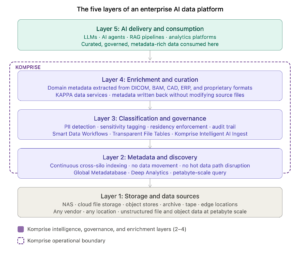
Data classification sits at Layer 3 of the AI data platform: Classification and Governance. It comes after Layer 2, Metadata and Discovery, which builds the index that classification runs against, and before Layer 4, Enrichment and Curation, which adds deeper business and domain context to whatever classification has identified as relevant. Komprise operates at this layer through Smart Data Workflows, which classify data by sensitivity and type and enforce governance policies automatically before anything reaches an AI pipeline. See AI Data Platform for how all five layers work together.