Data Management Glossary
Unstructured Data Metadata Management
What is Unstructured Data Metadata Management?
Unstructured Data Metadata Management is the process of discovering, organizing, enriching, governing, and acting on metadata for enterprise files and objects.
Unstructured data includes: documents, PDFs, images, video, audio, email exports, engineering drawings, medical imaging, genomic files, contracts, research datasets, archived records, etc. Because unstructured data does not live in rows and columns, metadata becomes the primary way to understand and manage it. Useful unstructured metadata may include:
- owner
- department
- file type
- size
- age
- last accessed date
- permissions
- sensitivity level
- project name
- storage tier
- business relevance
Why It Is More Important Now
It is estimated that 90% of the world’s data was generated in the last two years alone. In the space of 13 years, this figure has increased by an estimated 74x from just 2 zettabytes in 2010. The 120 zettabytes generated in 2023 are expected to increase by over 150% for 2025, hitting 181 zettabytes. (source)
According to IDC, 90% of the data created in the enterprise is unstructured. At the same time, organizations face pressure to:
- reduce storage and backup costs
- reclaim expensive flash capacity
- prepare data for AI
- reduce ransomware exposure
- simplify migrations
- improve governance
- operate across hybrid cloud and edge infrastructure
Without unstructured metadata management, enterprises often have billions of unknown files spread across many systems.
Why Point Tools Fall Short
Many organizations use separate tools for file search, storage reporting, migration, data classification, archive management, AI connectors, etc. This creates several problems:
No Unified Metadata Layer
Each tool builds its own index.
Repeated Scanning
Multiple tools repeatedly scan the same storage.
Fragmented Policies
Retention, security, and lifecycle rules are inconsistent.
Slow Projects / Delayed Results
Teams manually export data between products.
Higher Costs
Licensing and operations costs rise with each tool added.
Inaccurate AI Results and AI Failures
This is becoming a major issue. According to Gartner, 50% of GenAI projects fail.
How Komprise Solves Unstructured Data Metadata Management
Komprise provides one analytics-driven unstructured data management platform for metadata intelligence, action, and optimization.
Global Metadatabase
A centralized metadata intelligence layer across NAS, object, and cloud storage gives enterprises one view of distributed unstructured data. Learn More.
Deep Analytics
Understand: growth trends, inactive data, duplicate content, ownership patterns, storage hot spots, cost drivers. Finding just the right data across billions of files. Search and find data that fits your specific criteria across storage and use the results in a data management policy and enrich metadata with tagging.
Metadata Enrichment
Add business context using custom extraction and automation, including industry-specific metadata such as:
- DICOM headers
- research identifiers
- customer IDs
- project numbers
- grant codes
- contract dates
Learn more about KAPPA data services.
Smart Data Workflows
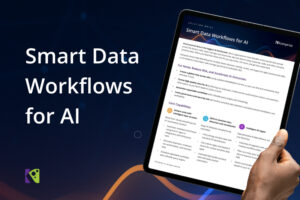 Use metadata to automate:
- AI data curation
- AI data ingestion
- data lifecycle management (migration, archiving, etc.)
- data tagging for AI
- compliance routing
- departmental exports
Read the solution brief: Smart Data Workflows for AI
Sensitive Data Management
Detect and govern confidential content hidden inside file data. Learn more.
Flash Stretch Optimization
Use metadata insights to identify cold data on expensive flash storage and reclaim primary capacity without disrupting users. Learn more.
Transparent Tiering
Move cold data to lower-cost storage while preserving normal file access. Learn more.
AI Benefits of Unstructured Data Metadata Management
Metadata management helps AI initiatives by enabling:
Better RAG Pipelines: Use owner, date, department, and sensitivity metadata to improve search relevance.
Lower AI Costs: Avoid indexing and trying to ingest billions of unnecessary files.
Better AI Results: Quickly identify the right data sets and ensure AI accuracy.
Higher Trust: Use governed and current data sources.
Repeatable Workflows: Automate ingestion for future AI use cases. Learn more.
Why Komprise Is Different Than Point Solutions
Most metadata intelligence tools analyze and catalog structured data, not unstructured data.
Storage-centric tools only optimize one vendor environment.
Many AI tools assume the data is already clean and ready.
Komprise connects all three unstructured data needs in one platform:
- metadata intelligence
- metadata governance
- storage cost optimization
- AI preparation
- lifecycle management and automation
- hybrid data mobility
This allows organizations to solve multiple priorities with one, unified platform. Learn more about the Komprise architecture.
What is the difference between metadata management and file search?
File search helps users find content. Metadata management helps IT and business teams understand, govern, optimize, and operationalize data at scale.
Why is unstructured metadata management critical for AI?
Most enterprise AI depends on files and objects. Metadata makes those assets searchable, filterable, trusted, and usable.
Can metadata management lower NAS costs?
Yes. It identifies inactive data that can be tiered or archived, reducing primary storage growth and backup costs.
How does metadata management help stretch data storage capacity?
It reveals cold data occupying expensive flash storage so organizations can reclaim capacity and delay refresh spending.
Why not use separate point tools?
Separate tools often create duplicate scans, inconsistent policies, and manual workflows. A unified platform is simpler and more scalable.
Can unstructured metadata management reduce ransomware risk?
Yes. Reducing stale data sprawl and moving inactive data off primary storage can reduce exposure and simplify recovery scope. Learn more.
How does Komprise help regulated industries?
Komprise supports governance, retention, sensitive data detection, and controlled AI preparation across hybrid environments.
Is metadata management only for very large enterprises?
No. Any organization struggling with file growth, AI readiness, or storage cost pressure can benefit.
What makes Komprise unique?
Komprise combines a Global Metadatabase, automation, transparent tiering, migration, sensitive data management, AI ingestion, and flash capacity optimization in one platform.