Data Management Glossary
BlueXP (now NetApp Console)
What is NetApp BlueXP?
NetApp BlueXP (now called NetApp Console) is a management console designed to unify a disparate set of hybrid cloud NetApp products. The BlueXP interface provides a set of data management capabilities, that are licensed separately. The capabilities are:
- Data Tiering
- Copy/Sync
- Data Classification / PII
- OnTap to S3 Backup

What are some BlueXP alternatives?
BlueXP was designed by NetApp to provide a control plane for managing multiple NetApp tools. It is important to note, however, that BlueXP is NetApp storage-centric and has key limitations and restrictions that impact the applicability and simplicity of the solution. With the huge influx of unstructured data, customers want a centralized solution they can use across their storage platforms and in a multi-cloud and hybrid environment. It is imperative that broader unstructured data management requirements and the benefits of a storage-agnostic solution are considered before embarking on this effort.
Read the 5 requirements of unified data control plane for unstructured data management.
NetApp BlueXP Tiering
Data tiering is one component of BlueXP. According to NetApp, BlueXP is able to:
- Tier to cloud object
- Set flexible policies
- Reduce data storage costs
 First of all, it’s important to understand the differences and benefits of file-level tiering vs block-level tiering used by NetApp. Read the white paper. Secondly, it’s important to understand the tiering requirements. As Komprise co-founder and CEO Kumar Goswami wrote in this post, block-level tiering has benefits for tiering snapshots, certain log files and other data that is proprietary and deleted in short order. But block-level tiering has significant shortcomings, including:
- Limited policies result in more data accessed, increasing increasing cloud egress costs.
- Defragmentation of blocks leads to higher cloud storage costs.
- Sequential reads lead to higher cloud costs and lower performance.
- Data tiered to the cloud cannot be accessed from the cloud without licensing a storage file system.
- Tiering blocks impacts performance of the storage array.
- Data access results in re–hydration, thereby reducing potential cost savings.
- Block tiering does not reduce backup costs or the backup window.
- Block tiering locks you into your storage vendor and requires rehydration of all data you tier when switching to a new system. Read: 5 Mistakes to Avoid in a Data Storage Refresh.
- Proprietary lock-in and cloud file storage licensing costs.
How is Komprise Tiering Different than NetApp BlueXP?
Komprise is a storage-agnostic control plane across all your hybrid data estate that optimizes data storage costs and puts enterprise IT organizations in control of their data at all times with no lock-in. Komprise uses a superior file-based tiering solution. Below are questions you should ask and a table comparing NetApp BlueXP functionality versus Komprise Intelligent Data Management:
- Can you tier data that is more than 183 days old?
- Can you tier directly to Amazon S3 IA or Azure Blob Cool?
- Do you require a cooling period on rehydration?
- Do you have flexible data management policies at the share, directory and file levels?
- Can you access tiered files without additional licensing?
- Can you migrate data or move to another system without rehydrating everything you’ve tiered?
- Do you tier files or blocks?
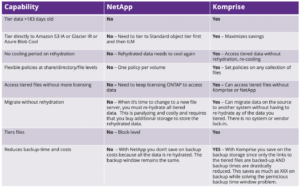
Learn more about Komprise Data Management for NetApp.
Webinar: NetApp + Komprise – Right Data, Right Place, Right Time
Watch a demo of Komprise Storage Insights.
What happened to NetApp BlueXP?
NetApp renamed BlueXP to NetApp Console in 2025 as part of a broader effort to unify management of NetApp storage and data services across on-premises and cloud environments. Several BlueXP services were also renamed, including BlueXP Tiering to NetApp Cloud Tiering.
How does NetApp Console differ from Komprise?
NetApp Console is primarily a NetApp-centric management platform for administering NetApp infrastructure and related services. Komprise is a storage-agnostic unstructured data management platform that works across NetApp, Dell, HPE, AWS, Azure, and other environments to optimize costs, mobilize data, govern file data, and prepare unstructured data for AI.
This distinction matters for enterprises with multi-vendor storage environments or those seeking to avoid vendor lock-in.
What are the advantages of a storage-agnostic solution like Komprise?
| Capability | NetApp NetApp Console | Komprise Intelligent Data Management |
|---|---|---|
| Primary focus | NetApp infrastructure management | Unstructured data management across vendors |
| Multi-vendor support | Limited / NetApp-led ecosystem | Yes |
| File data mobility | NetApp-centric tools | Cross-platform tiering, migration, lifecycle management |
| Cost optimization | NetApp storage optimization | Any NAS, object, cloud storage |
| AI data readiness | Selected services | Broad unstructured data discovery & curation |
| Vendor lock-in risk | High | None |
Why might enterprises choose Komprise alongside NetApp storage?
Many organizations use NetApp storage but also operate mixed environments with other NAS vendors, cloud object storage, and SaaS data sources. Komprise can complement NetApp by providing cross-platform tiering, migrations, showback reporting, sensitive data workflows, and unified visibility into unstructured data across the full estate.
Can Komprise help optimize NetApp storage costs?
Yes. Komprise can identify inactive file data on NetApp systems and transparently tier it to lower-cost object or cloud storage while preserving user access. This can help delay hardware upgrades, reclaim premium flash capacity, and reduce backup and DR costs.
Which is better for AI data management: NetApp Console or Komprise?
If your goal is managing NetApp infrastructure, NetApp Console is relevant. If your goal is preparing unstructured enterprise data across multiple environments for AI, analytics, and RAG pipelines, Komprise provides broader cross-platform data visibility, curation, governance, and orchestration.
What is Unstructured Data Management?
Unstructured data management has emerged as a new category that encompasses elements of data classification, mobility, governance, and cost optimization. While data storage and backup vendors each have some elements of data management included by design, they are primarily focused on optimizing their own devices and deployments, not providing comprehensive data visibility, mobility and value across heterogenous environments.
GigaOm notes in their 2024 Unstructured Data Management Radar Report: “As data ecosystems flourish, sophisticated unstructured data management (UDM) tools are emerging, poised to unlock the vast potential of dormant data and propel organizations into a data-driven future.” The report also advises: “Strategic deployment of UDM solutions grants organizations full visibility into their data, informing the development of cost-effective roadmaps that maximize ROI on data storage.”
- Data storage management services – “By 2027, at least 40 percent of organizations will deploy data storage management solutions for classification, insights, and optimization, up from 15 percent in early 2023.”
- Hybrid cloud file data services – “By 2027, 60 percent of infrastructure and operations leaders will implement hybrid cloud file deployments, up from 20 percent in early 2023. This will consolidate unstructured data to a single copy, enabling centralized management around the protection and security of the underlying data, thereby simplifying operations while consolidating use cases. Typical outcomes include cost optimization to align the cost of the storage with the value of the data; data governance to ensure sensitive data has the right protection and retention policies applied; data security to enable the right level of permission and access level controls; and enhanced analytics workflows that leverage data classification and optional tag the data with custom metadata.”
Understand the benefits of a storage-agnostic unstructured data management to deliver a unified data control plane for visibility and mobility across storage silos.
What are the Five Key Requirements of a Unified Data Control Plane for Unstructured Data Management?
Unstructured data management requires a cohesive product vision, product architecture and long-term commitment from a vendor to deliver enterprise scale. At Komprise, we believe that data management functionality is a layer independent of storage. This means it is possible to manage data holistically across vendors and across technologies, be they files or objects. This approach has allowed Komprise to create a data management solution that is vendor agnostic and integrates tightly with on-premises and cloud storage to create a hybrid data management platform, without lock-in.
Here are five requirements you must ensure are in place if you are looking for a modern approach to unstructured data visibility, mobility
1. Ease of Set Up and Administration
2. Agentless Architecture
3. Visibility + Mobility
4. Native Data Access without Vendor Lock-In
5. Unlock Data Value
