Welcome to Office Hours, a new monthly live demo series from Komprise. Each session puts Benjamin Henry, Field CTO, Komprise, inside the product, taking live questions instead of just walking through slides. The first session covered intelligent data tiering.
The Pain: Primary Storage Is Getting Brutally Expensive
Gartner projects combined DRAM and SSD prices will rise 130% by the end of 2026, as AI infrastructure investment pulls fab capacity away from everything else, per its own February 2026 memory pricing report.
- TrendForce’s own numbers are just as stark: 1Q26 conventional DRAM contract prices up 90% to 95% quarter over quarter, enterprise SSD up 53% to 58%, a new quarterly record.
- Hard drives are not a fallback either. Western Digital’s CEO told investors the company is sold out of hard drive capacity for all of 2026, with agreements already locked through 2027 and, for one customer, 2028, according to Tom’s Hardware.
- None of it gets solved by buying your way out; managing your data differently by regularly cleaning it out and right-placing it is the answer.
Komprise Intelligent Tiering is based on Transparent Move Technology (TMT), a patented innovation which moves entire files from the data storage, snapshot, backup and disaster recovery footprints while your users continue to see and access the tiered files without any change to your application processes or user behavior.
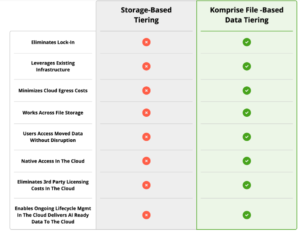
Unlike storage tiering which is typically offered by the storage vendor and causes blocks of files controlled by the storage filesystem to be placed in the cloud or archive tier, Komprise tiering operates at the file level and transparently offloads the entire file to the destination while leaving behind a link that looks and behaves like the file itself.
Step One: See All Your Data
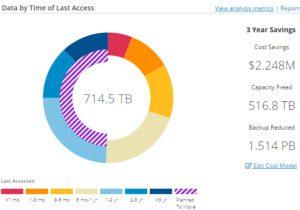 You cannot tier data you cannot see. The Komprise Plan page opens on the “data donut,” a heatmap of your entire storage estate, aggregated across every vendor and protocol, not just one array.
- Add storage once, at the cluster level. Point Komprise at your storage (such as Dell PowerScale Isilon) cluster management IP and credentials, and it auto-discovers every access zone and share underneath.
- Segment hot and cold on your terms. Default buckets are 1 month, 3 months, 6 months, and 1 year, but any admin can reset them to 5 or 10 years in Global Settings under Plan.
- Drill into one share or owner. In the demo, a single 274 TB marketing share showed the bulk sitting cold, with file count, size, and age available on hover.
- Get surgical in Deep Analytics. Filter by storage, share, subfolder, file type, name pattern, or access date. Save the query as public or private and export to CSV.
Step Two: Tier With Policy
Tiering runs on Transparent Move Technology (TMT). Build a plan (move anything untouched a year or more from a marketing share into an S3 folder), activate it, and the moved data shows up as a solid slice in the donut.
- Files leave dynamic links behind, not gaps. Users open the link exactly like the original file. The link type adapts to the platform; on Dell PowerScale (Isilon) it becomes a symbolic-link shortcut, with no application code changes.
- Set your own recall threshold. By default, a file streams back on access without pulling to primary storage unless opened five times in 15 days. Tune that to one access in a day, or three in two, as preferences dictate.
- Bulk-recall an entire project. An admin restores a whole share or subdirectory in one workflow, not file by file.
- Data lands in native format, no proprietary wrapper. A DICOM image or PDF in the S3 bucket is readable directly by cloud-native tools, and folder structure carries over as object prefixes.
- Migrate the links, not the files. Moving from Dell PowerScale (Isilon) to ONTAP later converts the link type in place, with no rehydration, no egress bill.
- Ransomware does not touch tiered data. If primary storage gets encrypted, Komprise can walk the object store and rebuild the links, since the data never lived on the attacked system.
Step Three: Put a Dollar Figure on It
Every donut slice ties to a cost model you define, per gigabyte, per month, across every storage type. That model feeds three reports: Orphan Data (in the demo, three years of carrying cost for data tied to deleted user accounts came to $160,000), Duplicate data (works across every vendor, and you define “duplicate” by name, extension, or timestamp), and a scheduled Showback report that automatically emails stakeholders total cost, cost after tiering, and savings by owner.
Why Tiering With Komprise: Avoid Getting Locked-In
Native tiering tools live inside one vendor’s array and lock you in. Komprise spans every vendor and protocol in the estate and prevents rehydration if you want to move tiered data to a new platform later. Unstructured data is growing 20% to 60% year over year by industry. Typically, 70% of enterprise unstructured data sits inactive on primary storage anyway, at primary storage prices. Organizations tiering it off primary storage have saved between $500,000 to $4 million a year on storage and backup with Komprise file-based hybrid tiering.
Pfizer’s case study shows the pattern in production: 75% saved on storage by continuously tiering cold data to Amazon S3, with zero disruption to users or applications.
That is the logic behind the Komprise Flash Stretch, an enterprise IT assessment that models how much primary capacity your own environment can free up and what it is worth in dollars, before you commit to a hardware refresh. It also means you are not tiering into a corner. Storage tiering keeps your cold data inside one vendor’s array, so a future refresh means migrating or re-architecting how that data moves. Komprise tiering is vendor-agnostic, so switching storage platforms later does not mean starting over. With DRAM and SSD prices still climbing, the fastest capacity you can add this year may be the capacity you already own and have not yet tiered.
Key Takeaways
- Cold data ratios of 70%+ are common. Find yours before buying more flash.
- Set cold thresholds, cost models, and recall rules to match your own compliance and backup retention policies, not the defaults.
- Dynamic links mean zero application rework and zero rehydration penalty at migration time.
- Komprise Reports turn tiering into a budget conversation backed by dollar figures, not a percentage slide.
Watch all of the recordings & register for the next live session at komprise.com/office-hours.
Read more Office Hours blog posts: