Deriving value from enterprise unstructured data for AI is a top priority. Yet many organizations struggle with curating this data, making it accessible and secure, and helping users find what they need without ballooning AI budgets.
 Komprise Universal File MCP, announced today, is a single interface for AI agents and LLMs to query across enterprise file storage, NAS, cloud, and unstructured data silos. It right-sizes responses by progressively delivering to the AI just the right information on just the right unstructured data, enriched with context and governed by user-specific access permissions. Now, any authenticated user can ask questions, and, where permitted, trigger real actions on enterprise data in plain language, through the AI tool they already use (Claude, ChatGPT, Gemini, or any other MCP-compatible assistant), and get back governed, trustworthy answers. Komprise Universal File MCP connects that conversation to our AI and analytics capabilities including Deep Analytics, Smart Data Workflows, KAPPA data services, and Transparent File Tables.
Komprise COO Krishna Subramanian breaks down this seminal new offering and why it matters now.
Why is this important for enterprise IT customers?
Krishna: Many enterprise vendors have published MCP interfaces in the past year to connect internal data with everyday AI tools, but now, this is causing MCP bloat. AI is overloaded with multiple tool definitions, resulting in lower accuracy, slow performance and higher costs rather than a productivity boost.
Connecting unstructured data to AI makes matters more complex, as this can be millions to billions of files across disparate hybrid storage. Most of this data is dark and unclassified, leading to a common risk of sending AI too much of the wrong data, which also drives up token costs. McKinsey’s Enterprise AI FinOps Survey reveals that a staggering 60% of agentic AI computing costs are consumed entirely by “response refinement,” which is the behind-the-scenes token loops where sub-agents critique and format data before presenting a final answer.
Data readiness is a commonly cited thorn for enterprise IT leaders tasked with delivering value from AI. Ad hoc scanning of all data isn’t useful nor safe, without preprocessing and proper governance. Many organizations are struggling to discover and understand petabytes of unstructured data across storage silos so they can leverage it effectively for AI, and within budgets.
While MCP connections are valuable for quickly surfacing data for a user’s query, they haven’t tackled the data readiness problem nor high token costs.
According to Gartner®: “Instead of merely providing access to raw data via APIs, MCP servers are evolving to dynamically aggregate, interpret, and serve contextually enriched data to reasoning models and third-party AI orchestrators.”
[Gartner Report, Playbook for Establishing an Enterprise Context Layer, By Christopher Long, Afraz Jaffri, etc., July 2026. Gartner is a trademark of Gartner, Inc. and/or its affiliates.]
Is this a new product or a new feature?
Krishna: It is a new product which brings together Deep Analytics, Smart Data Workflows, KAPPA data services, Transparent File Tables, and the new MCP interface into a single, purpose-built way for far more people across the enterprise to access, analyze, and act on unstructured data that has historically been out of reach.
Who is this for?
Krishna: Any enterprise user with access to enterprise unstructured data, not just IT and data specialists, can use Komprise Universal File MCP. Examples include researchers, compliance and legal teams, data engineering teams, and business analysts, who are subject to the same access controls that already govern their Komprise permissions today.
What’s different about this versus what Komprise already had?
Krishna: Komprise Universal File MCP allows new users, not just Komprise users such as IT and data specialists, to access, analyze, and act on the unstructured data they are authorized to see. That data has historically been scattered across the enterprise and locked in disparate NAS and object stores, reachable only by the small group of people who knew how to query it directly. This product changes who can reach it and allows them to do things like export metadata into an Apache Iceberg table for analysis in a data lakehouse or feed query results into a Smart Data Workflow that confines or deletes ex-employee files or clinical records of deceased patients after the retention deadline has passed.
What are some example use cases?
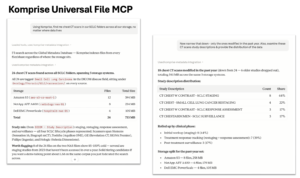
- A data analyst at a pharmaceutical company wishes to summarize the key outcomes from documents on substrate analysis authored by two scientists in the R&D organization. The analyst launches a query looking for “substrate” in file path or in the document title in Word or PDF documents with file owner or author being the names of the authors, and over the last 12 months only. Komprise MCP, powered by the Komprise Global Metadatabase, surfaces the requested files in the AI chat window for review and the user submits a task to develop a report and executive summary based on the data.
- A clinician asks their LLM to find pathology images related to certain lung studies in certain time ranges. The LLM uses Komprise MCP to run a query that filters the data based on system metadata, KAPPA-enriched DICOM metadata, user permissions and contextual knowledge. The resulting data set is then ingested to a Pathology AI application for analysis via Smart Data Workflows.
- An IT storage administrator uses the Komprise MCP to ask a series of questions about data to inform data lifecycle management plans for the coming quarter, such as: How much data have users in the Research department added over the past year? How much data is in Project X and show me a distribution by who created that data and its age? Where are we most likely to run out of space in the next six months?
- A compliance team preparing for an audit asks their AI assistant to locate every file across the enterprise’s hybrid storage that may contain a specific type of sensitive record and then confine the matches for review, all as a single conversational request instead of a multi-step manual process spanning several storage systems.
- A data engineering team can ask their AI assistant for a governed data set to use in a Databricks or Snowflake pipeline. Komprise MCP identifies the matching files and exposes them as a queryable Iceberg table through Transparent File Tables. This allows the lakehouse to query the data natively without moving or copying any files.
Does Komprise Universal File MCP replace Deep Analytics or the existing Komprise interface?
Krishna: No. Deep Analytics and the existing Komprise interfaces remain available and are unchanged. Komprise Universal File MCP adds a conversational and agentic way to reach the same underlying Deep Analytics, Smart Data Workflows, KAPPA data services, and Transparent File Tables.
Is this just a chat feature, or can AI agents act autonomously?
Krishna: It goes beyond chat. Because the same MCP server exposes Komprise functions such as KAPPA data services as callable actions, an AI agent can chain them into a multi-step, automated workflow on its own. It could find new files, confine anything sensitive, and ingest the clean set into an AI pipeline without a person manually running each step.
Can a user see data they aren’t authorized to see?
Krishna: No. Every request is authenticated through existing SSO and identity provider integrations. A user only ever sees what they are already authorized to see in Komprise today. Administrators also retain the ability to configure additional sensitive data exclusions.
How is sensitive data (PII, PHI, etc.) handled?
Krishna: Smart Data Workflows can run built-in content scanners or custom pattern matching to identify PII, PHI, and other regulated data, and confine matching files to a protected, admin-only area for legal or compliance review. No data is deleted in this process. If data has been tagged as sensitive, a user can ask to exclude all results containing sensitive data.
Can this be used to move or migrate data into an AI pipeline?
Krishna: Yes. A Komprise Intelligent AI Ingest workflow can curate and deliver a clean, governed, relevant subset of data into an AI pipeline, rather than sending an entire share. Files stay under the same governance as everywhere else in Komprise.
Does this require moving files or copying data?
Krishna: No, for the core query and workflow capabilities. For lakehouse use cases specifically, Transparent File Tables exposes matching metadata as an Iceberg table for Snowflake or Databricks, and the underlying files are never moved or copied.
When is this available?
Krishna: Komprise Universal File MCP is available today in an early access program for Komprise customers. General availability is targeted for the end of the year. Interested customers can contact their Komprise sales and customer success teams. For more information, contact eap@komprise.com.
What does it cost? Is this a separate purchase?
Krishna: Komprise Universal File MCP is included for current customers with the Komprise Intelligent Data Management subscription.
How is this different from what storage vendors like NetApp or Everpure (Pure Storage) are doing?
Krishna: While different vendors may be adding MCP interfaces to their storage or clouds, Komprise is providing a single unified interface to all unstructured data across multi-vendor NAS, object, cloud and application silos with enriched metadata delivered by the Komprise Global Metadatabase service. Plus, users benefit from the rich set of Komprise capabilities to curate and deliver just the right information on just the right data no matter where the data lives.
Is there a security or compliance risk in letting an AI assistant query enterprise data this directly?
Krishna: Enterprise data security, access control and governance controls are preserved in this interface just as Komprise handles access via the Komprise Director interface. Every request is authenticated and permissioned the same way, and sensitive data handling is governed by the same Smart Data Workflow controls Komprise customers already use, with governance, access controls and audit logging.