This article originally appeared in TechVoices on October 19, 2026 and has been modified.
Enterprise SSD pricing climbed more than 470% between Q2 2025 and Q1 2026, according to the VDURA Flash Volatility Index. Gartner forecasts DRAM prices to rise another 125% and NAND flash another 234% before the year is out, and many forecasts call for pricing pressure to continue well into 2027. What I hear regularly from enterprise IT leaders is what those numbers do to a single organization’s budget, and it is worse than the averages suggest.
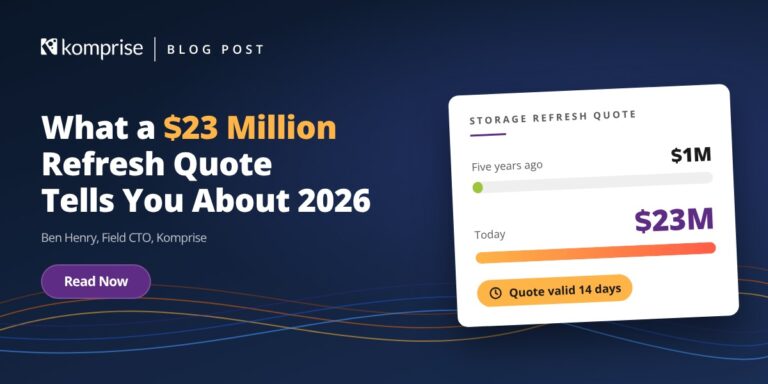
One infrastructure director told me his organization refreshes its storage arrays every five years like clockwork, because the finance math has always made sense. Not anymore. About five years ago, that organization spent just over $1 million on its current storage footprint. Today it faces a choice between a $23 million refresh quote and $800,000 to extend support past a five-year refresh cycle that matches its depreciation schedule. Dropping support and running at risk is not an option.
I am hearing versions of this story from nearly every IT leader I speak with this year.
Storage Quotes Now Expire in 14 Days
The shortage behind these numbers is well documented. Memory and flash manufacturing capacity that used to go toward enterprise storage was retooled for AI chips, and lead times that ran 60 to 90 days now stretch to a year or more. What is less understood is what the shortage is doing to the buying process itself.
A procurement leader at a large enterprise told me that vendor quotes, which used to hold for weeks, are now valid for 14 days or less. Her team missed a deadline by two days while waiting on an internal sign-off. The delay cost an additional $500,000.
Another IT leader described something I found hard to believe until I heard it a second time from someone else. A purchase order gets accepted, the underlying component cost rises again before the gear ships, and the vendor asks the IT organization to cover the difference or lose the order. Procurement teams that once treated vendor deadlines as a negotiating tactic now move fast, because this is not a game. It is real money, and inventory is vanishing before IT decision-makers’ eyes.
How the Storage Shortage Is Reshaping IT Budget Decisions
An IT director at a regulated financial services firm is reconsidering long-standing archive and retention policies, because keeping storage that is more than five years old under support is no longer defensible on cost. IT leaders who were firmly anti-cloud a year ago are now evaluating a hybrid model and shifting more investment to the cloud. Global enterprise spending on cloud infrastructure passed $143 billion in Q2, a 43% year-on-year increase, according to Synergy Research Group.
Customers with storage as a service (STaaS) contracts, which are subscription or consumption based and typically run one to five years, may have a false sense of security. Subscriptions signed before the memory price spike are partially insulated for their term, but renewals and new contracts are repricing sharply. Some large vendors have rewritten contract language specifically to pass mid-cycle cost increases through to customers.
For now, storage industry earnings look strong. Will that demand hold? What I hear is that much of the revenue comes from existing accounts pre-buying two to three years of capacity in a single cycle to lock in pricing before it climbs further. That pulls tomorrow’s spending into today’s quarter. It also means resellers and distributors keep the same percentage margin on deals two to three times larger than before. Enterprise IT organizations absorb all the pain.
Silo Blind Spots and Vendor Lock-In Compound the Cost
As unstructured data keeps growing across on-premises, edge and cloud, it gets harder to see the whole picture. A storage admin managing one platform has no visibility into what another team is doing on a different platform, let alone what sits untouched in a cloud tier. I have met infrastructure teams who discovered that three departments were each storing a full copy of the same multi-terabyte dataset on three different systems.
- Beyond cold data, which can easily make up 60% or more of the data in storage, IT is maintaining redundant, obsolete and trivial (ROT) data. These are typically files tied to projects that ended years ago, still sitting on expensive primary storage.
- Storage manufacturers see this too, and some are steering customers toward their own tiering features. These features are limited, create lock-in and only show what is cold on that vendor’s array. It cannot show your ROT liability, or that finance is paying for copies in a cloud bucket nobody remembers provisioning.
- Storage vendor tiering also makes you pay the rehydration penalty if you need to bring the data back. The fees and delays to make that data usable again can erase much of what you saved by moving it.
- Vendor-native tiering often moves data into the vendor’s proprietary format. The data is technically still there, but nothing outside that vendor’s ecosystem can read it natively, including the AI and analytics tools on the CIO agenda.
Strategies for Managing Unstructured Data Costs and AI Readiness
A few patterns are emerging among the organizations handling the storage crisis most cost-effectively. It starts with visibility into data across all storage, and knowledge of how much of your primary storage is cold, redundant or orphaned.
The organizations getting real value also classify their data, so cold logs, duplicate project files and sensitive records are handled differently instead of being lumped into one bucket. With that analysis, IT leaders can confidently move data where it belongs: a cheaper tier, new fast storage, a pipeline feeding an AI initiative or a confined location pending deletion.
Storage admin and storage architect roles are changing too. For years, the job was measured on uptime, performance and capacity planning within a single platform. Now it also carries cost accountability, closer to what FinOps teams have done for cloud spending for years. That means knowing what a terabyte actually costs from primary storage through backup and DR, which department is driving the most data growth, and the return on keeping data on primary storage versus moving it somewhere cheaper or somewhere it can feed AI and analytics.
–
How Komprise Shrinks the Refresh Bill
Komprise Intelligent Data Management puts that discipline into practice across every storage silo, independent of any storage vendor:
- See everything in one place. The Global Metadatabase indexes every file across NAS, cloud and object storage from every vendor, delivered as a service. Deep Analytics finds the cold, duplicate and ROT data driving up your refresh quote.
Sort what matters. KAPPA data services enrich files with custom metadata, so you can separate data to tier, data to confine and data to feed AI. - Tier and archive without lock-in. Transparent Move Technology moves cold data off primary storage with no change to user access and no rehydration penalty, cutting storage costs 70% or more. Files stay in their native format, readable by any AI or analytics tool.
- Plan the refresh around real usage. Komprise models how much primary capacity your environment can free up, and what it is worth, before you sign the next quote.