Data Management Glossary
Data Observability
What Is Data Observability
Data observability is the practice of understanding the health, reliability, and behavior of data by continuously tracking signals about the data itself, such as how fresh it is, how it is distributed, how its volume is changing, whether its structure is consistent, and where it came from, so that problems and trends can be identified before they cause bigger issues. The term borrows its name from control theory, where “observability” describes the ability to infer a system’s internal state from its external outputs, a concept introduced by engineer Rudolf Kálmán in the 1960s. Software teams adapted the term starting around 2016, when Honeycomb co-founders Charity Majors and Christine Yen, along with LightStep co-founder Ben Sigelman, applied it to understanding the behavior of complex software systems, and a widely cited 2017 blog post by Peter Bourgon proposed that observability rests on three pillars: metrics, logs, and traces.
Source: What is Observability?, Dash0
In 2019, Monte Carlo co-founder and CEO Barr Moses adapted the concept specifically to data, coining “data observability” and “data downtime” to describe applying the same monitoring discipline to data pipelines rather than application code, with five commonly cited pillars: freshness, distribution, volume, schema, and lineage.
Source: What is Data Observability? Why is it Important to DataOps?, TechTarget
Why Data Observability Matters for Unstructured Data
The mainstream data observability category, and the five pillars used to describe it, was built for structured data moving through pipelines: tables, warehouses, and scheduled jobs where “schema” means column definitions and “volume” means row counts. Unstructured data, files, images, documents, video, does not fit that model. There is no table to check for schema drift, and no row count to monitor for anomalies. Yet the same underlying questions still apply, just in a different form: how fresh is this data (when was it last accessed or modified), how is it distributed (across storage tiers, owners, file types, and locations), how is its volume changing (is a directory growing unexpectedly), is its metadata consistent (are files missing the tags or attributes a workflow depends on), and where did it come from (its provenance and lineage). Despite how central these questions are to managing unstructured data at scale, the observability category as it is commonly discussed has largely left files and objects out of the conversation.
Distribution takes on added importance for unstructured data feeding AI training, since a skewed distribution in the training set, an overrepresentation of one file type, source, or time period, can surface as bias in a model’s output well after training has happened. Security analyst Samuel Bocetta has argued that data observability practices should extend to surfacing these kinds of distributional imbalances before they train that bias into a model, rather than trying to detect it only after the fact.
Source: Data Observability in the Age of AI, Samuel Bocetta, DATAVERSITY
The Case for Unstructured Data Management in Data Observability
For unstructured data, observability is more than monitoring and alerts, it is a complete view of the files in an organization regardless of where they are stored, how they are being used and by whom, how fast the data is growing, and whether storage or access patterns look out of the ordinary. Building that view for a single storage system is straightforward; building it across dozens of NAS systems, cloud tiers, and object stores accumulated over years is not, and it cannot be done with periodic manual audits at petabyte scale. It requires a continuously updated, cross-silo index of file and object metadata, since a view that only covers one storage platform, or one that goes stale between audits, cannot answer the growth, distribution, and anomaly questions that matter.
Source: The Rise of Unstructured Data Observability, Komprise
How Komprise Supports Data Observability for Unstructured Data
The Global Metadatabase continuously indexes file and object metadata across every connected NAS, cloud, and object storage system, giving IT teams a single, current view of the data estate rather than a point-in-time snapshot. From that index, Komprise Deep Analytics can be used to investigate growth trends, storage and access patterns across departments or projects, and anomalies such as an unexpected spike in file creation or deletion in a given directory. KAPPA data services and Smart Data Workflows add richer context to that picture: enriching metadata with additional attributes improves the dimensions available for analysis, and tagging for PII or sensitive content can reveal if regulated data is stored somewhere it should not be, tying observability directly to governance rather than treating them as separate concerns. This is a distinct problem from application or infrastructure observability tools such as Splunk, Datadog, or New Relic, which monitor the health of running systems and services. Komprise focuses on the data itself, tracking how a file and object estate changes over time through a continuously updated index rather than streaming application telemetry.
Choosing a Data Observability Approach for Unstructured Data
| Evaluation Criteria | Without Cross-Silo Data Observability | With Komprise |
|---|---|---|
| Storage coverage | Visibility is limited to whatever a single storage platform’s native tools can report | The Global Metadatabase indexes file and object metadata across every connected NAS, cloud, and object storage vendor |
| Growth and anomaly visibility | Unusual growth or activity in a directory often goes unnoticed until it becomes a capacity or security problem | Komprise Deep Analytics can surface growth trends and unusual storage or access patterns across the entire data estate |
| Metadata consistency | Inconsistent or missing file metadata is difficult to detect without manually sampling directories | The Global Metadatabase provides a queryable, continuously updated view of metadata completeness across billions of files |
| Connection to governance | Observability and sensitive data governance are typically handled by separate, disconnected tools | KAPPA data services and Smart Data Workflows tag sensitive content directly in the same metadata used for observability |
| Freshness of the view | Manual audits and point-in-time reports go stale as soon as new data is created | The Global Metadatabase updates continuously, so the view of the data estate reflects its current state |
Data Observability Frequently Asked Questions
What are the five pillars of data observability?
The five pillars commonly used to describe data observability are freshness (how current the data is), distribution (how values and data are spread across the environment), volume (how much data exists and how that is changing), schema (whether structure remains consistent), and lineage (where data came from and how it has moved). These pillars were popularized by Monte Carlo for structured data pipelines and require reinterpretation to apply meaningfully to files and objects.
Is data observability the same as data quality?
No. Data quality measures whether data itself is accurate, complete, and fit for use. Data observability measures the health and behavior of the systems and pipelines that produce and move that data, monitoring signals like freshness, volume, and schema changes to catch problems that could lead to poor data quality before they spread downstream.
What is the difference between data observability and AI observability?
Data observability tracks the health of the data itself, its freshness, volume, distribution, and structure, before that data reaches an AI system. AI observability tracks the health of the AI models and systems built on top of that data, monitoring model performance, drift, bias, and output quality. Gartner predicts 40% of organizations deploying AI will implement dedicated AI observability tools by 2028 to monitor model performance and outputs, a separate and fast-growing category from data observability. The two are complementary: an AI system can only be trusted if both the data feeding it and the model consuming that data are being observed.
Source: Gartner Predicts 40% of Organizations Deploying AI Will Use AI Observability to Monitor Model Performance by 2028, Gartner
Does data observability apply to unstructured data?
Yes, though the standard five-pillar framework needs adapting since it was built around tables and pipelines. For unstructured data, observability means tracking freshness through access and modification patterns, distribution across storage tiers and owners, volume through growth trends, metadata consistency in place of table schema, and lineage through a file’s movement and origin history.
How is data observability for unstructured data different from tools like Splunk or Datadog?
Tools like Splunk, Datadog, and New Relic are built to monitor the health of applications and infrastructure, tracking logs, metrics, and traces from running systems. Data observability for unstructured data is a different problem: understanding the file and object data estate itself, how it is growing, where it lives, and whether its metadata is consistent, which depends on a continuously updated index of the data rather than streaming telemetry from applications.
How does Komprise support data observability for unstructured data?
The Global Metadatabase continuously indexes file and object metadata across every connected storage system, giving IT teams a current, cross-silo view of the data estate. Komprise Deep Analytics can then be used to investigate growth, usage, and anomaly patterns, while KAPPA data services and Smart Data Workflows enrich and tag that same metadata for sensitive content, connecting observability directly to governance rather than keeping them in separate tools.
How does data observability help identify ROT data?
Observability signals are often the first sign that ROT (Redundant, Obsolete, and Trivial) data is accumulating in an environment. A freshness signal showing a file or directory has not been accessed in years points to obsolete data. A volume signal showing unexpected growth in a directory often traces back to redundant copies rather than genuinely new information. A distribution signal showing many near-identical files spread across storage tiers can surface trivial or duplicate content with no analytical value. Observability does not clean up ROT data on its own, but it is what makes ROT data visible in the first place, before a classification or cleanup policy can act on it.
Where does data observability fit in the AI data platform?
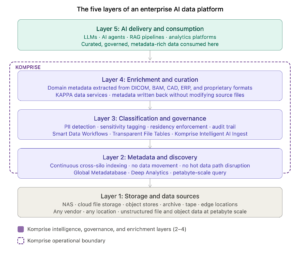
Data observability draws primarily on Layer 2 of the AI data platform, Metadata and Discovery, where the Global Metadatabase provides the continuously updated index that makes growth, distribution, and freshness visible in the first place. It also connects to Layer 3, Classification and Governance, since sensitive data tagging is one of the signals that makes observability actionable rather than purely descriptive. See AI Data Platform for how all five layers work together.
Related Terms: AI Data Governance, Data Lineage, Data Provenance, Global Metadatabase, Metadata Intelligence, Sensitive Data Management