Data Management Glossary
AI Cost Optimization
What is AI Cost Optimization?
AI cost optimization is the practice of reducing the infrastructure, storage, compute, and operational costs associated with artificial intelligence infrastructure and workloads while maintaining performance and business outcomes. It focuses on making AI initiatives more efficient, scalable, and financially sustainable.
Why AI Cost Optimization Matters
Many AI projects become expensive due to:
- GPU and accelerator costs
- Rapid storage growth
- Cloud compute consumption
- Data movement charges
- Duplicate or low-value datasets
- Poorly managed AI pipelines
Without optimization, AI budgets can grow faster than business value.
The Hidden Cost Driver: Unstructured Data
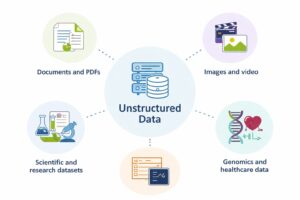 Most AI projects depend on unstructured data, such as:
- Documents
- Images
- Audio / video
- PDFs
- Emails
- Logs
- Research files
This creates cost challenges:
1. Too Much Low-Value Data: Organizations often process stale or redundant content.
2. Expensive Primary Storage: Inactive data stays on premium flash storage.
3. Cloud Egress and Movement Costs: Moving large datasets into AI environments can be expensive.
4. Compute Waste: AI systems spend resources processing irrelevant data.
In many cases, the biggest AI cost issue is not the model, it is poor data management.
How Komprise Helps Optimize AI Costs
Komprise helps enterprises reduce AI costs by improving how unstructured data is stored, selected, and delivered.
Intelligent Tiering
Move inactive data off expensive storage to lower-cost object or cloud tiers.
Data Discovery & Curation
Identify relevant high-value datasets for AI and avoid wasteful processing.
Global Metadatabase
Gain visibility across all unstructured data to reduce duplication and improve efficiency.
Transparent Access
Keep archived or tiered data accessible without disruption.
Workflow Automation
Reduce manual effort in preparing and moving data for AI initiatives.
Why This Matters
Successful AI requires both innovation and financial discipline. Komprise helps organizations move from expensive, uncontrolled AI data sprawl, to efficient AI pipelines built on the right data at the right cost
Why are AI projects so expensive?
GPU demand, cloud compute, storage growth, and poor data efficiency all increase costs.
How does unstructured data impact AI costs?
Unstructured data is the primary fuel for enterprise AI, but it is also the primary source of wasted AI spend. Most enterprise unstructured data estates contain significant volumes of duplicate, stale, and irrelevant files that have accumulated over years without systematic curation. When these files enter AI pipelines without filtering, every redundant or outdated file consumes compute resources during ingestion, embedding, indexing, and inference. If 70% of ingested data is irrelevant, organizations are effectively spending 70% more on AI processing than their use case requires, with no corresponding improvement in model accuracy or output quality. The problem compounds with scale. At petabyte volumes, the cost of processing noise is not marginal, it is a primary driver of AI infrastructure budget overruns and one of the leading reasons enterprise AI projects fail to deliver expected ROI.
Beyond compute, unstructured data also drives storage costs that directly inflate AI infrastructure budgets. With enterprise SSD and NAND flash prices rising 234% in 2026 according to Gartner, keeping cold and inactive unstructured data on expensive primary storage alongside active AI datasets means organizations are paying premium storage prices for data that adds no value to AI outcomes. The cost of inaction compounds every quarter as unstructured data grows at 55-65% annually.
How does Komprise reduce AI costs?
Komprise reduces AI costs across two dimensions simultaneously: storage infrastructure costs and AI processing costs.
On the storage side, Komprise scans the entire unstructured data estate across all NAS and cloud environments to identify cold and inactive data. Intelligent Tiering automatically moves this data to lower-cost cloud or object storage based on policy, typically reclaiming 70% or more of primary storage capacity. Data moved via Transparent Move Technology remains in its native format and is accessible for any AI pipeline that legitimately needs it via Dynamic Links, so tiering does not limit AI access, it just eliminates the cost of keeping inactive data on expensive primary storage.
On the AI processing side, Komprise Intelligent AI Ingest, part of Smart Data Workflows, delivers a surgical curation approach using the Global Metadatabase to find precisely the right data for a specific AI use case rather than blindly copying entire directories or file shares. Precise filtering based on metadata and custom tags, combined with built-in sensitive data detection and PII scanning, ensures AI pipelines receive a targeted, governed dataset rather than a noisy, over-inclusive one. Komprise Intelligent AI Ingest delivers 2x faster data transfer than standard cloud provider transfer tools, reducing the time and compute cost of pipeline preparation. The combination of right-sized datasets and faster delivery directly lowers the per-inference cost of AI operations.
Can AI cost optimization improve performance too?
Yes, and the relationship is direct rather than coincidental. AI model performance degrades when context windows are filled with irrelevant, outdated, or contradictory information. Reducing the volume of noise in a dataset does not just lower token consumption, it improves the signal-to-noise ratio of every inference, making model outputs more accurate, more relevant, and more consistent. Organizations that curate precise datasets using Komprise Deep Analytics and Smart Data Workflows typically see improvements in both AI accuracy and pipeline throughput alongside the cost reductions, because the same data quality improvements that reduce processing waste also give models better context to reason from.
Gartner confirms this dynamic in its Market Guide for Data Storage Management Services, noting that modern DSMS solutions are foundational to business analytics and generative AI initiatives, helping enterprises make data more discoverable, contextualized, and actionable. Discoverable and contextualized data is not just cheaper to process. It produces better AI outcomes.
What techniques reduce AI inferencing costs through better unstructured data management?
AI inferencing costs scale with token usage, and token usage scales with the volume and quality of data processed per query. Three data management techniques directly reduce inferencing costs without requiring changes to the AI model or infrastructure.
- First, eliminate noise before ingestion. Every irrelevant, duplicate, or outdated file that enters an AI context window consumes tokens without contributing value. Removing ROT data and filtering cold inactive files from AI datasets before ingestion reduces the total volume of data a model must process per inference, lowering cost per query directly.
- Second, enrich metadata to improve retrieval precision. RAG pipelines and agentic AI systems retrieve data based on metadata relevance scores. When metadata is rich and accurate, retrieval returns fewer but more relevant results, reducing the number of tokens consumed per inference. KAPPA data services extract custom metadata from file content, and Komprise Deep Analytics precision queries deliver targeted datasets rather than broad file share dumps to AI platforms.
- Third, right-place data based on access patterns. AI pipelines that retrieve data from high-latency storage tiers introduce pipeline delays that inflate compute time and cost. Komprise Intelligent Tiering keeps actively queried AI data on appropriate, accessible storage tiers automatically, so retrieval latency and cost stay predictable as the data estate grows.