Data Management Glossary
NAS Data Management
What is NAS Data Management?
NAS data management refers to the processes and technologies used to monitor, organize, move, protect, and optimize data stored on Network Attached Storage (NAS) systems.
It includes:
- Gaining visibility into file data across NAS environments
- Managing data growth and storage utilization
- Moving data between storage tiers based on usage
- Reducing storage, backup, and infrastructure costs
- Ensuring compliance, security, and accessibility
Because NAS is the primary platform for unstructured data, effective NAS data management is essential for controlling costs, reducing risk, and enabling data-driven initiatives.
Why NAS Data Management Is More Important Now
1. Storage and Memory Prices Are Surging in 2026
Rising costs for DRAM, NAND flash, and SSDs are driving up the price of primary storage. Supply chain constraints, AI-driven demand for high-performance infrastructure, and component shortages are forcing vendors to increase prices.
The result: expanding or refreshing NAS is significantly more expensive than in prior years.

2. Unstructured Data Growth Continues Unchecked
Most enterprise data is unstructured and growing rapidly across file systems, often without lifecycle policies. Much of it is inactive (see cold data) but still consuming premium storage.
3. Ransomware Risk Is Increasing
Large volumes of unmanaged data increase exposure:
- More data to protect and recover
- Larger attack surface
- Higher recovery costs
Reducing unnecessary primary data reduces the ransomware blast radius and improves recovery outcomes.
4. Hybrid Complexity is the New Normal
Data spans on-premises NAS, cloud file storage, and object storage. Without centralized visibility, it becomes difficult to optimize placement and control costs.
5. AI Requires Better Data Access
Organizations need to find, prepare, and use unstructured data for AI, but much of it is poorly organized and too expensive to manage efficiently.
What NAS Vendors Typically Provide
 Most NAS vendors offer built-in data management capabilities such as:
- Snapshotting and replication
- Basic tiering within their storage platform
- Policy-based file movement
- Reporting limited to their system
While useful, these tools have important limitations:
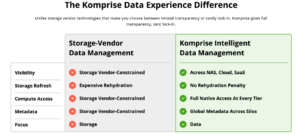
- Single-vendor scope (no cross-platform visibility)
- Limited analytics into actual data usage and value
- Static policies rather than dynamic, usage-based decisions
- Rehydration requirements when accessing or migrating tiered data
- Vendor lock-in, making future changes costly
These approaches optimize storage systems, not the data across your entire environment.
Why a Storage-Agnostic Unstructured Data Management Approach Is Critical
A storage-agnostic approach focuses on the data itself, not the underlying infrastructure.
Benefits include:
- Global visibility: See and analyze data across all NAS systems, object storage, and cloud environments.
- Better decision-making: Use analytics to identify cold data, growth trends, and optimization opportunities.
- Freedom from vendor lock-in: Move and tier data across platforms without being tied to a single vendor ecosystem.
- No rehydration penalty: Access and migrate data without recalling it to expensive primary storage.
- Consistent policy enforcement: Apply data management policies across hybrid environments, not just within one system.
This is essential in modern enterprises where multi-vendor and hybrid IT is the norm.
Key Strategies to Reduce NAS Costs
1. Identify and Tier Cold Data
Typically, 60–80% of NAS data is inactive. Moving it to lower-cost storage frees up expensive primary capacity.
2. Reduce Backup and DR Costs
Shrinking the primary data footprint reduces:
- Backup storage
- Replication costs
- Recovery time in ransomware events
3. Extend the Life of Existing Storage
Reclaiming capacity delays or eliminates the need for costly storage refresh cycles.
4. Optimize for Hybrid Storage
Right-place data across NAS, object storage, and cloud to balance cost and performance.
5. Use Analytics Instead of Assumptions
Data-driven insights ensure accurate, sustainable optimization instead of guesswork.
What Makes Komprise Unique for NAS Data Management
Komprise delivers analytics-driven, storage-agnostic NAS data management at enterprise scale.
- Global Analytics Across All Storage: Komprise provides a unified view of unstructured data across multi-vendor NAS, object, and cloud environments.
- Transparent File Tiering: Inactive data is moved to lower-cost storage while remaining fully accessible to users and applications.
- No Rehydration Penalty: Data can be accessed or migrated without being moved back to primary storage—eliminating hidden costs.
- Ransomware Risk Reduction: By reducing primary data volumes and enabling policy-driven data placement, Komprise helps:
- Limit the attack surface
- Improve recovery efficiency
- Support immutable storage strategies
- Cost Optimization Across Storage and Backup: Komprise reduces:
- Primary NAS capacity needs
- Backup and replication volumes
- Overall infrastructure costs
- AI-Ready Data Foundation: Komprise organizes and enriches unstructured data, making it easier to:
- Identify relevant datasets
- Apply governance and classification
- Feed AI and analytics workflows
Why NAS Data Management Matters
Without modern NAS data management:
- Costs rise with data growth
- Infrastructure becomes inefficient
- Ransomware risk increases
- AI initiatives are slowed
With a storage-agnostic, analytics-driven data management approach:
- Costs are aligned to data value
- Storage investments are maximized
- Data is accessible and usable for AIRisk is reduced across the environment
NAS data management is no longer just about storag – it’s about controlling cost, reducing risk, and unlocking data value.
With a storage-agnostic, analytics-driven approach like Komprise, organizations can optimize NAS environments, extend infrastructure life, reduce ransomware exposure, and prepare unstructured data for AI in a cost-effective way.
Why are NAS storage costs increasing now?
How do NAS vendor tools compare to third-party data management solutions?
How does NAS data management reduce ransomware risk?*
What is the biggest opportunity for NAS cost savings?
The largest opportunity is identifying and tiering inactive data off expensive primary storage, which also reduces backup and infrastructure costs.Additionally, making unstructured data more visible, organized, and accessible, enables organizations to efficiently prepare and use data for AI and analytics.