Intelligent Data Tiering
Reduce hybrid storage costs by moving inactive cold data off expensive tiers with transparent access and zero rehydration penalty.
Why Komprise Intelligent Data Tiering?
Eliminates Lock-in
Leverages Existing Infrastructure
Minimizes Cloud Egress Costs
Works Across File Storage
Users Access Moved Data Without Disruption
Native Access in the Cloud
Eliminates 3rd Party Licensing Costs in the Cloud
Enables Ongoing Lifecycle Mgmt in the Cloud Delivers AI Ready Data to the Cloud
Storage-Based Tiering
Komprise File -Based Data Tiering

Avoid Costly Storage Expansion and SSD Upgrades
Avoid unnecessary SSD and NAS expansion with non-disruptive, policy-based intelligent tiering.

- Identify 60–80% of unstructured data that no longer needs expensive, high-performance file storage.
- Offload cold data to lower-cost cloud object storage or cheaper NAS instead of buying more capacity
- Eliminate delays caused by hardware shortages and long storage procurement cycles

Cut Storage, Backup and Rehydration Costs
Control cloud and on-prem storage spend with analytics-driven tiering that automatically places data on the most cost-effective tier.

- Use real usage analytics, not assumptions, to decide what stays local and what moves to cloud
- Unlike storage tiering, cut both storage and backup costs by offloading entire files, not blocks
- Komprise file-level tiering means zero rehydration penalty
- Flexible tiering policies by department, by workload, by age and any custom criteria to suit enterprise needs
Experience Transparent Access for Users and Applications with No Disruption
Schedule a demonstration with the Komprise experts to get started today.

Preserve Access While Maximizing Cost Avoidance
Reduce storage and cloud costs without breaking file access, workflows, or application performance.

- Transparently tier full files while preserving metadata, permissions, and access paths
- Komprise is always out of the hot data path: no performance risk for active workloads
- Avoid vendor lock-in with native access across NAS, cloud, and object storage
Dig Deeper

Use case
Cloud Tiering with Komprise: Three Customer Use Cases
Benefits and Trade-Offs for Hybrid Cloud, Public Cloud, and Private Cloud Tiering and Archiving At least 70% of data on…

blog
File-Based Cloud Tiering with Komprise Intelligent Data Management
At Komprise, we believe that data management functionality is a layer independent of storage…
White Paper
5 Considerations When Picking a Storage Tiering Solution
Frequently Asked Questions
What is Cloud Tiering?
Cloud tiering, also known as cloud storage tiering, is a data management strategy that involves dynamically moving data between different storage tiers based on its usage patterns, performance requirements and cost considerations. The primary goal of cloud tiering is to optimize data storage resources by efficiently allocating data to the most appropriate storage tier, whether it’s on-premises storage or cloud-based storage services. Read the white paper.
Also see Cloud Archiving
What are the advantages of Komprise file-level cloud tiering?
Unlike proprietary storage tiering solutions, file-level tiering is a data management solution that works across
multi-vendor file and cloud storage to move files seamlessly without lock-in. File-level tiering and transparent tiering solutions overcome the limitations of block-level tiering solutions by keeping data in native format in the cloud while enabling transparent access to tiered data from the original filesystem.
- File-level Cloud Tiering Eliminates Lock-In: File-level tiering is a more advanced technology and is standards-based. File-level tiering means the file along with all of its metadata moves to the new tier. Whether you have NTFS extended attributes or POSIX ACLS, you need the ability to move the file and all of its associated metadata with high fidelity and rehydrate it back into its exact original form if needed. Moving just the file is not enough. Many applications rely on attributes of the file to operate. The file system imposes access control through basic and extended attributes. File-level tiering maintains full file fidelity and preserves all the attributes and metadata along with the file at each tier.
- File-Level Cloud Tiering Minimizes Cloud Costs, Maximizes Savings: The total savings is more significant since the entire file is preserved. With transparent file-level cloud tiering you can access files natively as objects in the cloud without any third-party software, so there is no need to pay an additional fee in perpetuity. Since all the file metadata is preserved, you can also access the cold data as files in the cloud and return it to the source storage exactly as it was before. Also, by transparently moving the entire file, all other operations such as third-party backup applications
and migrations can be done without rehydrating the data or incurring cloud egress and retrieval costs—thus maximizing the full savings.
File-level cloud tiering enables you to maximize savings by offloading cold data to the cloud. It minimizes cloud egress costs by enabling access to data without costly rehydration, and it future-proofs your investment by writing data using standards with no lock-in.
Why is hybrid data tiering that is agnostic from data storage a better approach?
Hybrid data tiering, or hybrid tiering, is the practice of moving data seamlessly between on-premises and cloud storage tiers to balance performance, cost, and compliance requirements. A storage-agnostic tiering approach is better because it decouples data management from any single vendor or hardware platform. Advantages of storage-agnostic data tiering include:
- No vendor lock-in: Data is always kept in its native format, so enterprises can access it directly with cloud services or move it to a new platform without rehydration or re-ingestion.
- Cost optimization at scale: Cold or inactive data can be tiered to the most cost-effective storage, whether cloud object, archive, or lower-cost on-prem tiers, without disrupting hot data access.
- Hybrid flexibility: Organizations can tier across multiple clouds and storage systems simultaneously, maintaining visibility and governance across all environments.
- Future-proofing: As storage vendors and technologies evolve, IT teams retain control of their data strategy without being forced into costly migrations dictated by proprietary systems.
How Komprise helps:
Komprise Intelligent Data Management delivers hybrid, storage-agnostic data tiering that works across all major NAS and cloud platforms. Data remains fully accessible in its native format, ensuring both IT and business users can leverage tiered data for analytics, AI, or compliance. Customers typically reduce storage and backup costs by 50% or more while retaining governance and flexibility to support future data initiatives.
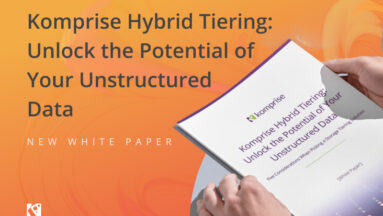
Read the white paper: Komprise Hybrid Tiering: Unlock the Potential of Your Unstructured Data
Can intelligent data tiering help AI initiatives?
Yes. Intelligent tiering helps free expensive high-performance storage for AI training, GPU workloads, analytics, and inference while moving inactive data to lower-cost storage. It can also place valuable unstructured data in object storage where it is easier to use for AI pipelines, retrieval, and large-scale analytics.
Why is intelligent tiering important for AI-ready unstructured data?
Most enterprise data used for AI is unstructured: files, documents, images, video, and logs. Without intelligent tiering across hybrid storage infrastructure, inactive data consumes premium storage budgets that could be used for AI infrastructure. Komprise intelligent tiering helps organizations reduce storage waste, identify valuable datasets, and make the right data more accessible for AI and analytics.
A Smarter, Faster, Proven Data Tiering Strategy
Schedule a call with our unstructured data management experts and analyze, move and manage your see your unstructured data in a whole new way.
Industry Leaders Trust Komprise


