Data Management Glossary
Data Intelligence
What Is Data Intelligence?
Data intelligence is the process of analyzing data to understand what it contains, how it is used, and how it can deliver business value. It combines data discovery, metadata analysis, classification, and usage insights to help organizations make better decisions about managing, protecting, and using their data.
Data intelligence solutions typically fall into two main categories based on the types of data they analyze:
Structured and Semi-Structured Data Intelligence
Platforms such as Databricks, Snowflake, and Informatica focus primarily on structured and semi-structured data intelligence. These platforms analyze data stored in:
- databases
- data warehouses
- data lakes
- analytics platforms
They provide insights into schemas, tables, pipelines, and analytics workloads to help organizations manage data used for business intelligence, analytics, and AI model training.
Storage-Based Data Intelligence
Storage vendors such as NetApp and Everpure (Pure Storage) also offer forms of data intelligence embedded within their storage platforms. These capabilities typically provide visibility into storage usage, performance, and data activity within that vendor’s infrastructure.
However, these tools are limited to data stored on a specific storage platform, making it difficult to gain a unified view across heterogeneous storage environments.
Because modern enterprises store data across multiple storage systems, clouds, and platforms, organizations increasingly need data intelligence that spans the entire data estate, not just a single system or vendor silo.
Why Data Intelligence Matters
Modern enterprises generate enormous volumes of data across data centers, cloud environments, and edge systems. Without data intelligence, organizations often struggle with:
- Data sprawl across multiple storage platforms
- Rising storage and infrastructure costs
- Limited visibility into sensitive or regulated data
- Difficulty finding high-quality datasets for analytics and AI
Data intelligence provides the visibility and insights needed to manage data strategically, ensuring that the right data is accessible, secure, and optimized for cost and performance.
What Is Unstructured Data Intelligence?
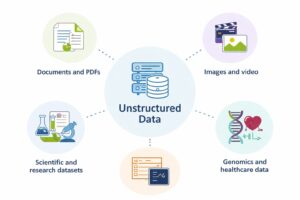 Unstructured data intelligence focuses on analyzing and understanding unstructured data, which represents the majority of enterprise data and includes:
- Documents and PDFs
- Images and video
- Scientific and research datasets
- Machine logs and application files
- Genomics and healthcare data
Much of this data resides on network-attached storage (NAS) systems and object storage platforms.
Unlike structured data stored in databases, unstructured data typically lacks defined schemas or consistent metadata. As a result, it is far more difficult to analyze, govern, and optimize without specialized technology.
Unstructured data intelligence platforms like Komprise Intelligent Data Management, analyze file metadata, file system activity, and content attributes to provide insights such as:
- Which files are actively used vs. inactive or “cold” data
- Where sensitive or regulated information is stored
- Which datasets are valuable for AI, analytics, or research
- Which data can be moved to lower-cost storage tiers
Because unstructured data accounts for 80–90% of enterprise data, gaining intelligence into this data is essential for modern data strategies.
Why Unstructured Data Intelligence Is Different
Managing unstructured data presents unique challenges that traditional data intelligence tools were not designed to address.
- Massive Scale: Unstructured datasets often contain billions of files and petabytes of storage spread across multiple systems.
- Distributed Storage Environments: Data may be stored across:
- NAS platforms
- object storage
- cloud file services
- research storage environments
- Vendor Silos: Storage systems only provide analytics within their own platform. If organizations rely on vendor-specific tools, they can only see data within that particular storage silo.
To truly understand and optimize unstructured data, organizations need a storage-agnostic approach to data intelligence that provides a unified view across all storage platforms.
A storage-agnostic model allows organizations to analyze data wherever it resides and take action across heterogeneous environments without vendor lock-in.
Unstructured Data Intelligence from Komprise
Komprise Intelligent Data Management provides powerful storage-agnostic unstructured data intelligence that enables organizations to analyze and manage file data across heterogeneous storage environments.
Komprise analyzes file data across NAS, object, and cloud storage platforms, providing insights into billions of files and petabytes of data without disrupting users or applications.

With Komprise, organizations can:
- Analyze file data at petabyte scale across NAS and object storage platforms
- Identify inactive data to optimize storage cost and capacity planning
- Discover and classify sensitive data for governance and compliance
- Create AI-ready datasets from valuable unstructured data
- Enable intelligent data tiering by moving cold data to lower-cost storage
Because Komprise operates independently of any specific storage vendor, organizations gain a unified view of unstructured data across their entire storage estate.
This storage-agnostic approach enables enterprises to unlock the value of unstructured data while optimizing cost, improving governance, and accelerating AI and analytics initiatives.
