Data Management Glossary
Storage Costs
Rising Storage Costs
Storage costs are the price you pay for data storage. With the exponential growth and variety of cloud storage tiers to choose from, it is important to regularly evaluate your storage costs, which will vary depending on the storage solution, type and provider you choose. See Data Storage Costs.
Read the interview with Komprise Field CTO: Is there any relief for data storage costs?
Read the Komprise eBook: 8 Ways to Save on File Storage and Backup Costs.
- Consolidate storage and data management solutions.
- Adopt a data services mindset:
- Adopt new data management metrics.
- Introduce an analytics approach for departments and users:
- Become a cloud cost optimization expert.
- Develop best practices for data lifecycle management.
- Develop a ransomware strategy that also cuts costs.
- Don’t get locked in.


What factors can impact storage costs?
- Storage Type: Different storage types have varying costs. For example, solid-state drives (SSD) generally cost more than traditional hard disk drives (HDD) due to their higher performance and faster access times. Additionally, specialized storage options like archival storage or object storage may have different pricing structures based on the intended use cases.
- Capacity: The amount of storage space you require directly impacts the cost. Providers typically charge based on the amount of data you store, usually measured in gigabytes (GB), terabytes (TB), or petabytes (PB). As you scale up your storage capacity, the costs will increase accordingly. See Capacity Planning.
- Redundancy and Data Replication: If you require data redundancy or replication for increased data durability and availability, additional costs may be involved. Providers may charge for creating and maintaining multiple copies of your data across different locations or availability zones.
- Data Access and Retrieval: The frequency and speed of data access can influence storage costs. Some storage services offer different retrieval tiers with varying costs, such as faster access options for immediate retrieval (which can be more expensive) or lower-cost options for infrequent access.
- Data Transfer: Uploading and downloading data from storage solutions often incurs data transfer costs. These charges may apply when moving data into or out of the storage service or transferring data between regions or availability zones.
- Service Level Agreements (SLAs): Certain storage solutions may come with service-level agreements that guarantee a certain level of performance, availability, or support. These enhanced SLAs may have higher associated costs.
- Cloud Provider and Pricing Models: Different cloud providers have their own pricing structures, and costs can vary between them. It’s important to carefully compare the pricing details, including storage rates, data transfer costs, and any additional charges specific to each provider. Read: Cloud Storage Pricing in 2023: Everything You Need to Know.
To get accurate and up-to-date pricing information, it is recommended to visit the websites of cloud storage providers like Amazon Web Services (AWS), Google Cloud Platform (GCP), or Microsoft Azure. They typically provide detailed pricing calculators and documentation that can help estimate the costs based on your specific storage requirements.
Why are storage costs rising in 2026?
Storage costs are increasing as demand for AI infrastructure accelerates and supply of key components like SSDs and NAND flash remains constrained. Vendors are prioritizing high-performance systems for AI workloads, tightening supply and driving up prices for enterprise storage.
For IT teams, this means higher costs for the same capacity and increased pressure to optimize how existing storage is used.

How are SSD and NAND flash price increases affecting enterprises?
Rising SSD and NAND flash prices are making all-flash storage significantly more expensive, especially for primary workloads. Organizations that rely heavily on high-performance storage are seeing budget strain, delayed upgrades, and reduced flexibility in scaling capacity.
As a result, many enterprises are rethinking whether all data truly belongs on premium flash infrastructure.
What are effective ways to extend the life of existing storage?
Instead of continuously adding new storage, organizations can reduce costs by making better use of what they already have. Proven strategies include:
- Moving inactive data off expensive primary storage
- Eliminating redundant, obsolete, or trivial data (ROT data)
- Automating data lifecycle management
- Aligning storage tiers with actual data usage
These approaches help defer new purchases and maximize existing investments.
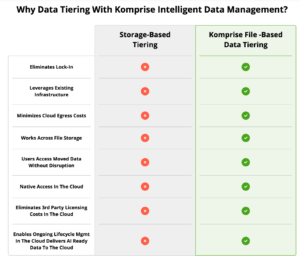
Why is the right approach to data tiering critical for cost savings?
Traditional storage tiering often relies on manual processes or vendor-specific tools that don’t scale across environments. Without a smart, automated approach, large volumes of inactive data remain on high-cost storage.
Modern, transparent data tiering ensures that cold data is moved to lower-cost storage without disrupting access, enabling organizations to significantly reduce storage costs while maintaining performance where it matters.
What role does unstructured data management play in controlling storage costs?
Unstructured data accounts for the majority of enterprise data growth and is often poorly managed. Without visibility into data usage and value, organizations end up overprovisioning expensive storage.
Unstructured data management provides the analytics and automation needed to identify cold data, optimize placement, and enforce policies, helping IT teams control costs at scale and deliver greater data value.
How does Komprise help reduce rising storage costs?
Komprise Intelligent Data Management helps enterprises reduce storage costs by analyzing unstructured data across file and object storage and automatically moving inactive data to lower-cost tiers, without changing how users and applications access it.
With analytics-driven, transparent file tiering, Komprise enables organizations to reclaim expensive primary storage, reduce reliance on flash, and extend the life of existing infrastructure.
To learn more, explore Komprise resources on:
- Data tiering and cost optimization
- Storage assessment and capacity planning
- Unstructured data management for AI-ready data
These approaches help organizations cut storage costs while building a more efficient foundation for AI and future growth.