Data Management Glossary
Flash Storage
What is Flash Storage (NAND Flash)?
Flash storage, based on NAND flash memory, is a type of non-volatile storage that electronically stores data without moving parts, enabling significantly faster access and performance compared to traditional disk-based storage. Flash storage is intended to electronically secure data, which can be electronically erased and reprogrammed. The other advantage is it responds faster than a traditional disc, increasing performance. Flash storage stores data in memory cells that can be electronically erased and reprogrammed. Unlike hard disk drives (HDDs), which rely on spinning disks and mechanical components, flash storage delivers:
- High performance for read/write operations
- Low latency for real-time data access
- Greater reliability due to no moving parts
While Flash storage can offer a great improvement for organizations, it is still too expensive as a place to store all data. Flash storage has been about twenty times more expensive per gigabyte than spinning disk storage over the past seven years. Many enterprises are looking at a tiered model with high-performance flash for hot data and cheap, deep object or cloud storage for cold data.
Flash is widely used in:
- All-flash arrays (AFAs) in the data center
- Solid-state drives (SSDs)
- High-performance workloads such as analytics, databases, and AI
As unstructured data continues to grow, driven by mobility, cloud applications, and IoT, organizations increasingly rely on flash storage to ensure fast access to critical data.
Why is Flash Storage Important?
Flash storage enables organizations to:
- Process and analyze data faster
- Support real-time applications and AI workloads
- Improve user experience and system responsiveness
For data to deliver business value, it must be quickly accessible and actionable, something traditional disk storage often cannot provide at scale.
What are the Advantages of Flash Storage?
Flash storage offers several key benefits:
1. High Performance
- Faster data access compared to spinning disk
- Enables real-time analytics and AI workloads
- Improves application responsiveness
2. Reliability
- No moving parts → lower failure rates
- Higher durability and uptime
- Typical lifespan of 7–10 years for enterprise arrays
3. Efficiency
- Lower power consumption and footprint
- Reduced cooling requirements
What is NAND Flash?
NAND flash is a type of non-volatile memory used in flash storage devices that stores data in a grid of memory cells, optimized for high-density and high-speed data storage. NAND flash is the underlying technology used in:
- SSDs
- All-flash arrays
- USB drives and mobile devices
It is designed for:
- High-capacity storage
- Fast sequential and random access
- Cost efficiency compared to other memory types (like DRAM), though still more expensive than disk
Why is Flash Storage So Expensive Now?
Flash storage remains more expensive than traditional disk due to several factors:
1. Supply and Demand Dynamics
- Increased demand driven by AI, cloud, and hyperscale workloads
- Limited manufacturing capacity for advanced NAND chips
2. Advanced Manufacturing Complexity
- NAND flash requires highly specialized fabrication processes
- Transition to newer technologies (e.g., 3D NAND) increases production costs
3. Performance Premium
- Flash delivers significantly higher performance than HDDs
- Organizations pay for speed, latency, and reliability
Cost reality
Even with price declines over time, flash storage can still be 5–20x more expensive per GB than spinning disk, depending on the workload and configuration.
Why Not Store All Data on Flash?
While flash delivers performance benefits, it is not cost-effective for all data. Challenges include:
- Large volumes of cold or inactive data
- Rapid growth of unstructured data (files, images, videos)
- Budget constraints for high-capacity storage
As a result, most organizations adopt a tiered storage strategy:
- Flash for hot, active data
- Lower-cost storage (object, cloud, or disk) for cold data
How Does Intelligent Data Tiering Optimize Flash Costs?
 Intelligent data tiering is the practice of automatically moving data between storage tiers based on real usage patterns and business value.
How it works
- Identify hot vs. cold data using analytics
- Move cold data off expensive flash storage
- Retain transparent access for users and applications
Why it matters
Without tiering:
- Flash becomes overfilled with inactive data
- Costs increase unnecessarily
- Performance benefits are diluted
With intelligent tiering:
- Flash is reserved for high-value workloads
- Storage costs are significantly reduced
- Data remains accessible across tiers
How Does Komprise Optimize Flash Storage?
Komprise enables organizations to maximize the value of flash storage through analytics-driven data management. Key Komprise Transparent Move Technology (TMT) capabilities include:
- Identify cold data on flash
- Using access patterns, age, and usage analytics
- Transparent tiering to object storage
- Move cold data to lower-cost storage without disrupting users
- Global visibility across environments
- Analyze data across NAS, object storage, and cloud
- Policy-based automation
- Continuously optimize data placement over time
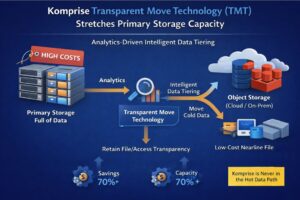
The Komprise Global Metadatabase provides:
- A unified view of all data across storage systems
- Insights into data usage and value
- The intelligence needed to make tiering decisions
What is Komprise Flash Stretch?
Komprise Flash Stretch provides a customized analysis of enterprise NAS environments and quantifies how to maximize savings across all storage and backups without the customary data rehydration penalty that occurs using storage vendor tiering solutions. With Komprise, enterprise IT organizations are able to:
- Reduce flash storage costs by offloading cold data
- Extend the life of expensive flash infrastructure
- Improve performance by keeping only active data on flash
- Enable better data curation for AI and analytics

What is the difference between flash storage and HDD?
Flash storage uses electronic memory with no moving parts, while HDDs rely on spinning disks and mechanical components.
Why is NAND flash important?
NAND flash is the core technology that enables high-speed, high-density storage in modern systems.
Is flash storage replacing disk?
Not entirely. Most organizations use a hybrid model, combining flash for performance and lower-cost storage for capacity.
How can I reduce flash storage costs?
By identifying and moving cold data off flash using intelligent data tiering.
How does Komprise help with flash optimization?
Komprise analyzes data usage and automatically tiers cold data to lower-cost storage, preserving performance while reducing costs. Flash storage delivers the speed and performance required for modern applications and AI, but it is too expensive for all data. Intelligent tiering with Komprise ensures that only the right data stays on flash, optimizing both cost and performance in a modern data infrastructure.
Learn more about Komprise Transparent Move Technology (TMT).