Data Management Glossary
Storage Reclamation
What Is Storage Reclamation?
Storage reclamation is the process of identifying, relocating, archiving, or removing inactive, redundant, or unnecessary data to recover usable storage capacity and reduce both infrastructure and operational costs.
In enterprise environments filled with unstructured data (files, images, backups, research outputs), storage reclamation goes beyond simple cleanup – it’s an essential part of storage refresh strategy and a strategic way to right-size storage estates, reduce risk, and optimize long-term data value.
Why Storage Reclamation Matters More Now
Enterprise IT is under pressure from multiple directions:
- Rising Storage Costs SSD, flash, and memory pricing has increased, making it more expensive to store all data on high-performance tiers without discrimination. Read: Storage and Memory Price Hikes Call for Unstructured Data Action
- Explosive Unstructured Data Growth: Unstructured data continues to grow exponentially, outpacing budgets and making traditional approaches to storage hard to scale.
- Ransomware and Risk Expansion: Cold, orphaned, or poorly governed data increases exposure to ransomware and complicates recovery. Learn more about Komprise as part of a comprehensive ransomware solution.
- AI and Analytics Readiness: AI and analytics projects fail when models are trained on noisy, irrelevant, or sensitive data. Reclamation reduces noise and improves dataset quality. Learn more about AI data workflows for unstructured data.
For these reasons, enterprise IT organizations are shifting from manual cleanup to intelligent, automated reclamation as part of broader data lifecycle management strategies.
The Limits of Storage-Based Tiering
Many storage vendors offer storage-based tiering:
- Automated movement of data between performance tiers within that vendor’s platform
- Policies based on age, access, or cost
- Faster performance for hot data
But storage-based tiering has limits, includingL
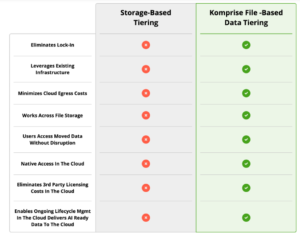
- Platform Lock-in: Storage-based tiering only works within a single storage ecosystem. It can’t span multi-vendor or hybrid environments.
- Volume-Centric: Most tiering operates at the volume or aggregate level, not at the individual file level, making precise reclamation diffucult.
- Doesn’t Scale Easily: At petabyte scales with billions of files across NAS and object stores, storage-centric tiering becomes hard to manage uniformly.
- Limited Data Governance: It can relocate data but often lacks integrated sensitive data detection or AI data workflows with governance.
That’s why storage-based tiering is a start, but not a complete solution for enterprise storage reclamation.
Storage-Agnostic File-Based Tiering: The Modern Approach
To truly reclaim storage at scale, enterprises need storage-agnostic, file-level tiering that works across the entire data estate, not just within one vendor’s products.
Benefits of file-level tiering for unstructured data include:
- Global visibility across all NAS, cloud, and object sources
- File-level intelligence, not volume level, for precise data tiering decisions
- Policy automation that respects age, last access, sensitivity, size, and usage
- Transparent access for users and applications after data moves (learn more about Komprise Transparent Move Technology)
- Open architecture that avoids vendor lock-in
This is especially critical for petabyte-scale workloads, where billions of files span multiple platforms and geographies.
How Komprise Enables Intelligent Storage Reclamation
Komprise delivers enterprise-grade, storage-agnostic data reclamation through automated file-based tiering and analytics:
Enterprise-Wide Visibility
Komprise analyzes file metadata across NAS, object storage, cloud, and hybrid environments, identifying:
- Cold, inactive files
- Duplicate and redundant data
- Orphaned or abandoned content
- Sensitive or regulated information
File-Based Tiering Across Any Storage
Komprise moves inactive files to lower-cost storage (cloud or object) while maintaining transparent access – no stubs, rewrites, or application disruption.
This differs from storage vendor tiering by being:
- Platform-agnostic: works across all vendors
- File-centric: enables precise reclamation decisions
- Scalable to petabytes: built for massive unstructured data estates
Policy-Driven Automation
Automated policies enable continuous reclamation based on business rules, not manual intervention.
Proven Cost Reduction
By reducing primary storage and backup footprint, enterprises typically save up to 70% on storage and backup costs – a measurable ROI that storage-only approaches cannot match at scale.
This maps directly to the Komprise data tiering and lifecycle data management use case, where analytics plus automated action drives real business outcomes.
Storage Reclamation vs. Archiving vs. Tiering
These terms overlap but have distinct goals:
- Storage Reclamation: Free up capacity and reduce cost across the estate
- Archiving: Long-term retention and compliance
- Tiering: Moving data between performance tiers (may be storage-centric or file-centric)
- File-based tiering bridges all three when automated and governed.
Storage Reclamation and AI Readiness
AI projects require clean, relevant, governed datasets:
- Reclamation eliminates redundant and irrelevant files
- Sensitive data detection prevents compliance leaks in AI models
- High-value data is curated for analytics and machine learning
- Reduces storage noise and training costs
Intelligent reclamation is foundational to effective, responsible AI data pipelines.
Frequently Asked Questions
What is storage reclamation?
Storage reclamation is the process of recovering usable storage capacity by identifying and relocating or removing unnecessary data across enterprise systems.
How does file-based tiering help with storage reclamation?
File-based tiering identifies inactive files and relocates them to lower-cost storage while preserving transparent access, reducing primary storage footprint and backup costs.
Why is storage-agnostic tiering important?
It avoids vendor lock-in, works across all storage platforms, and enables consistent reclamation at petabyte scales.
How does storage reclamation reduce ransomware risk?
By reducing inactive and orphaned data, it limits the ransomware attack surface and simplifies recovery.
Can storage reclamation save money?
Yes. By reducing primary and backup storage needs, enterprises often achieve up to 70% savings on storage and backup costs, more than storage-only approaches.
Conclusion
Storage reclamation is essential for enterprises facing rising data storage costs, exploding unstructured data, ransomware risk, and AI demand. While storage-based tiering is useful within a silo, true reclamation happens with storage-agnostic, file-centric tiering that scales across environments and drives measurable cost, risk, and efficiency outcomes.
Komprise delivers this next-generation approach, enabling enterprises to reclaim, optimize, govern, and prepare data for the future.
