Storage Refresh Assessment
Visibility to control rising SSD costs, delay storage purchases, reclaim primary storage, cut ransomware risk, govern sensitive data, and select the right AI-ready data.

Get Rapid Insights Across Your Entire Data Estate
Understand data growth, usage patterns, hot/cold data, and risk before planning new storage investments.
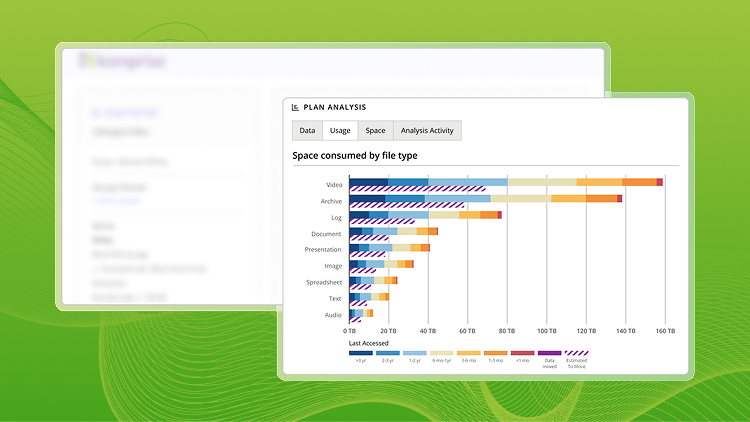
- Global insights into file and object data across NAS, cloud.
- Identify cold, duplicate, and orphaned data.
- Departmental showback to get stakeholder buy-in.
- Detect sensitive data to reduce compliance, ransomware risk.

Cut Storage and Backup Spending with Intelligent File Data Tiering
With SSD and memory prices rising, tier inactive file data off premium storage to reduce cost of storage refresh.
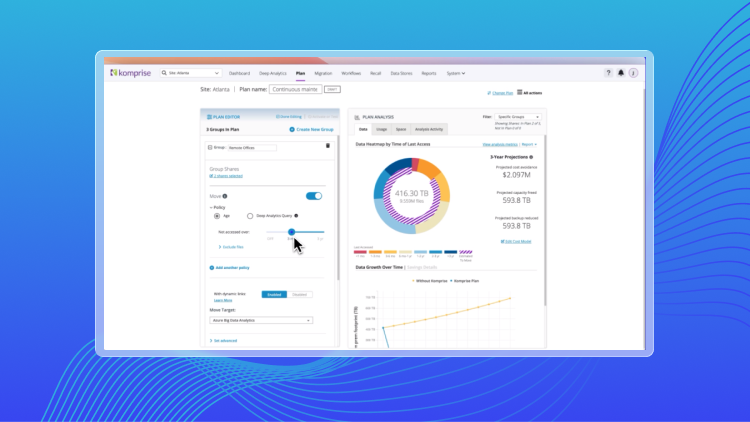
- Transparently tier cold NAS files to lower-cost object or cloud storage.
- Eliminate storage-vendor tiering rehydration penalty that erodes savings.
- Reclaim 80% primary storage capacity with full file tiering.
- Tier before migrating to cut 70% primary storage and backup cost.
- Avoid overbuying flash by migrating only active, business-critical data.
Ready To Discuss a Smarter Storage Refresh?
Schedule a demonstration with the Komprise experts to learn more.

Forecast Capacity, Storage Reclamation, Savings, and AI Readiness
Model refresh scenarios and turn infrastructure change into long-term advantage.

- Estimate capacity and savings with an interactive cost model.
- Align data placement with retention, compliance, and governance policies.
- Quantify storage reclamation benefits
- Plan before you migrate to minimize cutover.
- Curate high-value datasets to support AI and analytics initiatives.
Dig Deeper

Resource
8 Ways to Save on File Storage and Backup Costs
Make better investments with analytics-driven unstructured data management.
blog
File Data Metrics to Live By
Are you measuring the right things for unstructured data management and file storage?

Blog
5 Ways to Boost Unstructured Data Value: The Komprise Data Experience
CIOs and IT leaders are grappling with petabytes of data scattered across…
Frequently Asked Questions
Why is the right approach to storage refresh planning so important now?
SSD and memory price increases are driving up the cost of primary storage. Migrating inactive or redundant files onto premium flash unnecessarily inflates hardware and backup costs. A storage refresh assessment ensures only active data lands on high-performance tiers, significantly reducing capital and operational expenses.
How does file-based data tiering reduce storage costs?
File-based tiering identifies cold, inactive files on network attached storage (NAS) and transparently moves them to lower-cost cloud and capacity storage while preserving user access. Unlike storage-vendor tiering which is block-based and forces expensive rehydration when switching vendors, file-based tiering eliminates the rehydration penalty as you can move data directly without bringing it back to the original storage first. File-based tiering reduces primary storage footprint, lowers backup volumes, and can cut overall storage and backup costs by an average 70%.
Read the white paper: File-level vs. Block-level Data Tiering
How does storage refresh reduce ransomware attack surface?
Inactive and orphaned data increases ransomware exposure and recovery complexity. By identifying stale and sensitive data before refresh, organizations can tier, archive, or remediate high-risk files to shrink the attack surface.
Can storage refresh improve AI readiness?
Yes. AI initiatives require clean, relevant, and governed datasets. A storage refresh assessment eliminates redundant and trivial data, identifies sensitive content that should not enter AI pipelines, prepares curated datasets for analytics and AI workloads and can also help identify gaps in high-performing storage required for AI.
Do I need to migrate all data during storage refresh?
No. A modern refresh strategy focuses on migrating only active and business-critical data. Cold data can be transparently tiered to lower-cost storage, archived for compliance, or defensibly deleted. Thisreduces migration time, cost, and long-term risk.
How does Komprise file tiering differ from storage-vendor tiering?
Storage-vendor tiering solutions help address the mix of their storage tiers but they are proprietary and hence do not reduce the backup footprint.They also require you to rehydrate and buy more expensive storage if migrating to another vendor. Komprise eliminates this rehydration penalty so IT can use any storage as needs change. Komprise also maximizes savings by cutting both storage and backup costs.
What is a data storage refresh?
A data storage refresh is the term used to describe the process of updating or upgrading an enterprise IT organization’s data storage infrastructure. This can involve replacing outdated hardware, migrating data to more modern data storage technologies, or implementing more efficient, optimized data storage solutions.
Some of the benefits of refreshing data storage infrastructure include: improved performance, increased scalability, enhanced reliability, better data security, streamlined management, support for new or advanced workloads, regulatory governments and compliance, reduced overall data storage costs and total cost of ownership (TCO). Additionally gaining competitive advantage from not only optimizing data storage costs but also harnessing greater value from unstructured data, for example analytics and AI initiatives, is increasingly an outcome of a data storage refresh.
How does Komprise help with a data storage refresh?
Too often we hear, “I wish I had known about Komprise Intelligent Data Management sooner!” Read the blog post, What can Komprise Analysis do for you? to get an understanding of the visibility that is possible with Komprise. And with Storage Insights, you get data and storage visibility in a unified data control plane.
Watch a Komprise Storage Insights Demo
With Komprise you can analyze file and object data to make nuanced versus one-size-fits-all data storage investment decisions. Know first. Move smart. Take control.
Ready to Get the Complete Picture of Your Unstructured Data?
Schedule a call with our unstructured data management experts and see your file and object data in a whole new way.
Industry Leaders Trust Komprise


