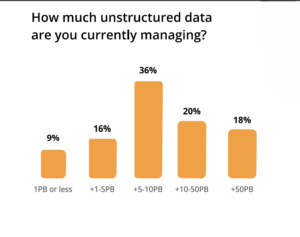
Data storage, backups and disaster recovery costs constitute more than 30% of IT budgets for 55% of enterprises, according to the Komprise 2026 State of Unstructured Data Management. This is no big surprise if you look at how much data organizations have on hand.
[source: Komprise 2026 State of Unstructured Data Management]
File storage costs are imploding in 2026 and beyond, given the onset of a global storage and memory shortage amid exploding demands for high-bandwidth memory (HBM) and high-capacity flash storage (NAND/SSDs) for AI.
Gartner estimates a130% increase in combined DRAM and solid-state drive (SSD) prices by the end of 2026. Increasingly, DRAM inventories have collapsed from historically healthy levels down to just two weeks’ supply, a drastic tightening that has ripple effects across hardware OEMs and data center planning.
Analysts are predicting that this shortage and subsequent price hike will last well into 2027.
And as consumers watching inflationary price hikes understand, once companies raise prices, those prices get sticky and don’t often come back down. Case in point: In 2014: A Starbucks Grande Latte cost roughly $3.65, but today you’ll shell out $7.00 or more, depending upon the milk and other factors like location.
As Komprise COO Krishna Subramanian wrote recently in Data Center Knowledge: “The memory crisis is significant for hardware markets, but it also exposes a deeper strategic gap in enterprise IT: years of treating data as infinite and free have turned unstructured data into an expensive liability precisely when modern AI workloads demand quality, context, and precision. Worse yet, unstructured data estates often contain vast quantities of ROT (redundant, obsolete, trivial data), which offers little to no value for analytics, modeling, or operational insight.”
IT organizations need intelligence on their unstructured data to right-size and right-place it, avoiding unnecessary capacity purchases and helping inform the optimal decision to tier or migrate data to new storage as needs change.
Our latest eBook delves into these issues, with key tactics to turn around this heaving ship, such as:
- Gain visibility on data in storage to optimize investments: Understanding data profiles and usage across storage allows IT to right-place data for its current performance requirements, such as by tiering cold data to cloud object storage.
- Adopt a data services mindset: How can you change the conversation so that you are a data expert and deliver data services, which are independent of storage technology?
- Get strategic on the cloud: Monitor cloud resources for under-utilization and have a strategy which ideally includes automated policies that move data and workloads as needed to save more.
- Develop a ransomware strategy that also cuts costs. Transparently tier cold files to object storage with immutable object lock retention for ransomware defense. Save 70-80% on storage costs and shrink the attack surface.
 Read the eBook: 8 Ways to Save on File Storage and Backup Costs
Learn more about Komprise Intelligent Data Tiering.
Check out our latest case studies to see how this happens in action.