This article has been adapted from its original version on The New Stack.
AI has moved decisively from experimentation to execution. It now sits at the core of enterprise transformation strategies, reshaping the way organizations think about performance, resilience, risk and accountability. As AI becomes operational rather than exploratory, governance has emerged as the defining priority for IT and cloud infrastructure leaders tasked with running the digital backbone of the enterprise.
A recent Komprise survey on unstructured data management found that 54% of IT leaders now rank AI governance as a core concern, nearly doubling from 29% in 2024.
AI success is no longer measured by model accuracy or pilot velocity alone. It is measured by whether AI systems can be trusted, governed, secured and sustained at scale. The discipline of governance for unstructured data is gaining momentum in the AI age, given that this is the primary data required to feed AI data pipelines.
Operationalizing AI Changes the Stakes
As AI becomes embedded in everyday operations, the margin for error narrows. Failures now carry regulatory, financial and reputational consequences. Executives responsible for infrastructure are no longer focused on isolated experiments. Their mandate is to operationalize AI across business units, geographies and clouds while maintaining control over data, models and outcomes.
The New Agenda for IT
As AI adoption accelerates, IT priorities are evolving in parallel.
- Secure data access remains foundational, with 64% of IT executives citing it as a top concern.
- Teams across the enterprise are developing their own AI use cases using specialized models, copilots and agents. These tools must connect to corporate unstructured data assets without introducing new risks or bypassing controls.
- Enterprises are deploying purpose-built models for finance, legal, HR, healthcare, manufacturing and other regulated domains.
- They are also adopting agentic systems that chain multiple tasks and data sources together. As AI environments become more distributed and autonomous, governance becomes the connective tissue that ensures consistency, compliance and trust.
The Governance Mandate
AI governance has evolved from a policy discussion into a multidimensional operational responsibility. IT leaders now oversee how training data is sourced and classified, how inference data is accessed and logged, and how outputs are monitored and audited.
Cyber resilience is a central component of this mandate. As AI expands the number of data pipelines and repositories, it also expands the attack surface.
Many executives now view AI data flows and model artifacts as high-value targets for ransomware and data exfiltration. Controls around access, immutability, segmentation and monitoring are no longer optional safeguards but prerequisites for AI readiness.
What Enterprises Are Building
Key points on current enterprise AI adoption, according to the Komprise survey:
• Chatbots lead adoption at 39%, followed by internal copilots at 26%.
• Only 14% of organizations restrict employee AI use, a figure unchanged from the prior year.
• Nearly nine in 10 organizations report making significant investments in storage, GPUs and networking to support AI workloads.
• 87% of companies rely on a multicloud approach to balance cost efficiency, resiliency and flexibility.
Top Requirements for Unstructured Data Governance
Unstructured data governance in particular is challenging due to the diversity, volume and distribution of file and object data across many silos. Since 90% of data today is unstructured, organizations are investing in data governance and management solutions designed for unstructured data, as it has vastly different needs than traditional structured data.
Look for these capabilities:
- Continuous scanning of NAS, object and cloud storage to identify sensitive and regulated files across petabytes of unstructured data.
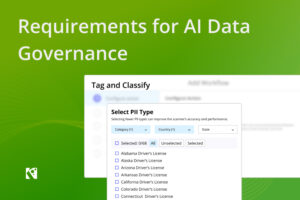
- Automatic classification of PII, PHI, ePHI, PCI and other protected data before it enters AI pipelines.
- Storage-agnostic analytics that detect enterprise-wide risk across all vendor environments.
- Enforcement of policies that restrict, quarantine, mask or move high-risk data
- Ransomware defense by eliminating cold files from active NAS attack surface.
- Audit-ready visibility across workflows to support enterprise security processes.