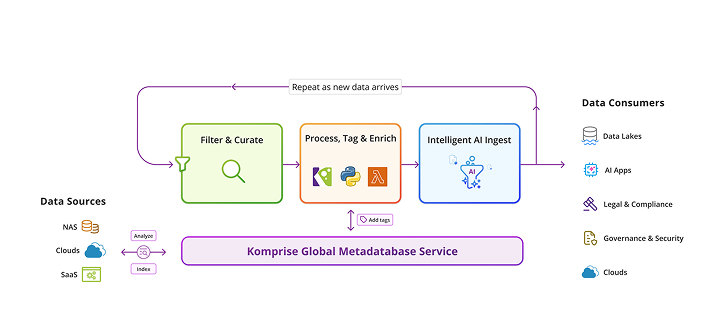
Success with AI depends upon feeding the right data at the right time to AI platforms. This is difficult and costly given the dispersity of unstructured data and its tremendous volume in enterprises. Komprise delivers a Global File Index for granular search and tagging of data across silos. In addition, with Komprise Smart Data Workflows, you can create custom workflows to easily search, find, and tag the exact files you want across all your hybrid cloud storage and create a plan to move the right unstructured data to a data lake or AI tool.

Komprise-Global-File-Index-Architecture

The Komprise Global File Index and Smart Data Workflows together reduce the time it takes to find, enrich and move the right unstructured data by up to 80%.


kdx_resource_thumbnail2_800x533-1-150x150


Why Komprise for AI Data Workflows?

  • Easy Search and Tagging: Komprise provides a platform that rapidly indexes petabytes of data and delivers a simple interface to search for data, enrich it as needed with additional metadata such as demographics or project keywords, and then move the required data to the desired location for analysis.
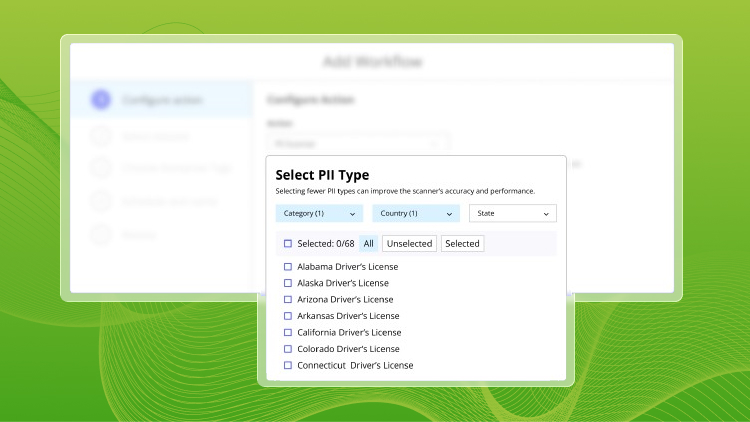
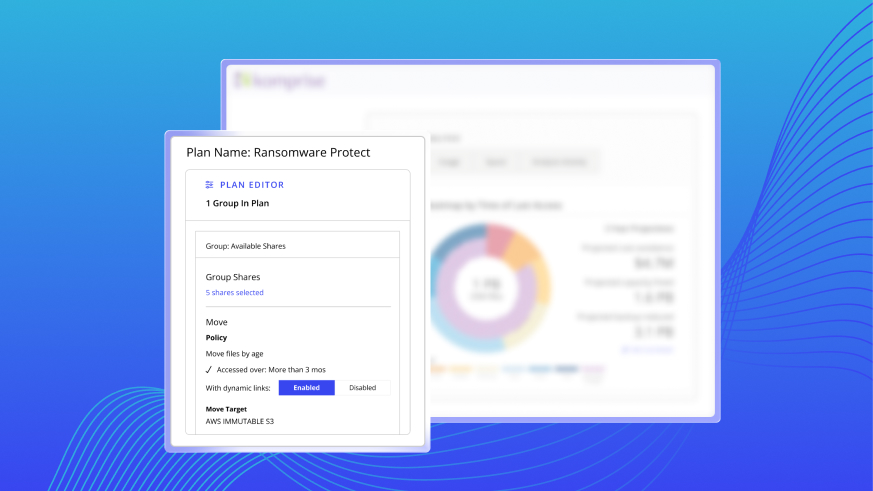
  • Smart Data Workflows: This Komprise feature is an automated process that saves the time and hassle of manually finding and moving the right data sets to analytics tools. It facilitates tagging and enriching data and automates feeding AI engines with the right data. You can harness the value of AI with ongoing workflows to achieve analytics goals for the business. Find sensitive data such as PII and take action on it, such as by moving it to a secure, immutable location.
AI DATA WORKFLOW USE CASES:
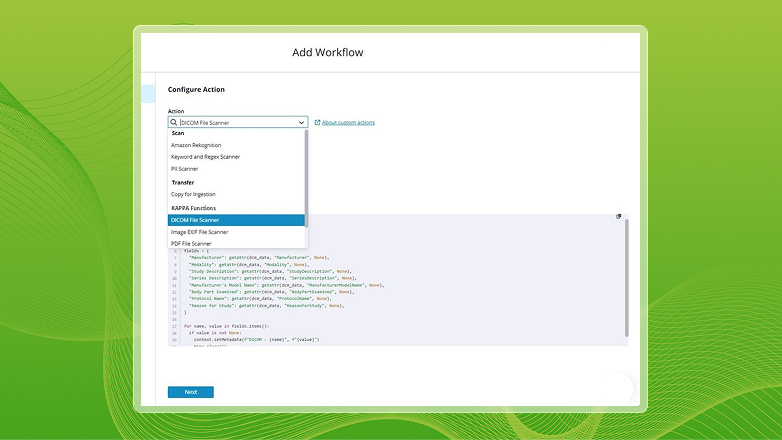
  • Automotive: With Komprise, an automotive company can: find crash test data related to the abrupt stopping of a specific vehicle model; use an AI tool to identify and tag test data with “Reason = Abrupt Stop”; move only the related data to a cloud service for analysis and; delete the irrelevant data or move it to a cloud service for archives.​ Watch the webinar with AWS.
  • Healthcare: A hospital could use AI to scan and analyze medical images like MRIs, X-rays and CAT scans and then tag the images with diagnosis codes. Researchers can then find images by diagnosis to support their projects. Learn more about Komprise for Healthcare.
  • Call Center: A company could employ AI to run sentiment analysis on call center recordings. The resulting customer satisfaction scores are recorded to each audio file with a tag. This allows employees to find relevant audio recordings to understand customer behavior and improve best practices.
  • Smart-Data-Workflows-600x600-4PII detection and protection: Komprise has a built-in scanner for PII and regex keyword searches to find and isolate sensitive data such as HR files, patient data, IP and financial information continuously across billions of files in an enterprise and then move to secure storage or confine it.
  • Surveillance/law enforcement: Unstructured data, such as bodycam and dashboard camera video, along with social media posts and text messages are evidence that can be critical for investigations. AI data workflows can find and analyze needed files and tag them to support research and e-discovery during a case or investigation.

All of the above processes can run continuously as needed.

What is a Smart Data Workflow?

Komprise Smart Data Workflows allow users define and execute automated processes to manage and move data, which are often industry and domain specific. With Smart Data Workflows you can create custom queries across on-premises, edge and cloud storage silos to find the precise data you need, execute external functions on a subset of data and/or tag the data with additional metadata. The workflow can move data to the desired location and operate continuously as needed.

What is the role of data governance in AI data workflows?
How generative AI technology and the laws and industry standards relating to it will evolve is a work in progress. Yet it’s clear that the ability to define and enforce basic data governance standards will be paramount for taking full advantage of AI solutions without assuming unnecessary risks. Many organizations will need to rethink or update their unstructured data management strategies. They need solutions and processes that allow them to find, monitor, secure and manage unstructured data of all types, and across all locations, in an efficient and cost-effective manner. That’s the only way to ensure that generative AI tools and services can generate insights based on unstructured data while simultaneously protecting organizations from data leakage, privacy and ethics violations and even lawsuits.The Komprise unstructured data management solution can help. By automating and centralizing the workflows
necessary to identify and manage data of any type across any cloud or vendor platform, Komprise makes it easy to work with unstructured data at scale as part of generative AI initiatives and a variety of other use cases.Read the white paper.

What business problems to AI data workflows solve?

AI data workflows help enterprises manage and extract value from the growing volume of unstructured data by addressing key business problems in cost, control, and compliance:

  • Data Overload and Inefficiency: Enterprises generate massive volumes of unstructured data (files, images, videos, logs) that are costly to store and hard to use. AI data workflows automate curation, enrichment, and classification so only the right data is retained and analyzed.
  • Slow Decision-Making: Business users often struggle to find and access the data they need for analytics or AI. AI workflows streamline data preparation and deliver curated datasets in native format, enabling faster insights and innovation.
  • Compliance and Risk Exposure: Sensitive data scattered across silos creates regulatory and security risks. AI workflows tag, exclude, and audit sensitive data, ensuring only governed datasets are used in analytics and AI pipelines. See Sensitive Data Management.
  • Rising IT Costs: Unchecked data growth drives up storage, backup, and cloud expenses. AI workflows help identify cold, duplicate, or irrelevant data to tier or archive, cutting costs before data ever reaches AI or analytics systems.
  • Missed AI/ML Opportunities: Feeding raw, messy unstructured data into AI often results in poor or biased outcomes. AI workflows enrich data with metadata and context, ensuring that AI/ML models operate on accurate, relevant datasets.

AI data workflows solve the challenges of unstructured data sprawl by giving IT teams visibility and control while enabling the business to unlock value from the right data in a governed, cost-efficient way. See AI Data Management.

What are the main AI data workflow challenges?

AI data workflows involve collecting, preparing, and delivering the right data to AI and analytics systems. While these workflows promise better insights and automation, enterprises face significant challenges, especially with unstructured data:

  • Data Sprawl Across Silos: Unstructured data lives in multiple on-premises and cloud storage systems. Without visibility, IT teams struggle to find, classify, and consolidate the data needed for AI.
  • Data Quality and Relevance: AI models require clean, curated datasets. Unstructured data often contains duplicates, outdated files, or irrelevant noise that must be filtered out before training.
  • Metadata Gaps: Unlike structured databases, unstructured files lack rich metadata. Missing context makes it difficult to search, enrich, and organize datasets for AI workflows. See Metadata Management.
  • Governance and Compliance Risks: Sensitive information may be unintentionally included in AI training sets. Lack of audit trails or controls raises security, regulatory, and privacy concerns.
  • Scale and Performance: AI workflows must process billions of files and petabytes of data. Moving this volume with generic tools is slow, costly, and disruptive to users.
  • Cost Management: Feeding all data into AI pipelines is inefficient and expensive. Without intelligent data management, organizations waste resources on storing and processing data that has little or no value.

The main challenges of AI data workflows are finding, preparing, governing, and moving massive volumes of unstructured data at scale. Enterprises need tools that give IT control while enabling business users to unlock the right data for AI. Read the AI Data Preparation Guide.